At Your Own Risk: A Saint’s Testament
by Derek Jarman (Hutchinson, 1992)
At Your Own Risk is the most recent volume of journals by Derek Jarman. Twenty years ago, he was known only by a few as the guy who designed the sets for Ken Russell’s The Devils. (Remember that 17th-century convent done in white tile, like a subway toilet?) Today Jarman ranks among the most original and provocative of European filmmakers. For some of us, he leapt to that status instantly with his first feature, Sebastiane (1976): You have to be some kind of genius if you’ve made a homoerotic film about an early Christian saint, with all the dialogue spoken in Latin. But even those who weren’t bowled over by the conceit (or turned on by the sex) found it hard to dismiss Jarman’s personal blend of historical evocation and unexpected anachronisms. He’d heighten that tension radically in subsequent films, particularly Caravaggio (1986) and Edward II (1992). But by the release of his second feature, the punk rallying cry Jubilee (1978), he’d already driven home the news that a genuine rebel had set up shop in the heart of British cinema. So of course he’s welcome simply for that; the imagination and humor in his work just makes it all the tastier. What’s extraordinary, though, is his refined sense of visual texture, something all too rare among filmmakers. Jarman’s delight is to combine a myriad of motion-picture technologies (super-8, video, projections, etc.), transfer the idioms back and forth, and then cut everything together on 16- or 35-mm film. These techniques are at the heart of his exquisite short film, Imagining October (1984), and his landmark non-narrative features The Angelic Conversation (1985), The Last of England (1987), and The Garden (1990). They raise his language, and the language of film itself, to a whole new level, where you can really feel as though you’re seeing freshly, for the first time.
Jarman was diagnosed HIV-positive shortly before Xmas of 1986. In 1990 his condition deteriorated to the point where he was hospitalized for seven months (during which time he temporarily lost his eyesight). Parts of The Garden were shot when he was too ill to be present, and upon its release, the mongoloids who write film reviews for newspapers used it as an opportunity to deliver their Jarman obit (and praise or pan the flick in passing). Quite sensibly, Jarman not only didn’t indulge them by dying, but went on to make one of his best films as well – and his most scathing assault on British classism and homophobia, namely Edward II.
In At Your Own Risk Jarman fills in the gaps in his autobiography, which had been left by his previous books, Dancing Ledge (Quartet Books, 1984) and Modern Nature (Hutchinson, 1991). But the emphasis with this book is squarely on now: Each chapter is ostensibly about a decade in his life, from the ‘40s to the ‘90s, yet throughout them he interpolates his present-day experiences as both a person with AIDS and an out gay man in homophobic England. “I can’t remember ever seeing an article in the British press, which didn’t see my sexuality in a negative light,” he observes, and his book contains verbatim chunks of British reportage on the horrors of being queer. What makes them truly ghastly, even more than their idiocy, is their familiarity. The thunderings of romance-slinger Barbara Cartland in 1955 – “Our youth is menaced by these perverts, it is a sin against God and mankind […] Nothing more sinister than this tolerance can be imagined” – are exactly the same kind of crap we hear everywhere today. And a litany of twisted headlines from recent British tabloids reads just like the hate for sale from the American press: “Lesbian Teacher Horror,” “Vile Book In School – Pupils See Pictures Of Gay Lovers,” “I’d Shoot My Son If He Had AIDS, Says Vicar.”
Jarman has become for the British almost as much of a synonym for homo as Pasolini was for the Italians (until they killed him). In reality, Jarman grew up deeply repressed and alienated from his own body, especially after he’d been caught at the age of nine getting frisky with a classmate. “It’s a myth that all-male boarding schools are the center of jolly sexual activity,” Jarman laments. “Like a lot of young men I was afraid of my body. I don’t think this is to do with my sexuality […] I’ve remained angry about it ever since and, because it made me desperately unhappy as an adolescent, it’s one of the motivating forces in what I’ve done with my life. Adolescence is difficult enough for any of us, but to have those pressures on top of it, to be corrupted into heterosexuality, that was the worst.” As a result, Jarman’s coming out was difficult – especially when you consider he was coming out to the early 1960s England documented in At Your Own Risk, which was almost as grossly repressive as that country is today. Jarman’s list of “identifiable homos” at the time is awfully short: “Cocteau (above board), Genet (under the counter), Burroughs and Ginsberg (heard of but not read).” But for all its queer focus, his book is of real value to all readers, however they swing – and it’s particularly valuable for the people who are least likely to read it, namely straight men. Fellas, you don’t have to suck cock in Colorado to know that Jarman’s arguments are also your sole defense against having politicians and policemen deciding what you can do with your bodies: “If you or I decide to have sex, whether safe, safer, or unsafe, it is our decision and other people have no rights in our lovemaking.”
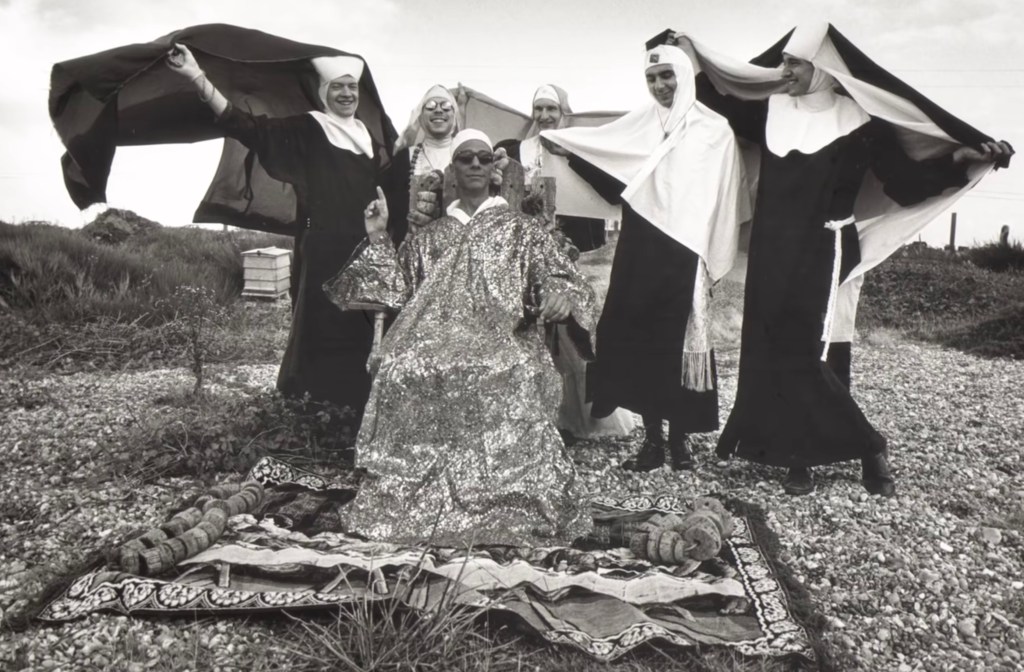
Jarman subtitles At Your Own Risk “A Saint’s Testament,” referring to his official canonization by the Sisters of Perpetual Indulgence. This international order of gay nuns (Sister Jack-Off All Trade, Mother Fecundity of the Mass Uprising, etc.) creates saints in recognition of individuals who have fought for the rights of queers. (“Pope John Paul II has created 234 new saints, at the rate of 19 a year, so it’s time we started.”) With Jarman – now known more familiarly as “Saint Derek of Dungeness of the Order of Celluloid Knights” – they found the perfect subject.
(If you’re having trouble tracking down At Your Own Risk, try your local lesbian & gay bookstore, or write the publisher directly: Hutchinson, c/o Random Century Group Ltd., 20 Vauxhall Road, London SW1V 2SA UK.)
(This book review first appeared in Brutarian No. 7, 1993.)
Link to:
Other Writings: Book Reviews: Contents
For more on Derek Jarman, see:
Film Interview: Derek Jarman
Film Review: Edward II
Film Review: Wittgenstein
 NICOLE V. GAGNÉ