Candy Darling
by Candy Darling (Hanuman Books, 1992)
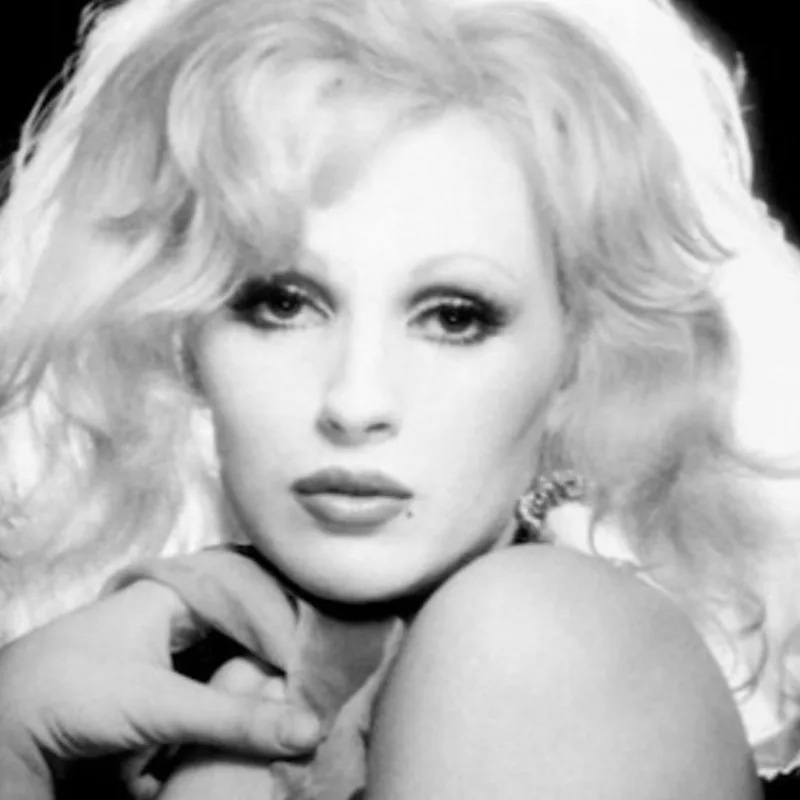
Candy Darling was a striking, platinum-blonde Garboesque actress and comedienne who appeared in the Andy Warhol/Paul Morrissey films Flesh (1968) and Women in Revolt (1972) and graced the pages of Vogue and Photoplay before her untimely death from cancer in 1974. But at her birth on November 24, 1944, she was a boy named James Slattery. Candy recorded some of the distance she traveled between these two points in journals that she kept during the early ‘70s. Those writings have recently been published by Hanuman Books, the people who make those little 3X4-inch books of unavailable stuff by some of the best writers of our time – Genet, Kerouac, Burroughs – as well as by such welcome provocateurs as Nick Zedd, Cookie Mueller, Taylor Mead, and Jack Smith.
The book Candy Darling makes for a fascinating, funny, and touching read. Along with the make-up hints, formulae for lightening her hair, and recipes for borscht and turkey salad, you’ll find Candy’s notes for dramatic scenarios (always of domestic heterosexual conflict), wisecracks for every occasion (“I’ve brushed off more men than the porter at the Waldorf”), and drafts of letters to family, friends, and even actress Yvonne De Carlo, to whom Candy offers advice after seeing her on TV’s “Movie Game”: “That jacket is awful, throw it out. You should never squint.”
Wisely, the editors have left Candy’s prose intact: They’ve repaired neither her spelling nor her grammar, and so have heightened her special blend of the childlike and the worldly. The person who was so dazzled by reruns of “Route 66” that she had to write the network and say, “God bless television,” was also the person who would decline to visit her family, explaining, “the rejection will hurt. But it can never hurt me as much as I can hurt myself […] You must always be yourself no matter what the price. It is the highest form of morality.”
Unfortunately, Candy didn’t write much about her family or her childhood, other than to note, “The children always referred to me as Marilyn Monroe or Greta Garbo.” (When the adult Candy boarded the bus and paid only two dimes, the driver said, “It’s thirty cents, Greta.”) She did jot down some choice gossip, however – not surprisingly, in a welter of dropped names: “Jane Fonda’s husband Roger Vadim who was married to Brigitte Bardot is in love with me. I was out with him last night […] He kisses me and holds me in public because he is truly innocent and cares not what people think. I always feel I have to protect him. We have not been to bed together.”
The book reveals that Candy, like too many other transgender people in America, suffered deeply conflicted feelings about herself. Tired of being lonely, unhappy, and ridiculed, she could be shaken by her conversation with a girlfriend who was in analysis: “She said the reason we are the way we are is that we did not have suitable male identities while we were growing up. And just because we did not have suitable male identities is no reason for us to think we are women. Perhaps she is right. She says it is $30 per visit. Maybe God is speaking to me through Taffy.”
Ultimately, Candy could never abandon what she describes as “my identity as being a male who has assumed the attitudes and somewhat the emotions of a female.” She knew it was her path to the success she longed for: “I must do whatever furthers my career, I must take the steps necessary to further my ability to function on the highest level I can operate on. I operate better as a woman.” And she could operate that way with fewer illusions than you might think: “I am not a genuine woman but I am not interested in genuineness. I’m interested in the product of being a woman and how qualified I am.”
Also intriguing are Candy’s misgivings about feminism: “Betty Friedan and Gloria Steinem […] come across very hard to me and I don’t like hardness especially in women […] I can’t forget the visual image of her [Friedan] standing on a platform in Bryant Park like a field marshall.” A devotee of glamour, Candy naturally would have resisted certain aspects of the women’s movement, which trash the mystifications men have created around the female sex. In some ways, she’s a perfect example of the person who embraces and lives out male stereotypes of femininity. But remember, Candy was writing at a time when divisiveness between non-transgender women and transgender women – for that matter, between gay men and gender-variant men – was at its height: Lesbian feminists actually had transvestites barred from participating in Gay Pride Marches during the early ‘70s. Nowadays, lesbians, bisexuals, gay men, and transgender people are more alert as to who the enemies really are; the term “queer” has gained favor because it embraces all four subgroups and resists attempts by the white-het-male power structure to encourage conflict among queers as well as between queers and women, people of color, the poor…
Operating without that kind of solidarity, it’s inevitable that even someone as uniquely talented and attractive as Candy could be watching “The Newlywed Game” on TV and be moved to write, “I’m glad to see some people that are happy even though I can never be happy.” But she was also sensible enough to note to herself, “do not allow the mind to be affected by the world.” Her refusal to lower her mentality to other people’s level is inspirational – and is beautifully expressed a few pages later: “I know I’m destined for stardom because when I walk along the street I sometimes see people staring at me and pointing […] last week I went to IFA and was so glamorous that I overheard a man in the outer room gasp out loud. Also the receptionist told the agent I was trying to see that ‘this one must be seen to be believed.’”
(This review first appeared in Brutarian No. 8, 1993.)
Link to:
Other Writings: Book Reviews: Contents
For more on gender, see:
Film Essay: Gender Variance and Race
Film Interview: Holly Woodlawn
Film Review: Gun Hill Road
Film Review: Kokomo City
Film Review: Queeendom
Film Review: Seat 31
Film Review: Transamerica
Music: KALW Radio Show #5, Gender Variance in Western Music, part 1: Male-to-Female Representations
Music: KALW Radio Show #6, Gender Variance in Western Music, part 2: Female-to-Male Representations
Other Writings: Essay – “A Working Model of Gender”
 NICOLE V. GAGNÉ