The Case of Ed Wood
If American cinema is to be defined solely by the narrative features produced by Hollywood studios, then the films of Edward D. Wood Jr. will always be regarded, at best, as misfires from the no-budget, Grade Z lunatic fringe; at worst, Glen or Glenda, Bride of the Monster, and Plan 9 from Outer Space get consigned to an aesthetic Alcatraz as the epitome of awful movie-making, good only for the occasional campy yuk. But if your interest in film stretches beyond the commercial industry, Wood’s place shifts radically. Step back far enough to take in the full spectrum of American filmmaking, and Ed Wood winds up not at the margin but at the center. His films exist right at the nexus, the crossroads where Hollywood’s collapsing studios intersect the cinema of independents, experimentalists, and exploitationers.
Thanks in large part to interest and enthusiasm from Europe, American critics have learned to recognize just how much style could surface from low-budget studios and have come to appreciate quick and resilient filmmakers such as Edgar G. Ulmer, Joseph H. Lewis, and Roger Corman. Ed Wood, who existed beyond Poverty Row, has proven more difficult to trace. (Even from abroad: The revival of interest in his films has been mostly an American phenomenon.) From the late forties to the late seventies, Wood labors during a period where Hollywood’s flow of cash dries to a trickle and the industry yields to its mavericks – Orson Welles, Samuel Fuller, John Cassavetes – splintering into a multitude of parallel universes. Here, Hollywood reinvents itself as tiny-budget enterprises with targeted circuits and audiences: everything from minority filmmaking, such as the all-Black films of Oscar Micheaux, to the various exploitation networks, including Dwain Esper’s “adult-themed” efforts, Herschell Gordon Lewis’ gore films, and the sex and violence confections of Russ Meyer.
Residing beneath these lower depths is Hollywood’s ultimate parallel universe: the underground of Kenneth Anger, Jack Smith, Andy Warhol, the Kuchar Brothers, Nick Zedd, and their peers. Only a select few, most notably Paul Morrissey and John Waters, have emerged from these nether regions into the klieg light of day. The rest have remained where everything must be done by the filmmakers themselves and hence nothing can be taken for granted, where roles of power and sexuality are overthrown, and standards of glamour, ugliness, coherence, and continuity are redefined. Deeds illegal and indecent, acts despised and depraved, manifestos anarchic and apocalyptic, all are welcomed here. In this context, Ed Wood comes off not as a distant cousin but a blood brother, with family ties that stretch from Glen or Glenda’s transvestite pride to Necromania’s blow job in a coffin.
That particular oral outrage points to yet another facet of American cinema, one that exists layered between all this above- and below-ground activity (overlapping them too, judging from court cases in the United States): the sex-film industry. Freed commercially by the establishment of the X-rating at the end of the sixties, American porn has grown into a large, variegated, and provocative body of work. Ed Wood, with his last three features – a softcore nudie released in 1970, Take It Out in Trade, and two hardcore films, Necromania and The Only House – was one of the first filmmakers to enter the swelling porn industry and twist it to accommodate his own personal concerns. Unfortunately, as of this writing, both of Wood’s “triple-X” films remain lost. However, after twenty years of oblivion, Take It Out in Trade has finally resurfaced and the film is quite simply a revelation: fast, funny, and subversive to the bone.
I’ve been fortunate enough to view Take It Out in Trade and will cover it in detail in the second part of this article. For now, I just want to say that, having seen the weird wonders of what is still Wood’s last surviving film, the recovery of his later efforts seems all the more urgent. (I also feel more keenly the tragedy of his final inactive years – an almost universal syndrome for American filmmakers.) Take It Out in Trade is as self-conscious and deliberate in its outrageousness as the late films of Samuel Fuller or Russ Meyer and adds fuel to the argument that Wood was not simply a naïf, unaware of how radical his own work was. If anything, Wood’s films can be seen anticipating other innovative forms of experimental filmmaking. The notion of essay – as distinct from documentary – filmmaking is perhaps most familiar these days from Welles (F for Fake, Filming Othello), Hans-Jürgen Syberberg (Ludwig: Requiem for a Virgin King, Karl May, Hitler: A Film from Germany), and Federico Fellini (The Clowns, Roma). Forty years ago, when Wood made Glen or Glenda, the concept was virtually unknown – but it’s there in his film nonetheless. By the same token, Wood also deserves recognition as a precursor of postmodern cinema’s fondness for found footage. After the groundbreaking films of Bruce Conner, this approach has been taken up by numerous filmmakers, from Ken Jacobs (Tom, Tom the Piper’s Son) to Ken Russell (The Planets). Ed Wood may have employed stock footage because, financially, he had to, but his peculiar use of it creates yet another level of discourse in his pictures – neither the look of the footage itself nor the context into which he inserts it offer any comfortable similarities to the Hamburger-Helper methods typical of other fifties movies.
Yet despite his originality, stylishness, and humor, discussion of Ed Wood is still considered suspect unless it adheres to the “world’s worst director” moniker attached to him by a handful of low-brow writers. Granted, these critics could then cash in on the growing interest in his films without actually having to think about them, but there’s more to that posture than just the search for an easy buck. Certain mentalities require the existence of a “worst” filmmaker – they can’t tell if something’s good without something “ungood” to hold up against it. Thus, Wood’s films get dismissed for not conforming to habitual, cliched standards of Hollywood technique, and what actually happens in them is never really considered. But by excluding new and different methodologies in art, critics constrict the paths through which information can enter their minds, and when that closing down really takes over, the unfamiliar becomes not just unacceptable but unrecognizable.
Thus, one reporter who interviewed Wood’s biographer Rudolph Grey, wound up asking of the films, “Yeah, but do they, you know, suck?” The very fact that the questioner wasn’t sure anymore, that his definitions of quality went into a tailspin, immediately indicates just how valuable Wood’s cinema is. Obscuring that value for the interviewer may well have been the anxiety that underlies a lot of audience hostility toward modern and postmodern art: the fear of being conned. “Gee, what a great painting!” “It was made by a chimpanzee! Sucker!” You pay your hard-earned money and the artist who pockets the cash has no real talent, knows it, and is now having a horselaugh at your expense. That fear has been around for a long time and has always been completely justified, as long as you regard art as something to buy. If you’re involved with art as an opportunity to change the way you think, then it’s impossible for anyone to swindle you.
Most critics prefer entertainment to deconditioning, and so they’ve had a rough time sorting out Ed Wood’s films. Certain apologists may even suggest that, if Wood had had bigger budgets or more time or better actors, if someone had made him hip to certain gaucheries of dialogue, blocking, or editing, then he could have been, if not a major director, certainly an acceptably competent one – another, say, Jack Smight or Buzz Kulik; who knows, maybe even someday a George Roy Hill or Arthur Hiller. Which is like saying a camel would make a good plow horse if you sawed off its humps. The one thing that’s instantly apparent from any Ed Wood film is that this man could never have been just another Hollywood hack.
Children tend not to be so blinkered by conditioned expectations, and not surprisingly most of Wood’s admirers can vividly remember their childhood encounters with his films on TV. I certainly remember watching Plan 9 from Outer Space repeatedly when I was a kid and always being awed by it. For me, that was one scary film. Not so much for its images of horror – I expected to see Tor Johnson, Vampira and Bela Lugosi prowling through graveyards. No, what unnerved me was the film’s constant, unpredictable weirdness: abrupt changes from location shots to studio sets; disregard for continuities of day and night; the same chunks of blistering music repeated over and over; intently stitched together visual material that didn’t so much cohere as collide – the Lugosi footage, completely different in look and sound from anything else in the film, and then the doubling of Lugosi’s character by a completely different actor.
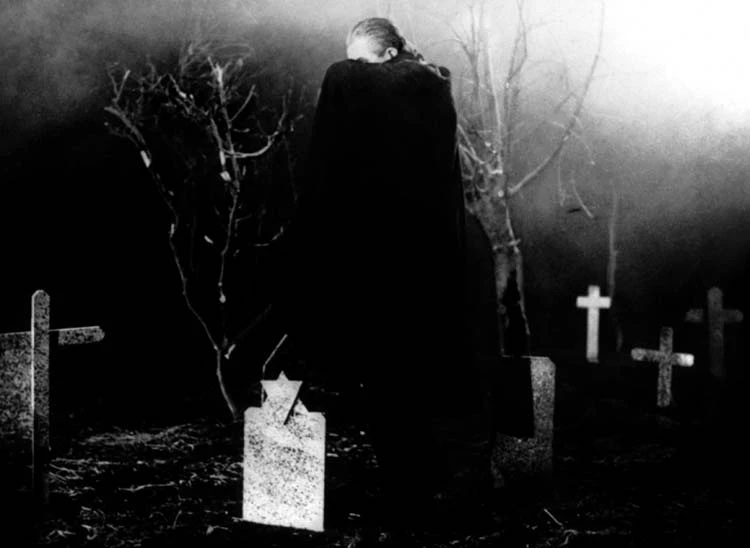
Other monster movies might have shock images, but the films themselves were reassuring simply by being models of coherence and control. Plan 9 from Outer Space was genuinely disorienting, and its trippiness would creep me out – I’d get this funny feeling I wasn’t in Kansas anymore… The only other film that got to me in the same way was Bride of the Monster. This was in the early sixties, when I was barely old enough to catch the Lugosi connection between the two films; perception of Ed Wood would take many more years. But I was always disconcerted by Bride’s bizarre finale, where dark, non-matching, displaced shots of Lugosi’s zapped and scarified Dr. Vornoff, alternately grimacing with ogre rage and gnawing his knuckle in elderly desperation, were sutured into action footage of the hero taking on the oversized and monsterized mad scientist. What do those close shots have to do with the combat in the far shots? How big is Vornoff now? Just what the hell is going on here anyway?
At that age, I didn’t really have the idea of receiving information that could be imperfect – whatever I was seeing had to be what I was supposed to see. Thirty years later, I feel pretty much the same way. A film can’t be evaluated against an archetypal correct movie that’s floating around somewhere in the universe; there’s only the different things being projected onto the screen and whatever art object they add up to. And Ed Wood mixed together a lot of very different things into his films.
So many different things, in fact, that it becomes pointless to dismiss the crazy-quilt results as the seams left visible by an inept tailor. These films are so consistently over the top that they obviously spring from a very special sensibility concerning the range of activity permissible within a single film. Just look at his first feature, Glen or Glenda, where Wood’s willingness to split and neutralize his narrative is the most extreme. Individual scenes may be paced normally or even leisurely, but the film takes on a quick tempo through the intercutting of the boy-and-girl love story with Timothy Farrell’s socio-psychological analyses and Bela Lugosi’s poetic, mystical commentary – and these alternate voices are just as likely to include footage of steel mills, highway traffic, bison stampedes, and lightning bolts as close-ups of talking heads. But then, all the different currents in the film are open to taking their own sharp turns: Lugosi at certain moments shares the screen with some of the story’s characters; Farrell talks to cop Lyle Talbot, to the boy and girl lovers, even to us; and the love story itself, ordinarily the most familiar narrative terrain, includes the film’s most bizarre footage in Glen’s devil-plagued nightmare.
Ironically, certain prints of Glen or Glenda take the include-me-in approach to its logical extreme: Producer George Weiss wanted to goose the film’s running time over seventy minutes, and so he stuck into Glen’s nightmare some bondage footage that Wood neither shot nor intended to use in his film. Thanks to Weiss’ interference (as if its subject matter wouldn’t have been enough!), Glen or Glenda’s distribution and recognition was long restricted to the sexploitation market – the arena to which Wood was drawn again and again in his career and where he would eventually finish that career.
“Pornography – a nasty word for a dirty business,” growls police lieutenant Kenne Duncan in Wood’s 1960 melodrama The Sinister Urge. This film, a depiction of the porn racket as a cesspool of crooks and psychos, would be Wood’s only directorial effort in the sixties. He would support himself for most of the decade by writing pornography – which brings a weird, retrospective sarcasm to his film’s square-jawed arguments for decency. By the seventies, Wood would be filming pornography, probably starting with Take It Out in Trade. Wood is rumored to have made the film in two versions, with and without hardcore footage. The print that has been recovered is strictly softcore – although it still falls well within the domain of an X-rating – and seems far too fast-paced and humorous to readily accommodate extended sex scenes. Of course, knowing Wood, he wouldn’t have hesitated to disrupt Trade’s overall shape with extraneous or contradictory sequences. But as it stands now, the film lacks nothing – except an audience.
Marking the end of a ten-year hiatus from directing, Take It Out in Trade was to have been Ed Wood’s comeback film. But part of his problem was that nobody had noticed that he’d been away. (In fact, his death would go unreported; there are no obituaries of his passing.) The film disappeared back in 1970, after only a few screenings on the SoCal softcore circuit, and became one more question mark in Wood’s career. Now, with its rediscovery and the inevitable appearances at revival houses, there’s going to be a bittersweet irony: Take It Out in Trade really will be Ed Wood’s comeback film.
Apparently inspired by Ernie Kovacs and “Rowan & Martin’s Laugh-In,” Wood uses blackout gags throughout Take It Out in Trade, giving his film a comic-strip feel, as though the sex cartoons from Playboy had sprung to life. Wood clearly shared Russ Meyer’s sense of humor, fun, and sexual enthusiasm, and the film readily embraces the rapid-fire editing and freewheeling zooms and pans typical of Meyer. But if the Meyer canon can be regarded as an ice cream sundae, then Take It Out in Trade is a green cherry plopped atop the whipped cream, because Wood pushes Meyer’s vision of unrepressed sexuality out into queer fringes unknown to Meyer (except when he and Roger Ebert could script gory demises for their pervs). All the verboten thrills of Take It Out in Trade – and there are plenty, including lovingly filmed lesbian action, Wood himself performing in drag, and a guy on female hormones getting frisky with his boyfriend (who’s played, to the eyes and ears of this reporter, by a woman in male drag) – are offered for the audience’s delectation not so much as forbidden fruits, but rather as delicacies just as tasty and available as any of the film’s more-familiar hetero-hijinx.
Two women comprise the first lovemaking couple seen in Trade, as a result of Wood briefly inserting some hot lesbian nuzzling into a voiceover intro of his detective hero, Mac McGregor (Michael Donovan O’Donnell). The cutaway serves to deflate the man’s machoid posturing, in a subversive thrust that characterizes almost all the sexuality shown in the film. All-female eroticism, long a favorite byway in the porn of heterosexual males, was the transgression Wood could most easily introduce, and being a het male himself, he uses it constantly in the picture. But Wood was a gender-variant het male, and so he brings a different spin to his gal-on-gal antics, emphasizing the strength and self-sufficiency of the women who staff Madame Penny’s Thrill Establishment. These superior beings easily dismantle the detective, stripping him to his jockey shorts, tossing away his toupee, and hog-tying him with a bullwhip. “You’ve got better gumshoe tactics than I do,” he confesses to one prostitute after she pulls a strip of tape away from his mouth – yanking off his fancy mustache in the process!
That woman’s triumph really sticks it to the debilitated and depilated he-man; she’s been his quarry throughout the film. (Private dick McGregor has been trying to track down this very wayward daughter of a wealthy family.) But the young lady can take care of herself – and any man too. Her father, incidentally, is played by Duke Moore, Wood’s reliable cop-type from Plan 9, Night of the Ghouls, and The Sinister Urge. Moore is his old smooth self in all the exposition and straight-line scenes, and so he manages to throw into relief the limitations of the blank-eyed, leaden-voiced actress who attempts to play his wife. However, when she chokes out, “But – but – but” and Duke retorts, “Stop sputtering, Emily!” that exchange alone is worth the price of admission.
Trade plays on the notion that sex, buried beneath the surface, is constantly at a boil and threatening to disrupt everyday life. When the parents first discuss the case with McGregor, Wood slips in shots of their daughter merrily plying her trade (and always to the relentless beat of the soundtrack). McGregor himself, as soon as he secures a hefty expense account, blows his wad on a globe-trotting fuckfest, constantly espying and sometimes joining in the action. “Sex! That’s where I come in!” says McGregor, but usually he comes in just to peep at the escapades of others, parting ferns to leer lasciviously, Wood adding voyeurism to the film’s panoply of kinks.
Not surprisingly, we don’t see McGregor get laid until he pays a visit to two gay guys. (Their female housemate takes a shine to the shamus.) Otherwise, McGregor’s luck picks up mostly when he’s offscreen: “‘Working on a hot tip,’” reads Duke Moore off the back of yet another postcard from McGregor. “I wonder what he means by that?” We see he means he’s happily tonguing a woman’s breast.
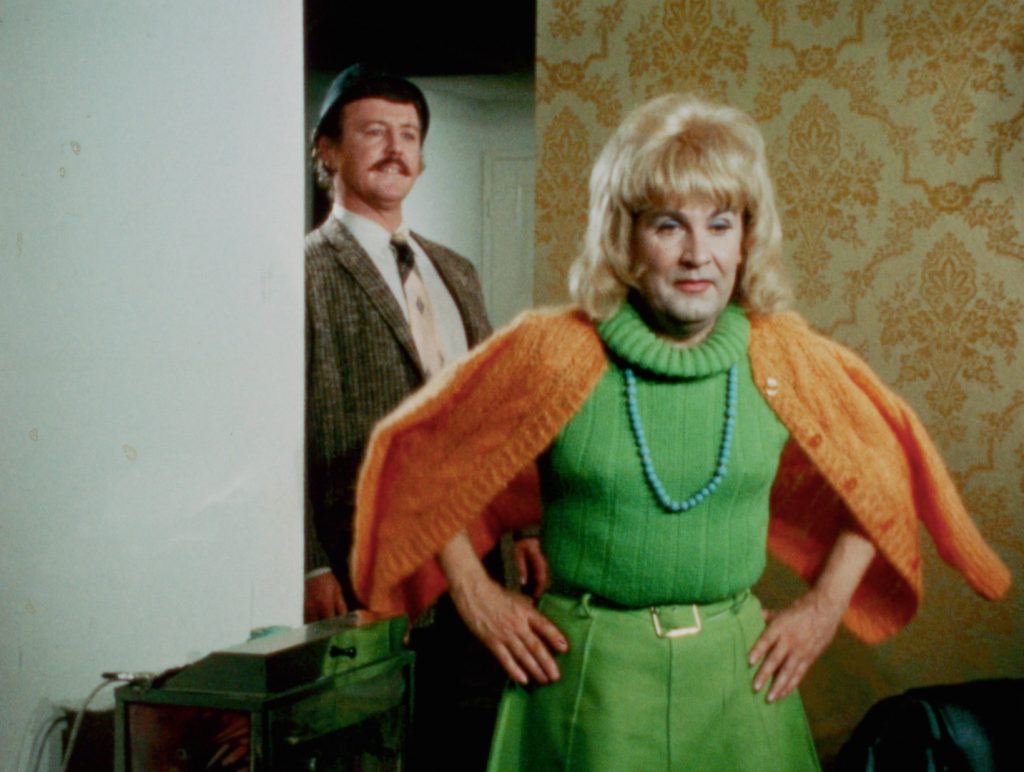
Such lip service notwithstanding, the most potent expression of Trade’s adoration of female sexuality must be Wood’s appearance as “Alecia,” resplendent in blonde wig, green dress, and white high-heel boots. He has some very funny moments camping around with the detective, but reserves for himself the classic moment of transvestite humiliation when his wig is yanked off and the man beneath is exposed. Unlike Glen or Glenda, where the dewigging came at his own hand (with Glen goading himself while gazing in the mirror), here it’s McGregor who provides the insult – which director Wood milks in grotesque close-ups of actor Wood. This dark conclusion to an otherwise lighthearted sequence suggests that Wood may have suspected the comeuppance awaiting him for having stepped so far out of line in what should have been just another hetero-nudie film in the Russ Meyer tradition.
Wood wrote appreciatively of Russ Meyer in A Study in the Motivation of Censorship, Sex, and the Movies, Book 2, commenting on Meyer’s “place in the industry, which seems to strengthen year by year.” He made that observation in 1973, by which time his own place in the industry had become virtually non-existent. Two more Wood scripts would be filmed by others; he himself would go on to shoot only some short porno loops in super-8. In December of 1978, a few days after he and his wife were evicted from their apartment, Wood died of a heart attack in a friend’s home. He was 54 years old. That same month also marked the revival of his career with the first midnight screenings of Glen or Glenda in New York City. Had death not claimed Wood then, his celebrity in the eighties would certainly have enabled him to resume directing. (If the man was able to promote financing when he was an unknown, imagine what he could have done as the focus of all that publicity!) Such a re-emergence would perhaps have been the most striking demonstration of Ed Wood’s success as a filmmaker, especially when you consider that the previous decade never opened its purse lips very widely for Orson Welles or John Cassavetes or Russ Meyer or John Waters or Kenneth Anger or Jack Smith or Nick Zedd.
(This essay first appeared in Brutarian No. 6, 1992)
Link to:
Film: Essays: Contents
For more on Edward D. Wood Jr., see:
Film Dreams: Edward D. Wood Jr.
Film Essay: Cult Films
Film Essay: Erotic Films
Film Review: Ed Wood
Film Review: I Woke Up Early The Day I Died
And be sure to read Rudolph Grey’s book Nightmare of Ecstasy: The Life and Art of Edward D. Wood, Jr.
 NICOLE V. GAGNÉ