“Everything Else About Me Is Pure Lady”:
Gender Variance and Race in Six American Films of the 1990s
Introduction
In American cinema, gender variance most often appears in drag-themed comedies and in shockers that rely on crossdressing murderers. Other dramatic narrative films have ordinarily used trans people to indicate sleaze and decadence, depicting them either as someone bad in the criminal and/or pathological sense, or else as someone sad who winds up the victim of someone bad. The years 1996 and 1997 saw numerous films that kept to those party lines. Kiefer Sutherland was the serial killer in Matthew Bright’s Freeway, doing the Wolf-as-Grandma thing to Reese Witherspoon’s Red Riding Hood. David Lynch’s Lost Highway featured Robert Blake as the nameless and lethal “Mystery Man” whose fondness for cosmetics is meant to imply that he’s a demon from Somewhere Out There. Iggy Pop was the frontier Sally who served killers Billy Bob Thornton and Jared Harris in Jim Jarmusch’s Dead Man. Murderers dressed up like women in such exploitationers as John Eyres’ Judge and Jury and Daryl Cartensen’s Unnaturally Born Killers; the titular slasher in Diary of a Serial Killer, directed by Joshua Wallace, isn’t a crossdresser, but he does settle for murdering transvestite lovely David Michaels when he can’t slay a woman. Occupying a zone of its own is Surrender Dorothy, a psychodrama of forced feminization from writer, director, and star Kevin Di Novis.
During those same two years of 1996 and 1997, however, there were also a half-dozen American films, studio-made and independent, which associated an iconic value and meaning to their male-to-female trans characters, making them agents of vitality, freedom, anarchy, power, and self-transformation. The six characters are all supporting roles, but each is essential to the film; more importantly, they’re shown varying degrees of respect and even affection. These films, to their credit, also depict a range of lifestyles, with no two of these characters being in the same gender situation. There are transsexuals, post-op and non-op; drag queens, full-time, part-time, and just party-time; and even an androgyne poseur. What they have in common is race: They’re all Black.
Two of these films were updated versions of European classics. Twisted, an independent feature from writer/director Seth Michael Donsky, transported Charles Dickens’s Oliver Twist into the hustler underworld of 1990s New York City – and added a drag-queen character played by Billy Porter, who eventually took over the film. Twisted had only a brief release and received mixed reviews, but William Shakespeare’s Romeo + Juliet, set in contemporary Mexico City, was an unexpected hit thanks largely to the MTVisms of director Baz Luhrmann. However, the spectacle of Harold Perrineau as Mercutio, getting fierce at the Capulet costume party, certainly didn’t hurt the film (or him!).
Two other films were studio releases as well as box-office hits, yet ironically neither turned much of a profit because they’d cost so much to make. Both were science-fiction comic books of futuristic mayhem and machismo, with mighty heroes who were mighty glad to have trans folk helping them save the day. In John Carpenter’s Escape from L.A., victory hinges on support from rebel leader Pam Grier, playing a transsexual woman. Luc Besson’s The Fifth Element averts the apocalypse with some assist from Chris Tucker in a withering send-up of the rock star Prince as a femmy pop celebrity called Ruby Rhod.
Another pair of films explored contemporary American life and the personal and social phobias that simmer between people straight and gay, black and white, male and female. One was studio-made, the other independent, but neither found much of an audience. Midnight in the Garden of Good and Evil, produced and directed by Clint Eastwood, failed to please admirers of the murder-trial bestseller by John Berendt; yet its release made an even bigger celebrity of its co-star, Savannah’s real-life and living-real trans diva The Lady Chablis. Neptune’s Rocking Horse, written, directed, produced, and edited by Robert Roznowski and Robert Tate, barely surfaced beyond various film festivals. Their film revolves around a drag queen, played by Roderick Leverne, whose brutal arrest impacts the lives of the passersby who witness it. The iconic significance of trans people, implicit in the other five narratives, here becomes explicit, and her image returns to all who saw her, only now wearing the drag of their own needs and aspirations.
Attitudes in these six films regarding gender variance and race are examined more closely below. As for the conclusions that can be drawn, they seem to pose as many questions as they answer.
I. She Blesses, She Curses: Twisted and William Shakespeare’s Romeo + Juliet
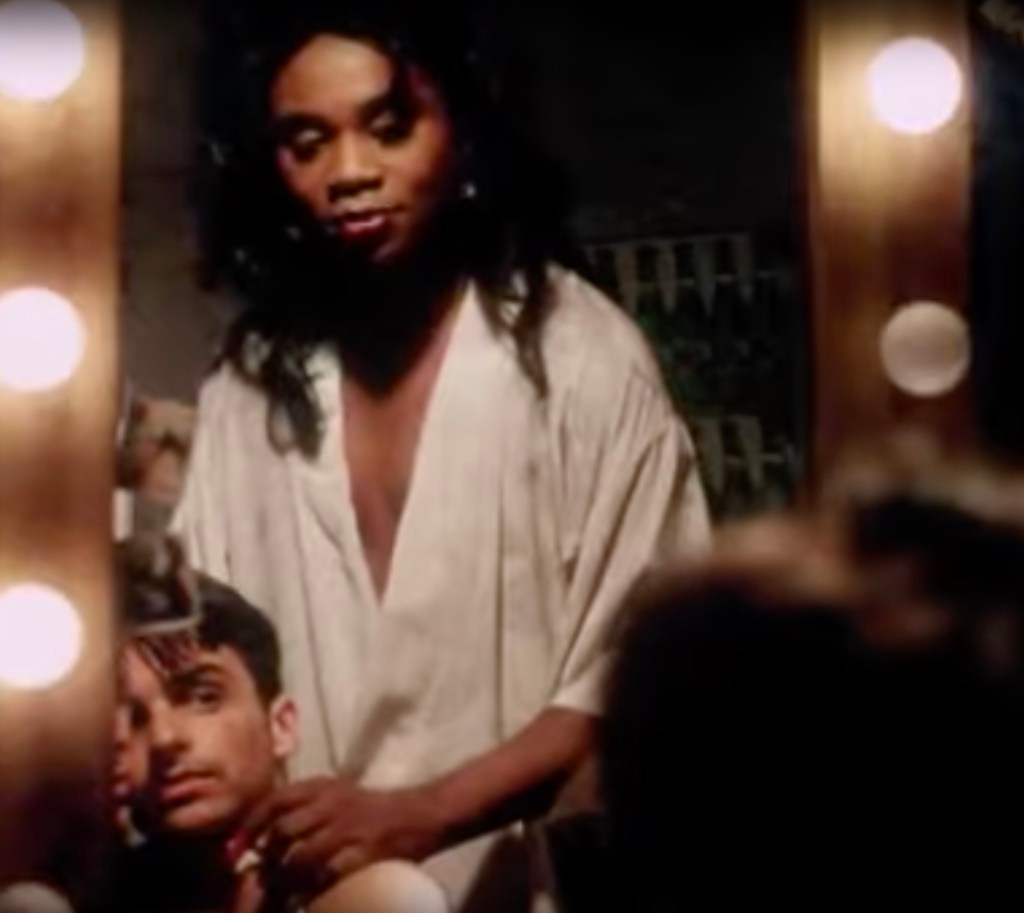
Most of the major characters in Twisted have their prototypes in Dickens. Homeless 11-year-old Black boy Lee is Oliver Twist; the hustler Art, who finds Lee on the street, is the Artful Dodger; brothel-keeper André, who takes in Lee, is Fagin; the kindly songwriter Angel is Nancy to the Bill Sykes of his evil drug-dealer lover Eddie. One of the few original characters is the drag artiste Shiniqua. Unfortunately, “original” here means only non-Dickensian, because Shiniqua is your standard heart-of-gold queen: all knowing, all loving, all rescuing, and all the time asexual and all alone – in other words, Hattie McDaniel, only with nicer clothes, a shapelier figure, and a tucked penis.
So absolute is Shiniqua’s Earth Mother status that she’s never seen out of drag – her opening scene makes a point of not revealing her face until after she’s gotten her wig on. As the film’s moral conscience, she treats Art like the lowlife he is, stands up to the vicious Eddie, and chides a bruised Angel for staying with his abusive boyfriend. The only hint of her emotional life occurs when Angel hugs and kisses her in gratitude for her help with Lee, and her arms slowly close on him and you glimpse her hushed face. You can also hear her love for Angel inflecting her voice as she sends him off to take Lee to the District Attorney. Alone again in her dressing room, she sits and shakes her head to herself.
By the time Shiniqua has arranged for Lee’s release, Donsky has lost sight of the boy as the focus of his narrative. Having no one else to work his plot around, he uses the character he’s added to resolve everything, and in the last reel Shiniqua is there at André’s door like a vengeful fury, announcing that she’s called the police on him and Eddie. She’s last seen barking at the cops to “get all these fuckin’ queens!”
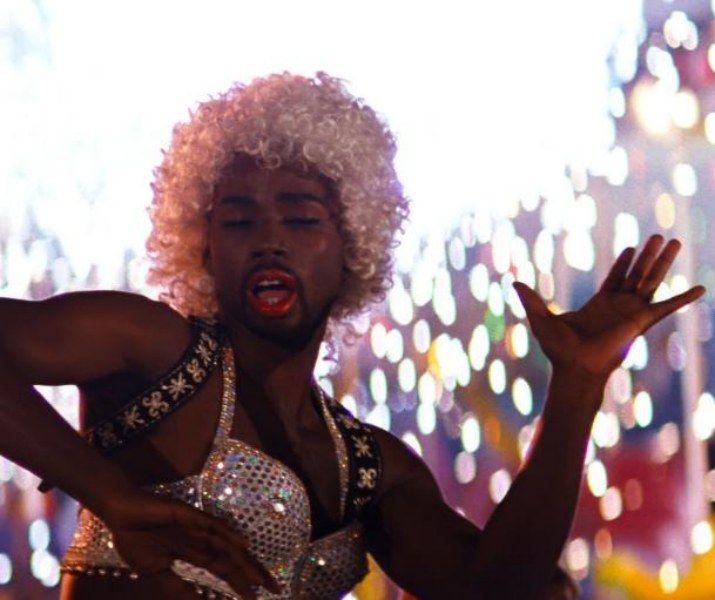
Like her sisters the Hijra of India or the Gallae of pre-Christian Rome, Shiniqua has the power to bless and to curse, and she exercises it on Angel and Eddie, respectively. Mercutio, although a sister more in spirit than in fact, demonstrates the same talent in William Shakespeare’s Romeo + Juliet. He’s introduced behind the wheel of his parked car, laughing as he puts on his lipstick, just as if his moustache and goatee weren’t there. Wearing a white sequined halter and miniskirt with matching platform heels and a short white wig, he struts over to Romeo’s pals and gives them invitations to the Capulets’ masked ball. Kym Mazelle is blasting from his car radio and he sings along – “Young hearts run free!” – as he extracts Romeo’s pass from under his skirt. Mercutio also gives his friend a hit of some drug that causes the ensuing party scene to look even more like a music video than the rest of the film does, which is saying a lot. At one point, a dazed Romeo sees Mercutio again lip-syncing “Young Hearts,” only wearing white garters and stockings and a much fuller white afro wig. He’s dancing and works a billowing white cape in a benediction for what’s about to happen: Romeo cools his head in a nearby basin of water and turns to gaze at the tropical fish in a large aquarium – and first sees Juliet, who’s on the other side, looking through it, right at him.
“Young Hearts Run Free” can be considered Mercutio’s theme as well as the lovers’ tune: an allusion to the wildness of his own heart, of which we see plenty, starting with the bigness and freeness of his entrance. We’re supposed to like Mercutio, and his unselfconscious cavorting in girl’s clothes is both endearing and empowering – not unlike some of the unexpected drag turns of Daffy Duck or Bugs Bunny. Mercutio’s death reveals how evil and insane the feud has become, because now someone has been killed who is neither Montague nor Capulet, and has no cause for which to die. Appropriately, he’s slain because someone else tried to stop the violence: Romeo interferes when Mercutio is fighting Tybalt, and inadvertently gives his opponent the chance to stab him. Zany to the last drop, the mortally wounded Mercutio tells Romeo, “ask for me to-morrow, and you shall find me a grave man.” He also articulates what the audience feels at that moment, “a plague o’ both your houses,” and curses them three times, just as he does in Shakespeare’s play.
II. Power Queen and Poser Prince(ss): Escape from L.A. and The Fifth Element
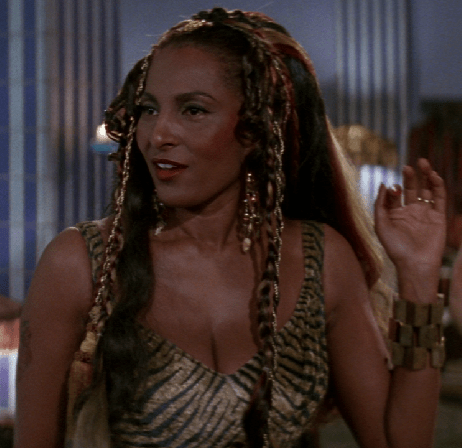
Escape from L.A., like John Carpenter’s 1981 actioner Escape from New York, is set in a big city that’s been converted into a penal colony sometime in the near future. To rescue the President’s daughter from the clutches of South American terrorist Cuervo Jones, the reluctant do-gooder Snake Plissken needs serious backup, and so he goes to Hershe: “a power player,” according to the knowledgeable Map To The Stars Eddie. “I mean, Cuervo’s got the numbers and the firepower, but Hershe’s got a burnin’ spine made outta steel.” Although her name is pronounced like the candy maker, this “Hershe” has no “y”; that unnecessary dangler has been removed to create a new feminine identity – which also describes the character herself, seeing as how Hershe was once Snake’s male cohort Carjack Malone.
Now Snake needs Hershe to be King Vultan to his Flash Gordon, and have her Vietnamese loyalists swoop in their hang gliders like the hawkmen of serial yore and overthrow Cuervo the Merciless. Resplendent in animal prints and big hair, Hershe lets Snake make his pitch and then demands, “What’s in it for me?” When he recognizes her deep voice and insists that she’s Carjack Malone, Hershe growls back, “I used to be!” Snake then lives out the yahoo’s dream of feeling a trannie’s goods for himself, and runs his hand up her fishnetted leg to her crotch. From there he removes the small gun that Carjack always kept stashed in his groin. Acknowledging the altered accommodations for this old standby, Snake observes, “The more things change, the more they stay the same.”
Ordinarily, the yahoo’s dream remains just that because yahoos are afraid of what they may find between a trans woman’s legs – and that they might like what they find. To neutralize this fear, Snake extracts a gun, removing any suggestion of a penis from Hershe. All this reassurance seems excessive, considering Escape from L.A. has a female star playing the trans character. Carpenter’s overkill is related to his praise of Grier’s performance in Film Journal International: “She can play a man playing a woman. That’s the thing I’d never seen before: A woman playing a man playing a woman.” In fact there are numerous instances of non-trans women cast as transsexual women prior to Escape from L.A., most familiarly Raquel Welch in Myra Breckinridge (1970), Anne Heywood in I Want What I Want (1972), Karen Black in Come Back to the 5 & Dime, Jimmy Dean, Jimmy Dean (1982), Vanessa Redgrave in Second Serve (1986), Carmen Maura in Law of Desire (1987), and Olympia Dukakis in Tales of the City (1993). Of course, Carpenter’s ignorance of film history is no big deal; what’s troubling is his notion of Grier as “a woman playing a man playing a woman,” because in real life, transsexuals don’t play anything, they’re being themselves. Grier plays Hershe (who lives in the hulk of the Queen Mary…) using drag-queen comportment and attitude, in line with the film’s belief that Hershe can’t be a woman and must really be someone else – hence, Snake’s insistence on calling her “Carjack,” which really annoys her, ha-ha.
Escape from L.A. tweaks the Christian Right by depicting America as a fascist theocracy that exiles everyone guilty of “moral crimes,” yet Carpenter scrupulously avoids any mention of governmental homophobia or transphobia. The film’s sole allusion to queer life is Hershe, who’s used more to represent the Wonderland unreality of penal-colony L.A. – where even tough hoodlums can become foxy women – than as any indictment of fundamentalist bigotry.
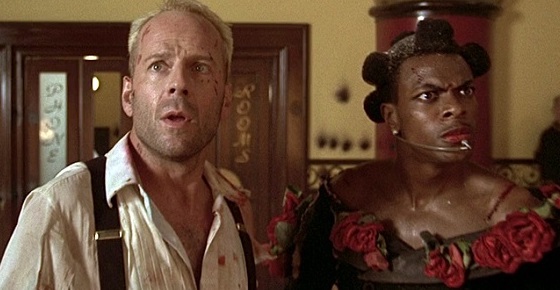
Even more tiresomely vanilla and macho-boy arrogant is the vision of the future offered by The Fifth Element, the first English-language film by France’s Luc Besson. It’s set 200 years after Carpenter’s L.A., but the world is still devoid of any suggestion of queerness, with one striking exception. This time, it’s the mincing, soprano-voiced radio luminary Ruby Rhod, basically a send-up of Prince. Playing Ruby well past the hilt, Chris Tucker is dressed in Jean-Paul Gaultier jumpsuits that open flowerlike and bare his shoulders and collar bone as though he was wearing a strapless gown.
Unfortunately, wardrobe is all that’s imaginative about the character. The Fifth Element is as fixated on the maleness of its trans person as Escape from L.A. was, and like the pistol-packin’ Hershe, Ruby Rhod also carries a phallic prop: a cane/microphone. Overkill here too, because he needs the shtick less. For all his girlish makeup and hairdo and outfits, Ruby is a compulsive het horndog who throws himself at various dazzled females and settles on a flight attendant, burying his head right where such hounds are wont to sniff. (While there he tongues her to, of course, the orgasm of her life.) When she insists that Ruby assume his individual position, he tells her, “I don’t want one position! I want all positions!” But nothing ever happens that would imply he might want to position his head between a man’s legs. Instead, Ruby Rhod is a textbook example of what film historian Vito Russo called a “yardstick sissy”: an unthreatening girly man whose faggotry makes the leading man seem all the more masculine. Ruby actually gets to protect, for at least part of one scene, the magical stones that will save the Earth, but when it’s show time Miss Thing can’t figure out how to activate them – unlike the three white guys who are also part of the mission – and so must stammer for a real man to come to the rescue.
III. Just Blessings, Thank You: Midnight in the Garden of Good and Evil and Neptune’s Rocking Horse
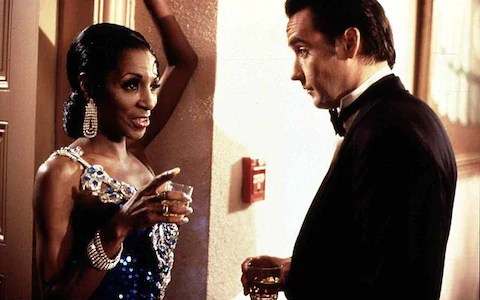
In yet-another instance of Homosexual Panic Hollywood-Style, John Lee Hancock’s script for Midnight in the Garden of Good and Evil invents a heterosexual narrator, Kelso, to be the audience’s Virgil and guide them through the Inferno of queer Savannah. With Kelso holding their hands (non-sexually, of course), normal people can be brought up close to Jim Williams, a gay man who’s on trial for murdering his hustler boyfriend Billy Hanson. Of course, no one in the audience has anything to fear from Williams, because the stolid, standoffish direction of Clint Eastwood never tells you anything about who he is or what drives him, much less encourage you to care about him. How you should regard Williams is made perfectly clear after he confesses to Kelso that his self-defense plea is a sham, because Billy’s gun was on safety and never fired. Knowing he can get a self-defense acquittal in court, Williams decides not to tell the truth on the stand, and the appalled Kelso walks out and goes directly to his girlfriend’s arms and lips.
Said body parts are attached to the director’s daughter, and although she’s actually pretty good in the film, nepotism encouraged her father to lavish screen time on the establishment of Kelso’s het credentials. Running over 2-1/2 hours and lacking any clearly defined character to command attention or concern, Midnight in the Garden of Good and Evil would be unwatchable were it not for the participation of The Lady Chablis. Although an amateur actress (you can always see that she knows she’s on camera), she does her dialogue well and really is just what she appears to be: a non-op, hormonally altered transsexual, living full-time as a female.
Rather than keep her in queer milieus, the film tends to place her in conventional social situations, such as a hospital or an all-black debutante cotillion, and have her create chaos and consternation. In the courtroom for Williams’s trial, she testifies about her gender situation to a stunned jury: “I have a man’s toolbox, but everything else about me is pure lady: I love to dress in women’s clothes, I love to go shopping, I love to have my nails done, and I love men. Any questions?” She knows full well that the defense wants her to testify because the victim will seem more reprehensible for having been a friend of hers. “Because Billy hung out with the drag queens, he deserved to die?” is how she sums it up to Kelso, who admits helplessly, “It’s fucked up, but yeah.” She responds, “Yeah, that’s fucked up,” and you hear the voice of someone who actually has endured many fucked-up realities. Such a moment makes her casting invaluable – finally, amidst all the phony goings-on, there’s a glimmer of something real.
Having no real narrative function – her testimony is of little value in Williams’ trial – The Lady Chablis is included mostly as a life-force character. In Eastwood’s make-you-gag ending, she and a Black man who walks an invisible dog flank Kelso and his lady: The eccentric Black folks blessing the normal white folks… Eastwood even has her arriving with a picnic basket of food for the couple and claiming to be their “chaperone,” in a burst of Mammyism that lacks only a red and white kerchief on her head.
She may be disruptive in conservative settings, but there’s no malice in The Lady Chablis, and unlike Shiniqua or Mercutio, she dispenses only blessings. The same can be said of the drag queen played by Roderick Leverne in Neptune’s Rocking Horse. She opens the film dressed in ‘60s finery – psychedelic stockings, white heels, pink mini-skirt, matching pink wig – as two policemen roughly lead her out of a New York City apartment building. Her hands are cuffed behind her but she breaks free and tries to run, so one of the cops throws his club at her legs and sends her sprawling to the ground. They pick her up, her forehead bleeding, and stuff her in their patrol car and drive off. She’s last seen in their back seat, her grim and bloodied reflection caught in the rearview mirror.
The film then turns to five people who witnessed her arrest and traces its aftershocks in their lives. Elderly Jewish caregiver Sadie tells her bedridden older sister, “I saw a transsexual get arrested today,” although her charge can no longer comprehend her comments. Gay activist John sets about protesting what he calls a false-arrest case, even though he doesn’t know who was busted or for what. Closet-gay Tom flashes on her when he sees similar-styled tights on a young woman, and again later when he confesses to a pal his discomfort with the drag scene. Lonely straight career woman Genna takes offense at the “flaming homo” and sneers to her gal pals at the health club about the “pathetic parody” of that “he-she.” Struggling doorman Malcolm, also Black like he-she, argues that a brother behaving like a sister is harmful to the race.
Unfortunately, Neptune’s Rocking Horse hasn’t a clue when it comes to making any of these five characters seem like real people. What makes this stilted, overplotted affair memorable are the fantasy scenes given each of the characters, in which the pilloried queen becomes their own ego image. Sadie sees her in a black dress and wide-brimmed hat, mourning for a lost loved one yet now freed herself. John envisions her as a ‘70s Angela Davis-type who leads her chanting marchers to City Hall: “FALSE ARREST ‘CAUSE HE WORE A DRESS!” Tom imagines her with long cornrows, Whoopi Goldberg-like, wearing his clothes as she offers him a “best of both worlds” pitch. Genna sees her as her own reflection in a glass door, an alluring figure who’s into her body and her sensuality. Malcolm, about to get into a fight with a burly white guy, envisions her as an African warrior goddess who subdues the tough by also being a Snap Queen!
It’s not much of a stretch to see the other five trans characters discussed above reflected in these five dreams: Mourning becomes Shiniqua; The Lady Chablis disrupts many a social institution; Mercutio’s drag fling defines the freedom to shed fear and inhibition; Ruby Rhod lives for sex and himself; and if Pam Grier isn’t an African warrior goddess, then I don’t know who is! As for the apotheosis of Neptune’s own martyred queen, the film supplies the image in its last scene, when she steps out onto the street again, this time at night and alone and looking sublime in a long white gown, her scarf billowing in the wind. Now her ride is a white stretch limo, and it takes off with a much happier girl in its rearview mirror.
To get to this wonderful moment, however, you have to sit through an awful ending, in which Leverne returns to the neighborhood sporting just a small bandage on his forehead. He strolls down the street dressed in a big baggy coat, his feminine features and demeanor only hinting at the womanly delights he can offer. Ignoring the adults around him, he attends to a crying little boy and calms him, but at the same time his presence quells another fistfight that’s about to erupt, this time between Malcolm and John. All five witnesses get to see him (he even kinda cruises Tom), and so they are relieved of whatever guilt they’d felt watching the arrest. Likewise, the audience is expected to believe that the police wouldn’t mistreat a drag queen who’d resisted them. In other words, the system works.
Outroduction
Admittedly, most of these films are outright failures, and even the more accomplished ones, such as William Shakespeare’s Romeo + Juliet or Escape from L.A., never rate beyond the level of guilty pleasures. Yet all six portray trans people as unique beings who can bestow valuable assistance and good fortune. The price these characters must pay to get onscreen with such power, however, is to be desexualized. (Note that Ruby Rhod, who has the most active libido, also comes closest to being just a comedy relief.) As in so many films made by white men, the tendency is to de-eroticize the Black male, here through feminization. If these feminized males are more respectable than most of the white trans people depicted in American films of the ‘90s, it may be because they have already been assigned a permanent second-class status – their race precluding the possibility that they could be real men in a white world, much less leading men in its movies.
Gender variance is a fall from grace for the white man in dramatic films of 1996-97, yet the Black man travels this forbidden zone immune to the punishments visited upon his pale brother. America has a long history of whites projecting onto Blacks a heightened sexuality: greater lustfulness, superior prowess, bigger (and therefore better) genitalia. What now is being attributed? Does this “more-ness” include gender fluidity? Is that one more level of virtuosity to which white people aspire, but can acknowledge only in the form of The Shadow?
Another factor that mustn’t be overlooked is the huge box-office success in America of Neil Jordan’s The Crying Game (1992). The film was a monster hit here thanks largely to the performance of Jaye Davidson, an American actor of mixed-race, as the trans woman Dil. Perhaps this essay has been describing a case of the Sage points and the Fool looks at the finger; but if any of the filmmakers under discussion here (or the people who financed them) assumed that Dil’s race legitimized her for The Crying Game’s American audience, they missed the point Jordan made with her. Dil has legitimacy not because she’s Black but because she’s a human being. Jordan let the audience care about her by revealing her emotions and aspirations, and so people were able to recognize themselves in someone who at first seemed so very different. Such legitimacy requires the filmmaker to look directly at the trans person without projecting illusions or allusions. The six gender-variant characters under discussion here, however, must to varying degrees remain The Other and therefore be unknowable.
(This essay, written in 2004, appears here for the first time.)
SOURCES
“She can play a man playing a woman”
Maitland McDonagh, “Now It’s L.A.’s Turn” in Film Journal International, August 1996, page 127.
“yardstick sissy”
Vito Russo, The Celluloid Closet. New York: Harper & Row, 1981, page 67.
Link to:
Film: Essays: Contents
For more on gender, see:
Film Interview: Holly Woodlawn
Film Review: Gun Hill Road
Film Review: Kokomo City
Film Review: Queeendom
Film Review: Seat 31
Film Review: Transamerica
Music: KALW Radio Show #5, Gender Variance in Western Music, part 1: Male-to-Female Representations
Music: KALW Radio Show #6, Gender Variance in Western Music, part 2: Female-to-Male Representations
Other Writings: Book Review – Candy Darling
Other Writings: Essay – “A Working Model of Gender”
 NICOLE V. GAGNÉ