“Tabard Is A Girl”: Sexual Anarchy in Jean Vigo’s Zero for Conduct
When told that Jean Vigo’s L’Atalante was on the 1992 BFI poll of the ten best films in the history of cinema, Federico Fellini confessed, “I have never seen L’Atalante and I feel a sense of shame in admitting it,” and then added, “but Jean Vigo is a great director.” He could only have been thinking of Vigo’s anarchist classic Zero for Conduct, a funny and dreamlike account of an uprising by boarding-school boys aged 12 and 13. Certainly the schoolkids of Amarcord show Vigo’s imprint on Fellini; for that matter, what is Fellini-Satyricon if not another take on wild boys shaking off the world of their elders in quest of something better? Vigo was also inclined, like Fellini, toward fragmentary narratives and surreal imagery – James Agee could have been writing about Satyricon when he praised Zero for its use of “objective, subjective, fantastic, and subconscious reality […] to insist that these levels of reality are equal in value, and interpenetrative.” Even more than its cast and setting, this plasticity of discourse, combined with Vigo’s mischievous sense of humor and his poetic feel for detail and incident, keeps Zero for Conduct forever young and surprising – a true eternal delight of early talking films.
The formal freedoms of Zero for Conduct are the natural extension of its political agenda; so too are the sexual freedoms Vigo explores. The film’s allusions to homosexual and gender-variant love, however, also arose from Vigo’s respect for innocence. (Another impulse he shared with Fellini, who found himself in similar waters when adapting Petronius: pre-Christian Rome or pre-adolescent schoolboys, c’est égal.) We’ll never know how the audiences of Vigo’s day would have responded to the liberties his film depicted, because it was banned in France immediately after its premiere in 1933. Zero for Conduct remained mostly unseen until the ban was lifted in 1945, and with its re-emergence, Vigo’s international recognition grew rapidly – although by then the man himself was long in his grave, having succumbed to rheumatic septicemia in 1934 at the age of 29, with only four films completed. Less than a year before his death, Vigo spoke at the premiere of Zero for Conduct in Belgium and insisted that the decision to ban his film had predated its screening: “The President of the Board of Censors told one of his friends, who went to see him privately concerning the film veto, that he and his colleagues had been given unofficial orders by the government to ban the film before they had even seen it or had the opportunity to make up their minds for themselves.” The French government’s problem with Vigo was his father, Miguel Almereyda: a legendary anarchist who had been assassinated in prison in 1917. The authorities were quick to squelch anything from Almereyda’s progeny which smacked of subversion – and Vigo hadn’t smacked, he’d body-slammed. Zero for Conduct mercilessly caricatured and ridiculed the school authorities, and made sure to bait the church and smirk at the military too. Near the end, a boy waves the flag of France only to throw it into the dirt, take up the flag of anarchy instead, and lead a throng of cheering kids. The film’s theme of sexual anarchy concerns three boys who plot the insurrection, and their gradual acceptance of a younger, androgynous boy who forms an intimate bond with one of them – and then blossoms into the most radicalized and confrontational of all the rebels.
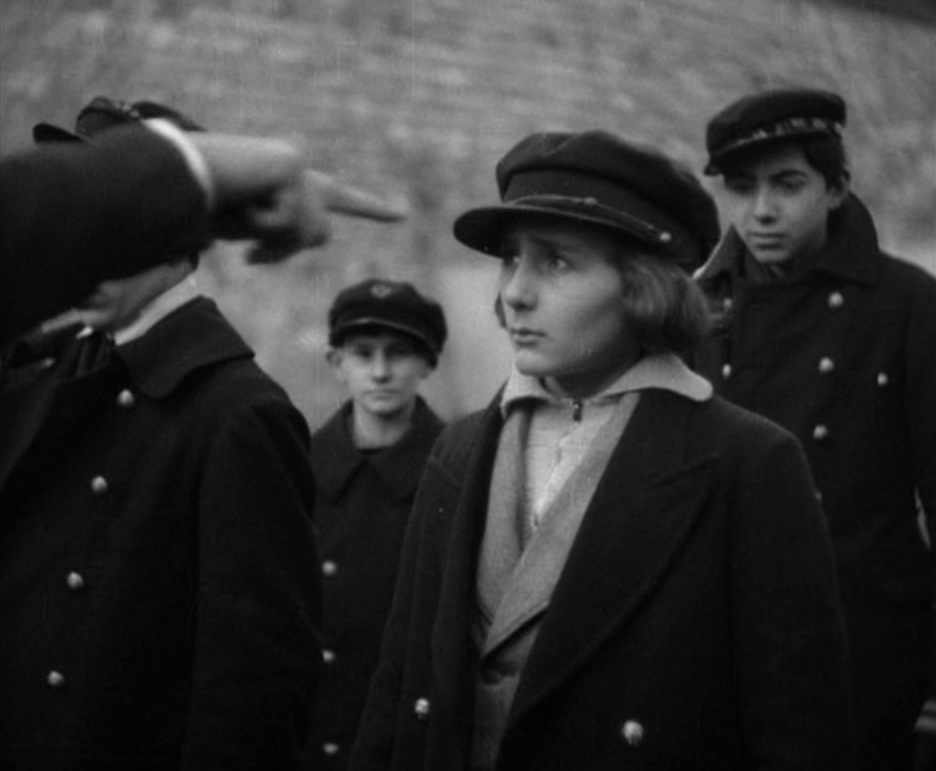
Of course, when you first see René Tabard (Gérard de Bédarieux) making his tentative entrance into the nighttime train station where the schoolboys gather, you’d think he couldn’t say boo to a goose. Brusquely ordered into line by the withered Superintendent Parrain (Robert le Flon) – dubbed “Dry Fart” (“Pète-Sec”) by the kids – the deer-in-the-headlights Tabard can’t utter a word, and must turn to his hovering mother for help. Mme. Tabard explains to Dry Fart that René won’t be arriving at school tonight because he’s feeling too sad, and then takes him away with her.
The kid in fact is on the verge of tears in this scene, which is a very different response from that of the other boys. But then everything about Tabard is different from the other boys, starting with his long hair which sticks out from under his cap and frames his pretty face. The jacket he wears (and keeps throughout the film) doesn’t cover the ends of his shorts and leaves his slim legs on display; all the other boys wear overcoats that reach well past their knees. He also has a white scarf nestled around his neck, much like the one his mother wears with her fur. Completing the girlish image is the small suitcase in his gloved hand, barely bigger than his mom’s purse and so unlike the duffel bags that the barehanded schoolboys carry slung over one shoulder.
The next day Tabard is alone in the schoolyard, leaning against a tree and gazing at the three conspirators who crouch nearby. Bruel (Coco Golstein), Caussat (Louis Lefebvre), and Colin (Gilbert Pruchon) pore over their map of the school and plot the rebellion until Caussat growls, “Hey, Tabard, why are you watching?” They fold up the map and shove off, with Bruel giving the smaller Colin a ride on his back. But Tabard still watches as they go.
Along with introducing Tabard’s interest in Bruel, this scene further distinguishes his appearance from that of the other boys. The three rebels, like most of their classmates, wear large black smocks over their uniforms, inevitably open in front like oversized shirts; Tabard’s smock is always closed in the front and open in the back or at the sides. It conceals his shorts, and with an outside belt around his waist, it looks very much as if he was wearing a dress.
Despite the initial cold shoulder, Tabard soon becomes chummy enough with Bruel to concern Head Superintendent Sant (du Verron), a silent snoop whom the boys call “Gas Snout” (“Bec-de-Gaz,” as in an exterior gas lighting fixture). When all the boys assemble in the schoolyard, Gas Snout makes sure to separate Tabard from Bruel prior to inspection. He then bows and scrapes to the Headmaster (Delphin): an imperious little person, tinier than any of the children, who sports a large beard and is given to making squeaky lectures. With the Headmaster’s approval the boys depart on their excursion, accompanied by the newly hired M. Huguet (Jean Dasté). The school’s only likable teacher, Huguet is funny and childlike, and possesses a white magic similar to the boys’ own. He’s also totally laissez-faire when supervising them, in the classroom or outdoors, and never even notices when Tabard slips out of his assigned place, drops back in line, and joins Bruel, taking his hand.
Not that Huguet would have minded if he had seen it. The Headmaster, however, is deeply disturbed by the possibility of just such enthusiasms, and in his office he pontificates about the boys to the tremulous Gas Snout: “According to you, Sir, Tabard and Bruel are behaving like little children, like youngsters – not serious, not serious at all. And will you consider our responsibility from the moral point of view?” In the following shot Huguet runs back to the school to escape the pouring rain; next come all the boys, also running except for two stragglers: Bruel and Tabard, snuggled together under Bruel’s coat. They stroll right into the indignant gaze of Gas Snout and the Headmaster, and then double-time it inside as the Headmaster grouses, “There we go again! The two of them together! Their friendship is becoming excessive. M. Sant, you are right. They must be watched.”
Tabard is really made to squirm in the next scene, when the Headmaster tries to counsel him but chokes on his own terror of the boy’s potential transgressions. Not much for appreciating irony, the Headmaster begins by addressing Tabard as “my little one” and assures him, “I’m almost like a father to you.” From there he crashes and burns rapidly: “At your age, there are things, are there not?… which… in a word, Bruel is older than you… your nature, your sensitivity, his… You understand? You know… neurotic… psychopathic… Who knows?!” With this last appeal, the diminutive Headmaster bounces out of his chair like a jack-in-the-box, his extended arms locked in hysteria. Tabard, confused and humiliated, returns to class but sits far from Bruel – and stays away, despite Bruel urging Tabard to join him. Bruel’s hurt can be glimpsed on his face as Caussat and Colin walk past his desk, but later in the schoolyard he and Tabard are together again. Bruel tells a dubious Colin to give his chocolate bar to Tabard, whose hiding place is safe from Gas Snout (who pilfers candy when snooping through the boys’ desks and belongings). “I promise you, he’s not a snitch,” Bruel declares of Tabard. “He’s a pal. Caussat’s wrong to keep him out of the plot. He doesn’t like the teachers. I swear he doesn’t like them.” Tabard, silent throughout, gazes up warmly at Bruel and then gives Colin a shy smile. Persuaded, Colin smiles back and hands him the chocolate.
Pitching Tabard to the third conspirator, however, is a lot tougher. “Leave me alone about Tabard,” snorts Caussat, “Tabard is a girl!” Colin protests, “Ever since he went to see the Headmaster, I don’t know what’s got into him,” but Caussat is unmoved: “I tell you, he’s a girl! What can he do? What can he say?” Then their chemistry class begins, and Tabard shows everyone what a girl can do and say.
He’s the first of the kids to enter, followed by Bruel who pats him on the back before seating himself a row away. The depressed Tabard sits with his head in his hands, unresponsive even when his hair is stroked by M. Viot (Larive), the slovenly and corpulent chemistry teacher. All the boys are writing their notes, except for the morose Tabard, so Viot again caresses his locks and asks, “Well, my little boy, aren’t we taking notes this morning?” The agitated Tabard yanks out his notebook and starts to write, and Viot pats his hand, with an unpleasant close shot of his big sweaty mitt. “That’s good,” he simpers, but Tabard pulls away and barks, “Leave me alone!” Less friendly now, Viot demands, “Now my little man, what have you to say?” and the fed-up Tabard replies, “What have I to say? I say shit to you!”
In the next scene, all the boys are attending Huguet’s class when in walks the Headmaster, followed by Viot, Gas Snout, and Dry Fart. Eager to keep tomorrow’s commencement activities unblemished, the Headmaster calls for Tabard to stand and announces that Viot has graciously agreed to forgive him – a largesse that has, like the man himself, a big but: “You must come, of your own accord, to beg me to accept your apologies, apologies that are worthless if they are not made in public, in front of all your classmates.” Caussat, sitting with Colin, shakes his head remorselessly about Tabard, and the saddened Huguet starts to leave rather than watch the boy be humiliated. “Tell us what you want to say,” the irritated Headmaster presses, and Tabard yelps, “Professor Sir, I say shit to you!” and then brusquely sits down, leaving his tormentors speechless.
Note the boy seated in front of Tabard, who brings his hand to his mouth to stifle his laughter as this shot fades: He’s the perfect lead into the fade-up on Tabard, Bruel, Caussat, and Colin, dressed in their nightshirts and seated on the floor of the dormitory, with the din of boys laughing and cheering all around them. Tabard is holding the rebels’ manifesto and their flag, a white skull & crossbones on a field of black. The four boys rise to their feet and the others cluster around them, joining hands to form a protective ring. From its hub, Tabard shrilly proclaims, “War is declared! Down with the masters! Down with punishment! Long live the rebellion! Liberty or death! Let us plant our flag on the school roof! Tomorrow, we must all be as one man! We swear we will bombard the old jackasses at the fête with old books, old cans, old shoes, and ammunition that we’ve hidden in the attic! Forward! Forward!” Roused from his bed, Dry Fart bleats, “What’s this? Tabard! Tabard!” But he’s just a fart in the windstorm now, unable to penetrate the ring and stop Tabard from slipping out of the dorm. The boys then go gleefully berserk, throwing their pillows and blankets and quilts and mattresses all over the dormitory, while Tabard plants their flag on the school roof.
He’s back with them for their apotheosis, a passage of heart-stopping beauty unique in world film. Vigo slows down the speed and runs the footage backwards, creating a lazy snowstorm of feathers in which a boy, standing on his hands, seems to thrust himself off the floor, with his nightshirt billowing casually to expose his buttocks as he ascends and his penis as he gently lands in a chair that’s held off the ground for him by another boy. Vigo then returns to forward action but stays in slow motion, and the ecstatic kids march past the camera in a sublime procession, carrying high their chair-borne classmate. Many hold up T-shaped wooden crosses from who knows where, adorned with paper Chinese lanterns yet, as they go squinting into the gentle blizzard, the slow motion magnifying the sheer happiness of their faces. Agee again: “as an image of millennial, triumphant joy [it] has only been equaled on film, so far as I know, by newsreel shots of the liberation of Paris.”
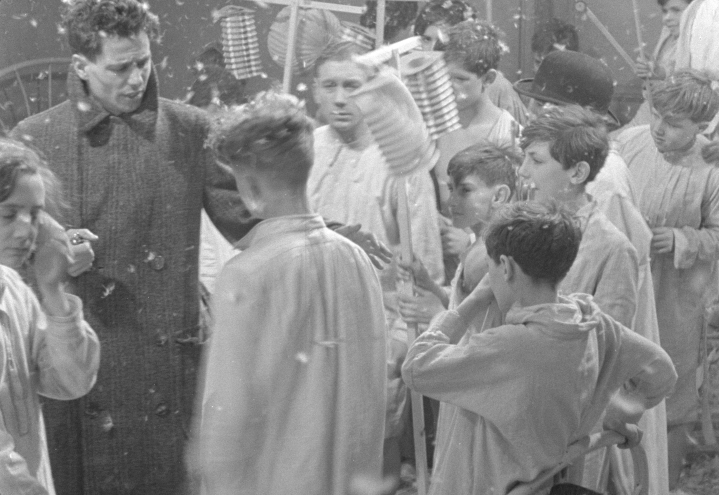
The next morning, while the rest of the boys sleep, the gang of four ties the sleeping Dry Fart to his bed and tilts it upright. As a few dislodged feathers drift down, they prop a lanterned cross in front of the snoozing teacher, creating a mock crucifixion tableau, and then tiptoe away.
At the commencement, the teachers are joined by priest and prefect; firemen provide entertainment by performing unremarkable gymnastics, and a row of grotesque dummies, refugees from a shooting gallery, fills out the review stand. From the roof the four boys rain garbage onto the officials below, provoking cheers from their classmates – and Huguet! Dignitaries run for cover, dummies topple, and the Jolly Roger, tossed down from the roof by Caussat, displaces the Tricolor with the exultant boys. The headmaster and his cronies get to the attic in time to see the four rebels climbing away on a roof ridge, their butts pointed pointedly at the teachers. The film’s last shot is yet another of Vigo’s indelible images: the now upright boys walk away from the camera, waving to their comrades below and ascending the slope of the roof toward a horizon of endless freedom. Tabard, on the far right, is beside Bruel.
In any other film of its era – or for decades afterward, and from France or Hollywood or anywhere else – a boy like Tabard could only be repudiated or rehabilitated: Either he’s the sissy who falls on his ass in the water/mud/paint and runs off crying for his mother while everyone laughs, or else he is officially pronounced to be one of the guys after all – and starts behaving like one. Neither happens in Zero for Conduct. Instead, Tabard stays true to himself and becomes a hero and a leader. By saying “MERDE!” to the teachers, he liberates the other boys, annihilating their belief in the grown-ups’ inviolability and igniting the rebellion.
From a contemporary perspective, the meaning is plain: The outsider status imposed on queer youth makes them the most ripe for revolution. Tabard’s ripeness is both political and emotional, and he utters what everyone else is thinking because the teachers have tried to drive a wedge between himself and his boyfriend. “The schoolboys themselves are the only real things in Vigo’s film: they and their feelings,” noted Parker Tyler. “The presence of the little homosexual, quite grave and hippie-haired, puts a finishing touch on the concept of love (whatever kind) as essential to individual freedom.”
Vigo’s conception of Tabard is detailed in the text of his screenplay: “Jules Bruel and René Tabard are very close friends and seem to be quite demonstrative with one another. There is nothing ambivalent about their relationship, however, and their feelings for each other are completely innocent. The school authorities are nevertheless keeping a watchful eye on the two boys.” In the scene of the Headmaster and Gas Snout observing Bruel and Tabard together in the rain, the screenplay comments, “To them, it is quite obvious that Bruel and Tabard are different from the others.” When Vigo spoke about the film in Belgium, he alluded to prototypes of the characters from his own school days, among them “Tabard whom we all called ‘the girl,’ Tabard who was spied on and persecuted by the school administration, when all he really needed was a big brother since his mummy didn’t love him.”
Does Zero for Conduct argue that only a creepy authoritarian would project queerness onto the relationship of Bruel and Tabard? If so, M. Viot then becomes the specter of genuine homosexuality, an adult vice in which Tabard has no interest. Vigo’s written comments describe his desire to settle the score for the injustices once suffered by “la fille”; his film, however, supports a very different interpretation. Tabard indeed rejects unwelcome, smarmy schoolteacher intimacies, but he also repeatedly accepts sought-after, affectionate schoolboy intimacies. Far more intense than any of the other friendships shown among the boys, the love between Bruel and Tabard is plainly not fraternal in spirit: They bond not through mutual identification but through the complementary attraction between a masculine boy and a feminine boy. As such, it is essentially a gay love, regardless of whether or not the boys are enjoying each other erotically. The relationship’s emotional depth, its gender variance, and the overt physicality of its expression all define it as queer. That isn’t all, however: Zero For Conduct also includes a privileged moment which legitimizes the assumption that Bruel and Tabard are lovers.
Like most smoking guns, this image turns up someplace it shouldn’t be, and when Vigo included it, he was gambling that the audience would fail to notice the presence of Tabard with Bruel. It was a shrewd bet too, because virtually every frame of his lamentably small output has been scrutinized for over half a century, and there’s no paper trail on this shot in Zero for Conduct: People literally do not see it.
Vigo had been contracted for a four-reel film, and when his initial cut of Zero for Conduct came in at five reels, he had to delete a thousand feet of footage (approximately ten minutes). This additional cutting intensified the episodic nature of his film, making it even more abrupt and quasi-hallucinatory. One sequence, however, was so whittled down by Vigo that all he had left was a single incident: a sleepwalking boy who wanders the dormitory at night. This moment of eerie beauty, much loved by commentators on Zero for Conduct, no longer fit in its original place in the middle of the film, so Vigo shifted it to the beginning and spliced it into the boys’ first evening in the dorm. He trusted that the spectacle of the sleepwalker would distract the audience from the error in continuity which his editing had introduced: Earlier in this sequence, Gas Snout stops in front of Tabard’s barren bed and is told by Dry Fart that the absent boy will be brought to school by his mother the next morning; nevertheless, Tabard is there with Bruel in the dormitory later that night, both gawking at the little somnambulist.
The sleepwalker is first seen in a medium close shot, sitting up in his bed, asleep but with his eyes wide open. Vigo then cuts to a full shot and the boy slips out of his bed and starts walking, with the camera tracking ahead of him. Throughout that 14-second full shot, Tabard and Bruel are plainly visible, cuddled together in Bruel’s bed, right alongside the sleepwalker’s: Tabard has his arm draped around Bruel’s neck, and both boys are in their nightshirts, like everyone else – it is well past lights-out, after all… In the concluding far shot of the sleepwalker traversing the dormitory and then returning to his bed, Tabard and Bruel can also be seen together in bed, albeit distantly. (You can always spot Tabard by his long hair, so unlike anyone else’s.)
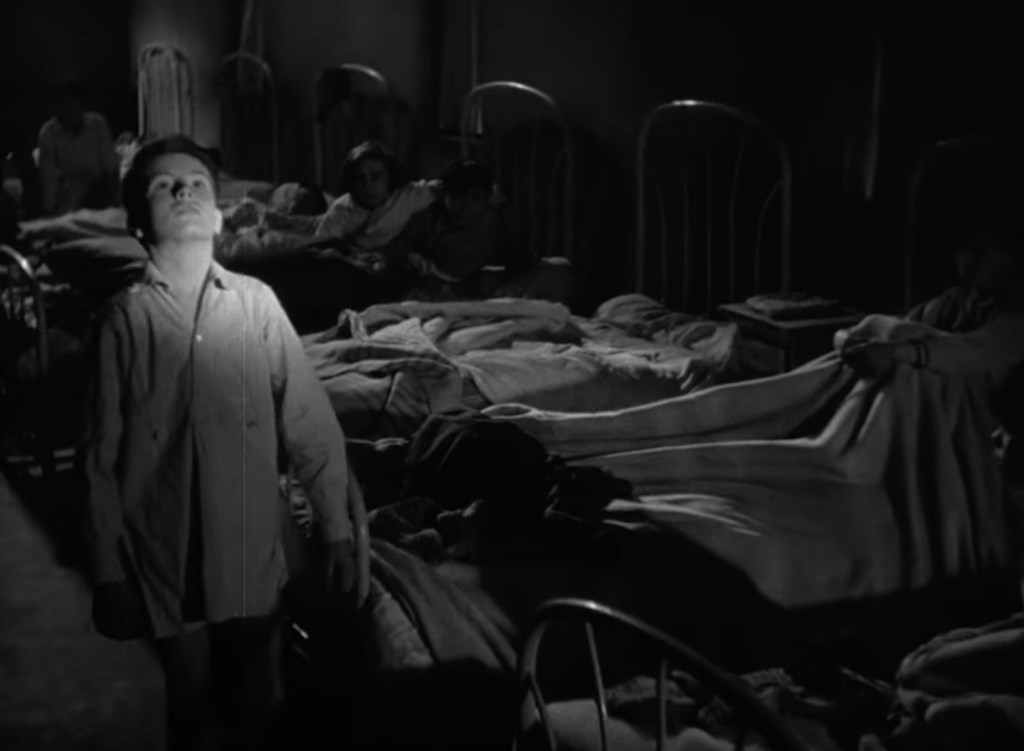
This scene was originally part of a sequence that had been situated after the Headmaster and Gas Snout catch Bruel and Tabard together in the rain, and before Tabard is called on the carpet by the Headmaster the next day. The screenplay text of the complete sequence includes this deleted bit of business, a not-so-metaphoric kiss between Bruel and Tabard: “Back in his bed, Bruel wants to reassure Tabard. Before bidding him goodnight, he pulls on the piece of chewing gum in his mouth and sticks the end bit on the tip of Tabard’s nose. Their lips and nose more or less stuck to each other, they exchange a friendly look. The Head Superintendent comes upon them at that moment.”
Had Vigo retained this scene, it most likely would have furthered the impression that the boys’ relationship is of the kind that was once termed “ambivalent,” and is therefore not “innocent” – unless you should happen to consider a spontaneous and loving erotic relationship between two boys to be the very definition of innocence. Honi soit qui mal y pense. And to Vigo’s eternal credit, Zero for Conduct encourages one to think well, politically and romantically.
On paper Vigo described a situation where it looks like a duck and sounds like a duck and acts like a duck but it isn’t a duck and therefore it’s OK; his film creates the situation where it looks like a duck and sounds like a duck and acts like a duck because it is a duck and that’s OK. To interpret Zero for Conduct on the basis of Vigo’s written remarks rather than the content of his film is to deny him his greatness as an artist. Zero for Conduct is epochal not just for the history of cinema; Vigo’s anarchic vision opens onto a new era of human possibilities because it fuels people to think beyond themselves – even beyond its own self, in the truest tradition of epochal utterance. When Thomas Jefferson wrote, “all men are created equal” in the Declaration of Independence, was he thinking, “all white heterosexual adult males who own property are created equal”? Probably. Is that what the Declaration of Independence means? Hell no.
Jean Vigo was 12 years old when the father whom he idolized was killed, and a year later, the delicate and sickly boy entered a boarding school in Millau, where he was bullied and harassed as the only Parisian among Southerners. Making this time worse was his fear, as he would later say of another schoolboy, that “his mummy didn’t love him”: His parents had never married, and after Almereyda’s death, Jean’s step-father obtained custody from the boy’s mother Emily Cléro. Vigo became increasingly estranged from his mother during his adolescence, while the legend of his father grew ever greater. One story he must have treasured was the account of how his father had changed his name. In 1900 the teenage Eugène Bonaventure de Vigo had been imprisoned as an accessory to theft – a harsh sentence meted out to him “because of the file on him as an anarchist,” according to Vigo’s biographer P.E. Salles Gomes. During his first stretch in prison he decided to shed his heritage of provincial Andorran nobility and adopt as his name an anagram of the scatological phrase “y a (de) la merde.” Jean Vigo also knew that, not long afterward, Miguel Almereyda had hung a banner denouncing the government, which read “JE VOUS DIT MERDE.”
René Tabard learned from the best.
(This essay, written in 2005, appears here for the first time.)
SOURCES
“I have never seen L’Atalante”
Conversations With Fellini, Costanzo Costantini, editor. New York: Harcourt Brace, 1995, p. 198.
“objective, subjective, fantastic, and subconscious reality”
James Agee, Agee on Film. Boston: Beacon Press, 1964, p. 263.
“The President of the Board of Censors told one of his friends”
Jean Vigo, The Complete Jean Vigo. Francombe, Godalming, Surrey, Great Britain: Lorrimer Publishing, 1983, p. 42.
“as an image of millennial, triumphant joy”
Agee, p. 264.
“The schoolboys themselves are the only real things”
Parker Tyler, Screening the Sexes. New York: Holt, Rinehart & Winston, 1972, p. 247 (Tyler’s emphasis).
“Jules Bruel and René Tabard are very close friends”
Vigo, p. 62.
“To them, it is quite obvious that Bruel and Tabard are different from the others”
Vigo, p. 73.
“Tabard whom we all called ‘the girl’“
Vigo, p. 44.
“Back in his bed, Bruel wants to reassure Tabard”
Vigo, p. 74.
“because of the file on him as an anarchist”
P.E. Salles Gomes, Jean Vigo. Berkeley: University of California Press, 1971, p. 10.
Link to:
Film: Essays: Contents
 NICOLE V. GAGNÉ