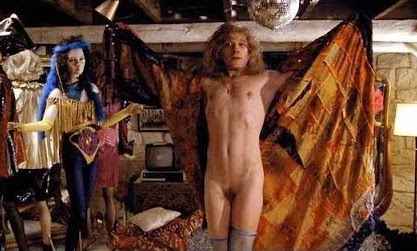
Lamb Chops with Panties: The Silver Anniversary of The Silence of the Lambs
As though taking the image of an arrowed heart literally, Valentine’s Day 1991 was the date of the world premiere of The Silence of the Lambs. Twenty-five years later, it’s worth taking a look back at a thriller that was met with near-universal acclaim – the far universe was then occupied mostly by angry LGBT activists who were appalled at the film’s transphobic and homophobic content. I’d like to set aside those considerations here, not because they don’t matter but because the points have pretty much been made. Anyone who still clings to director Jonathan Demme’s fig leaf – that the killer is “someone who is so completely, completely horrified by who he is that his desperation to become someone completely other is manifested in his ill-guided attempts at transvestism, and behavior and mannerisms that can be interpreted as gay” – need only substitute any other “other” in place of queerness to put the lie to it. Have the killer mimic Muslims instead of trans people, and then try to say that the film is not promoting fear and hatred of Muslims. Sixty seconds of scattered dialogue – “Billy is not a real transsexual,” etc. – cannot be as meaningful to an audience as the more than twenty minutes of intense visual imagery that depicts the killer.
Rather than flog that Demme, let’s consider what the film was supposed to have done well. The New York Times led the chorus of huzzas in 1991, lauding this “swift, witty new suspense thriller.” But of that entire string of adjectives, not one is appropriate for the film today. Of course it’s no longer new, but how anyone could have thought it witty remains a mystery – not many laughs in The Silence of the Lambs, unless Ed Gein is your idea of comedy. Swift the film is, yes, but not if you see it more than once. And as for suspense – the one adjective everyone has thrown at the film since its release – the problem with The Silence of the Lambs is that it is almost totally lacking in suspense.
Suspense was deliberately sacrificed on the altar of momentum. “Again and again,” according to the film’s writer Ted Tally, “both during our script work and later, during editing, [Demme] emphasized the supreme value of narrative momentum. ‘Better,’ he said, ‘to risk confusing the audience for three minutes than to let them get ahead of us for one second.’”
The Silence of the Lambs tells its story at two speeds, fast and faster, and when it gets faster, it’s usually trying to paper over a hole in the plot by misdirecting the audience. Such tactics, while diverting on the first bounce, just seem protracted and uninspired in a repeat viewing, and they drastically harsh the film’s overall tempo. The swift becomes sluggish: Once you know you’re watching people on a wild goose chase as they climb down an elevator shaft or surround the wrong house, those cutaways seem tedious. But you can’t ask an audience to believe that one lone FBI agent can find the killer’s house in Ohio, walk up to it, and knock on the door by herself, after everyone’s been knocking their brains out searching for him. It would come off as the last-reel cheat that it is, without the distraction of intercutting the FBI’s erroneous raid on a house in Illinois.
Even worse is the way Hannibal Lecter escapes from incarceration – the film’s shakiest example of velocity over intelligence. Lecter has (off-camera) killed his guard, switched clothes with the dead man, peeled off his face, and deposited the corpse atop an elevator. He is found lying on the floor as the guard and removed in an ambulance while the police hunt the elevator shaft for the corpse in Lecter’s prison uniform. The audience doesn’t know what has actually been going on until Lecter, inside the ambulance, removes his face mask and leans in to eliminate the EMS attendant.
The real-life question regarding Lecter’s escape is, How long would it take an EMS attendant to realize that the patient isn’t hurt? Eight seconds? Twelve? So the film dodges the issue by accelerating the tempo and intercutting the red-herring search.
The movie-life question regarding Lecter’s escape is, WWAHD? Alfred Hitchcock always insisted, “You can only get the suspense element going by giving the audience information.” The first thing Hitchcock would have done would be to let the audience know that it’s Lecter, not a wounded guard, lying on the floor. Then Lecter’s journey from the floor to the ambulance could be mined for two levels of suspense: the killer’s jeopardy at being discovered, and the cops’ and the EMS attendant’s jeopardy at being so close to this homicidal maniac.
Hitchcock and his writers would then have introduced moments of activity and uncertainty and luck and cop thickness and psycho slickness, all enabling Lecter to get on that stretcher and out of the building. In the film as it stands now, the elevator cutaways only shaft the audience with another instance of misdirection, like the climactic FBI raid. If intercut with this new scene of Lecter on the floor, all that footage could contribute its own suspense: How soon before these cops realize the corpse is the guard and Lecter is still in the building?
That’s how a genuine suspense film would have handled Lecter’s escape. Granted, a scene that could pack that kind of wallop, generating and multiplying its levels of suspense, would require a lot more talent and ingenuity behind the camera. But the result would have been a suspenseful scene that still worked the second time you saw the film – which is a lot more than can be said for the shocks of 1991.
(This essay first appeared on unicornbooty.com in February of 2016.)
SOURCES
“someone who is so completely”
Gavin Smith, “Identity Check,” in Film Comment, September/October 1991.
“swift, witty new suspense thriller”
Vincent Canby, “Methods of Madness in ‘Silence of the Lambs,’” in The New York Times, February 14, 1991.
“Again and again”
Ted Tally, “Ted Tally on Jonathan Demme,” in The New Yorker, March 21, 1994.
“You can only get the suspense element going”
Link to:
Film: Essays: Contents
 NICOLE V. GAGNÉ