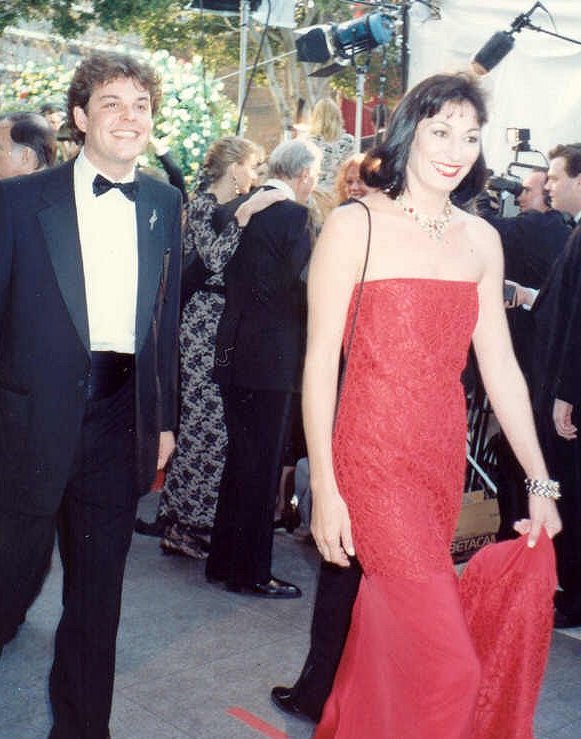
Interview with Danny Huston
Part One 11/9/87
Q: When will we be seeing Mr. Corbett’s Ghost here in the States?
HUSTON: It’s going to be released on English television the end of December, for the New Year. And after that, the producer is going to come here — he’s an Englishman — and he’s going to be doing some work with cutting the film down slightly; it’s got to fit a certain slot on television.
Q: Like 58, 57 minutes?
HUSTON: Exactly. So we’ve got to cut about a couple of minutes out, which shouldn’t be too big a deal.
Q: Just kind of bleed it out, or is there one little scene…
HUSTON: I think I can do it without hurting the film.
Q: Will this be for public TV or cable?
HUSTON: It’ll be for public television. It’s in the New Year’s, Christmas spirit, so it would be the following year.
Q: Well, that’s the perfect thing for it; it could have legs indefinitely if it’s released around that time.
HUSTON: That’s right. That’s what we had in our mind before we made it. A sort of Christmas Carol-type of thing.
Q: Both Corbett and Bigfoot were made with the television screen in mind. I’m curious if, in putting together Mr. North, you were very deliberate in trying to do something more appropriate for a film theater, or was there an eye toward distribution on cassette and television?
HUSTON: When I made Mr. Corbett’s Ghost and Bigfoot, one of my “selling points” was that I wasn’t going to make another television film. It would be made in the style of a feature film. I don’t really see why television has to be reduced in any way to a different form than cinematic features. Especially with Mr. Corbett; more with Mr. Corbett than with the Disney picture, because the Disney picture had more restrictions.
Q: In the sense of less time?
HUSTON: Less time, and more… Mr. Corbett’s Ghost was an independent picture; Disney was a studio, TV picture.
Q: People were looking over your shoulder more?
HUSTON: Right. And there were certain requirements that weren’t fair to argue, really. With Mr. Corbett’s Ghost, I really shot it as if it was a feature, and as if it would be shown on the screen. And in a sense, that’s caused a little difficulty as far as getting it on TV.
Q: In what way?
HUSTON: In that the length isn’t absolutely correct; and a lot of the film is very dark. So I’m going to have to fix those few little things for American television. So I don’t feel as if I have any particular style for TV or for television, or I differentiate.
Q: What is Mr. North about?
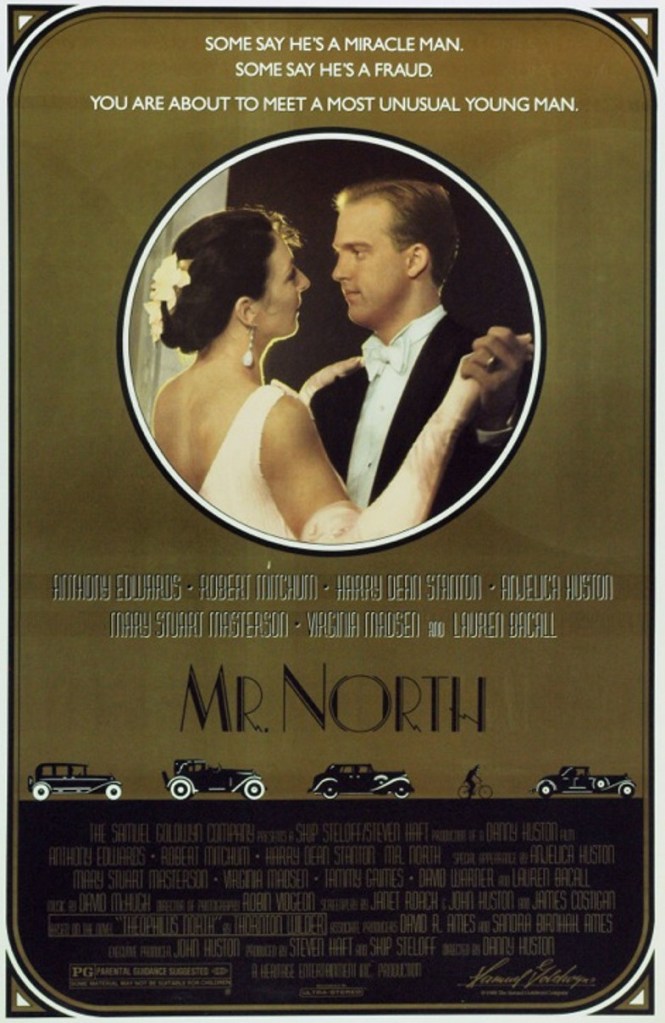
HUSTON: Mr. North is set in the 1920s. It’s about a man who comes into Newport, and he reads aloud to both the elderly and the young. And he has a strange quality about him, that is that his hands are electric. And this causes a little chaos, and some people think he’s a saint, some people think he’s a healer.
Q: You mean, if somebody takes him by the hand, they actually feel the electric current, or get a shock?
HUSTON: Correct. And this causes a little chaos and drama in this very civilized, structured town of Newport.
Q: Do you consider the film basically a comedy, or is it working in a broader generic sense?
HUSTON: There’s a lot of comedy in it; yes, I could consider the film a comedy.
Q: How did you select Anthony Edwards to play Mr. North?
HUSTON: I looked at all the young actors that were around. We had to find somebody who had worked before; we couldn’t look for an unknown. And I thought that he would be the perfect person. He’s a teacher, he’s been to Yale. It’s 1920s, he’s very witty, there’s a lot of very fast dialogue. And Tony Edwards seemed to be the perfect person.
Q: He’s done comedy before, hasn’t he? Sure Thing was a comedy.
HUSTON: That’s right. And he’s got very good timing.
Q: Is he in most of the film?
HUSTON: Yes, he certainly is. He carries right through it.
Q: To what extent were you in on the writing of the screenplay with your father and Janet Roach?
HUSTON: The way that started was that I gave the original script to my father, and I said, “I think this requires two things: One is for you to play the character of Bosworth, and the other is quite a big rewrite.”
Q: When you say the original script, do you mean your own adaptation of the novel?
HUSTON: No, there was an adaptation of the novel floating around, which I got my hands on.
Q: Was this a project that you had been wanting to film for a while?
HUSTON: No, I discovered the script while I was doing the Disney picture. And so it was the script that seduced me more than the book; after reading the script, I read the book — it was that way around.
Q: I’ve read in an interview with you where you said the plot was hard to nail down in the book.
HUSTON: Exactly.
Q: So the script had done some kind of a condensation job, but not a sufficient one for you to get started on a film.
HUSTON: Right. It’s Thornton Wilder’s last book, and Dad and Janet both suspect that he would have edited it, and it would have been a different book, had Thornton been still alive when the book would have been published — because the book was published after his death. And so I think they translated it very faithfully; but it’s certainly very different to the book.
Q: Will there be more writing on your own part to come? Are you interested in getting more involved in actual scriptwriting?
HUSTON: Yes. I don’t want to write a script from scratch and direct it, just right now, because I don’t want to be too bogged down by my love of the actual writing. I’d rather be in love with the material, if you know what I mean. And so I’ll give that a couple of years.
Q: Did you ever have to bring the script back to your father and Janet Roach, and say ‘This isn’t the way I want it to go,’ or was it just right?
HUSTON: After they delivered the first draft, very little work, but there was some. We just all read the script together, and we all had our own comments to make, and we worked on them. No arguments or friction of any kind.
Q: Was it a question of them promoting a package to be filmed, or had enough money been raised so they could start working on the script knowing it would be filmed?
HUSTON: Both things happened at the same time. Dad and I went to several meetings. One of the last was with Heritage Entertainment, and Skip Steloff agreed to do the picture. Literally, Dad and I were on the road trying to raise the money for the picture as it was being written. And the package was Dad playing Bosworth, Anjelica playing Persis, and Janet and Dad writing the script. That was the whole strength of it.
Q: And your father as executive producer as well.
HUSTON: Correct.
Q: Which would really have involved what?
HUSTON: What I’m saying, basically.
Q: Will Heritage be releasing it themselves, or is there another distributor lined up?
HUSTON: There is a distributor lined up, and I don’t know whether I’m allowed to actually say it, because I think they’re negotiating right now.
Q: Had Robin Vidgeon done other films?
HUSTON: He did Hellraiser, that’s just come out. And he was Dougie Slocombe’s focus puller for many years. That’s where he got his training. After he shot Mr. Corbett’s Ghost, I fell in love with him! And my father wanted him for The Dead, and he couldn’t get him because Robin is English and there were some union problems. So immediately we tried to do everything to get him on Mr. North. And since it was Rhode Island, for some reason it was easier.
Q: Rhode Island as opposed to California, you mean?
HUSTON: I don’t know; maybe we shouldn’t be too specific about that. But I guess the unions in the East Coast are more sympathetic to English cameramen coming in than in California — but I guess we shouldn’t get too political here!
Q: Can you tell me what it is about his look that made you feel he’d be right for Mr. North?
HUSTON: Yes, he’s very bold in his lighting; he’s very straightforward, and gets a very good, clean effect. That’s one of his major attributes. The other is that he’s very fast: We shot Mr. North in six weeks; Mr. Corbett’s Ghost we shot in about four-and-a-half weeks.
Q: Both Roberto Silvi and Tommy Shaw worked on Mr. North as well.
HUSTON: Correct; they’re old-timers.
Q: Neither of them are slowpokes either!
HUSTON: No.
Q: In working with so many people who had worked together on other projects, did the film ever start to get away from you at all?
HUSTON: Oh, no.
Q: You were still able to keep a rein on everything.
HUSTON: Yeah, very much so. And I had a great, great team behind me, helping me along all the way — only pushing me forward, not taking the film and running with it themselves and leaving me behind. And they helped me a lot under the stress of my father’s illness; I had not only a team but a family, in a sense, helping me along the way.
Q: That’s very beautiful, because the film in essence is a family project to begin with.
HUSTON: That’s right.
Q: And to be able to open it up into a larger family atmosphere in which to make it is very special. You’re quite fortunate.
HUSTON: Extremely lucky, and I only hope I can keep on working this way. You know, with the help of my sister. My brother, the writer — he just did The Dead. So I think we can form a good little Mafia.
Q: I was curious if you had anything up your sleeve about working with Tony.
HUSTON: There’s nothing we’d all like more than to work together. It seems almost the only way, to all of us. And another thing that you get is that you have a lot of power in that way. Because if your actor is your family, if the writer is your family, and the director is your family, it’s very hard for anybody to get in the way, as far as the studio, or as far as another opinion is concerned.
Q: There’s a united front, in other words.
HUSTON: Precisely. Which is very hard to break down. Exactly, a united front.
Q: Was there any resistance to your age as a director, particularly on Mr. North?
HUSTON: No, I don’t think so. If there was, I never knew about it. The way I use my age to an advantage is that I’m more in touch with youth, and I know what the majority of the public wants. And you have Spielberg who’s an example of that; you have Orson Welles, who directed Citizen Kane when he was 25.
Q: It’s obviously not a bad time for a younger person to get a gig as a director, but it can still be problematic in actually working with crews or with actors.
HUSTON: Right. And I had all the great old-timers. I worked with Paul Scofield on Mr. Corbett’s Ghost, who was ever so kind to me. And everybody on Mr. North, Mitchum and Bacall, have great, great love to my father, and a lot of respect, and that respect came down to me. So I never had any problems of trying to prove that I was older or an authority figure.
Q: I had heard that your brother and your father were working on a script called Revenge, and then I saw in Variety that a similarly named film was being done in Mexico, only not the same script.
HUSTON: Yeah. I’m not quite sure what’s happened to that script, but I think it’s on a sad note. They might be re-writing it, or doing something completely different with the same story. And it was a very, very good script, a very powerful script, a very violent script. And to change a script that’s written by my father and Tony — and Dad spent a lot of time on it — to change it I think is just a crime. But so it goes.
Q: I read that you did not only the titles but second-unit work on Under the Volcano.
HUSTON: That’s right.
Q: Can you tell me what second-unit footage of yours was used in the released film?
HUSTON: It was some stuff with some children. There was a dog in a graveyard, which I got ahold of. Just tiny little things like that which they needed done; they were more pick-ups than second-unit.
Q: We’re really talking more about inserts for certain scenes.
HUSTON: Exactly, exactly. That and the titles, which, you know, I just got a whole bunch of papier-maché dolls.
Q: Did your father approach you to do the titles, or had you done this and then showed it to him?
HUSTON: No, he approached me. There was somebody else who was doing the titles, and he didn’t like it. And the lights went on in the screening room, and he turned around and he said, “Danny, why don’t you do them?” Which was kind of a shock! And I went ahead and took the challenge.
Q: And what we see in the film is the way you shot it, from beginning to end?
HUSTON: Yes, edited by who else but Roberto Silvi.
Q: Those are dazzling, and they kick off the film perfectly.
HUSTON: You like them, huh?
Q: Oh, sure! Well, that’s one of my favorite films to begin with.
HUSTON: We put the papier-maché dolls in the lobby of the hotel, and hung some black velvet, and had a camera on a little arm, tracked right through them, and that was it.
Q: Were the dolls built for this, or had you just gone out and bought ones that you thought would work?
HUSTON: They’re made in Mexico City by this woman who’s a very good artist, and who in a sense has taken these little dolls from the Day of the Dead and taken them a step further, as an artform. So they are made by an artist.
Q: And so some are more stylized than you’d normally get.
HUSTON: Normally get, exactly.
Q: But it was not a commissioned thing for ones you wanted to use specifically for the titles.
HUSTON: No, they were all very, very much part of Mexico: They have, you know, the skeleton figures are the postman, the newlywed, the drunk, the cop — the whole village life, but they’re all skeletons.
Q: What do you have up your sleeve for your next project?
HUSTON: Nothing that I can give you the title of, but I’ve got a few things that I’m just jiggling around. And I’ll have them more pinpointed, and hopefully start to get some off the ground, as I finish this picture.
Q: What still needs to be done on Mr. North?
HUSTON: Release is this spring. So there’s the music, and still a lot of the editing; I haven’t seen the film in one sweep yet.
Q: Who is going to do the music?
HUSTON: I’m not sure yet.
Q: Mr. North is so much a family project, are you afraid it may be hard for people to see it as your own work?
HUSTON: I don’t know; I hadn’t really thought of that. No, I don’t think so. As a director, all I feel is my job is to interpret the material in the best way, in the best taste. And I believe that’s all I’ve done. So I feel confident that it’s my piece, yes.
Q: It’s fascinating to think of a film that brings together so many different generations of Hollywood.
HUSTON: That’s right, exactly. I like the spirit of that a lot. You know, having people like Mary Stuart Masterson, who I think is an incredible actress, and Bacall, in the same picture, gives me a kick!
Q: The press kit says you wound up on location for most of your father’s films, ever since you were able to walk.
HUSTON: That’s true.
Q: You’ve really absorbed film in just about every way someone could, not only by seeing it but also by being around the actual making of it.
HUSTON: Exactly. And then, with all that experience, I went to film school for two years in London.
Q: Did you feel that that was helpful, or could you have already taught and made films by that time?
HUSTON: I thought it was very helpful, because I actually got my hands on the film, and made two or three films of my own at the film school. It was a very practical school, in the sense that they literally threw the equipment at you and said, make your film. And I had a wonderful time, too, for those two years, so I thought it was very important.
Q: Are the films you made there something you now keep in the closet, or are you interested in promoting them too?
HUSTON: No, I’m interested in promoting them. They’re student films, but I’m proud of them. They’re all fiction, about ten minutes length, but quite professionally done, with all the right equipment and everything. They’re good little mystery stories.
Q: Is it true that your father made a documentary on Giacomo Manzu?
HUSTON: I don’t think so.
Q: That’s what your Heritage bio says. And if there’s a Huston documentary floating around that I haven’t seen, I want to see it.
HUSTON: I haven’t seen it. I would love to see it, if that’s the case. I know that my father — I spent a lot of time with my Dad and Manzu, and I never heard that brought up.
Q: Manzu had worked with him on The Bible.
HUSTON: On The Bible, exactly: Adam becoming man. And you know what’s incredible? I think Manzu was almost Dad’s best friend. And Manzu didn’t speak English, and Dad didn’t speak Italian!
Q: That’s the best way to have a friendship!
HUSTON: Isn’t it? They seemed to understand each other in the depths of their souls.
Q: So you think this documentary is a figment of somebody’s imagination over at Heritage?
HUSTON: I honestly don’t know. I’ve never heard of it, so it comes as just as much of a surprise to me. I’m going to find out about it, though. You just stand by, and I’ll find out all about, because I’m extremely interested in it. It might be true, and if it is true I’d love to see it. Let’s see it together.
Q: You have a date! Wherever it is, I will be there.
Part Two 11/19/87
Q: How did yesterday go?
HUSTON: Very good. Excellent — I couldn’t be happier, actually.
Q: That’s really good. Will there be further editing do you think?
HUSTON: Yes, tiny little adjustments. But that’s about it. I think it’s a good piece of work.
Q: It still doesn’t have a score yet.
HUSTON: No.
Q: Is somebody lined up yet?
HUSTON: Not yet. There will be in literally a couple of days.
Q: Is the distributor set up yet, or is it still shrouded in mystery?
HUSTON: It’s a bit of a mystery. They’ve got three major distributors lined up, and I’m not sure exactly who’s up on the top of the list. I think we’ll know all these things very soon.
Q: What was there about your sister that you wanted her for the role of Persis?
HUSTON: Well, my sister has an elegance and a beauty and a mystery about the way she looks and the way she walks and behaves, which we knew would be perfect for the part. The character is a woman who is a widow, extremely beautiful and unreachable — for our main character in the story. He catches glimpses of her as the film develops, and gradually falls in passion with her. Finally, towards the end of the story, he has this final dance with her, in a ball scene. We thought that she had this richness and elegance about her that would be absolutely perfect for the part. It’s quite a small part, as far as actual screen time, even though the film almost pivots around it. And I was a little concerned about the length of it, and I told Dad about that, and his answer was, “Anjel’s doing for you what my father did for me in Maltese Falcon” — which was a little cameo performance which helped Dad get the film made. So that sold me on it.
Q: You had been hesitating about offering her a part which was too small for her at this stage of her career?
HUSTON: Exactly. Even though it’s a very elegant and beautiful part, it wasn’t the kind of thing she’s used to recently.
Q: I had wanted to ask if, in light of her working so much in the last few years, it was hard simply to get her, but because the part was short, it wasn’t much of a problem.
HUSTON: Right. Even though she was there throughout the whole shoot – it wasn’t that she just flew in and left. She was there right through the whole shoot. And I must say, when we negotiate between the family on any kind of business issue, it’s all very professional. I asked her if she was interested in it, and she said yes, she was interested in it, and she was waiting for the re-write — which was being written by my father! — and when the re-write came in, she read it, she liked it, and she agreed.
Q: Plus you all have the same agent, I take it!
HUSTON: We don’t!
Q: You don’t work with Paul Kohner?
HUSTON: No.
Q: That’s interesting.
HUSTON: We don’t have the same agent. That is interesting, I hadn’t thought of that!
Q: Corbett, Bigfoot, and Mr. North all have strong fantasy elements. Is that almost a deliberate thing at this point, do you think, or is it more coincidental that all the films so far have used as a central device, a fantastic element?
HUSTON: I like an element of magic in a film, because I think film can really exploit that side in storytelling. To have a very subtle element of magic in a picture takes you beyond, into another world — which is a great feeling to have when you are witnessing a film. So it is deliberate, but in no way do I feel that all films should have that element. And it’s not exactly what I’m looking for when I read a script, but it does give a film a charming quality, which I think is very nice to have up there on the screen — that little magical touch.
Q: Film is one of the few media where you can give that kind of activity as much realistic weight as regular people walking and talking and living their daily lives.
HUSTON: Exactly. And if you want to do anything realistic, if you just have something which takes you beyond, a little bit, then really you have a lot of freedom to express other things that you might think are more realistic.
Q: You give them more emphasis, greater force, by setting them alongside the more unrealistic or fantastic elements.
HUSTON: Right, exactly. I agree completely.
Q: Was Mr. Corbett’s Ghost the last film your father acted in, or did he do Momo after it?
HUSTON: No, he did Momo just before it. So it was the last film.
Q: I understand that he had made arrangements with Robert Mitchum to replace him, if the need arose, on Mr. North.
HUSTON: Yes, he did. He called me when I was in Newport, and he said, “By the way, not that anything’s going to happen, but if anything does, do you think I could give Robert Mitchum a call and have him read the script, and stand by?” And I said, “If it’ll put your mind at rest, absolutely. But I just want you to know that it won’t be necessary, and I have all the confidence in the world that you are going to do this.” And he went ahead, made the call, and then when he was in Newport there was a whole week of readings where he was in great health, and we rehearsed and everything. And then the first week of shooting he wasn’t feeling too good. He asked me to call Mitchum, and I did, and Mitchum was there the next day. So it really demonstrated the professional quality that Dad has when he makes pictures, and the way he covers himself. It was just fantastic.
Q: Also the affection and loyalty he can exercise on certain people; to get an actor of Mitchum’s caliber to just show up like that, to make a commitment and then hold off on other things until he knows one way or another.
HUSTON: Exactly.
Q: So then you actually shot some footage with your father?
HUSTON: No, I didn’t shoot any footage with my father. Since he wasn’t feeling too good we delayed it, and then he checked into the hospital. And when he did that, I called Mitchum and he came to Rhode Island. And Dad was very happy about Mitchum. He had great respect for Mitchum.
Q: I understand that the film unit really did not shut down when your father passed away.
HUSTON: No, absolutely not. I think we started an hour late.
Q: Wow, that’s extraordinary. You folks should be proud of yourselves.
HUSTON: Yes, it’s exactly, I mean, I felt it would be just exactly what Dad wished it would be. To stop or to mourn or to have been like that wouldn’t have made him happy at all.
Q: To put your work on hold after all this would just have been a waste.
HUSTON: Exactly. And all that he’d put into it. That’s why we had to keep going.
Q: Was there a problem in getting the actors as revved up as they ought to be on a day like that, or on subsequent days after his passing?
HUSTON: No, not really. It seemed that dedication, and respect for Dad and everybody’s devotion increased, and things went only better. I had great support around me, in every way. Obviously, the circumstances were very sad, but I couldn’t have wished for people to behave in any better way, as far as their support and their love for my father passing down to me. And the respect they had for me. It was a very special moment, really. You know Tommy Shaw, who worked with Dad for a very long time as Production Manager, was on Mr. North. When Dad was shooting The Dead, there was one day where he wasn’t feeling all that good, and Tommy was in his hotel room, and Dad said, “You know something, Tommy, I’ve never taken one day off work in my life.” And Tommy said, “Oh well, you know, that doesn’t impress me, that doesn’t matter; you should rest today.” And of course, Dad didn’t, and he went on the set and worked. It’s just incredible the amount of pride he took in that; again, it’s just an example of pure professionalism. Which is something I really learned from Dad. It’s inspiring. And that inspiration helped us go through the hardship of it all.
(Excerpts from these two interviews appeared in The Film Journal, January 1988.)
Link to:
Film: Interviews: Contents
For more on John Huston, see:
Film Dreams: John Huston
Film Essay: Orson Welles and the Other Side of Nicholas Ray
Film Essay: Where Is The Other Side of the Wind?
Film Review: The Dead
Film Review: Under the Volcano
 NICOLE V. GAGNÉ