Britain’s Jarman Unveils Portrait of Wittgenstein
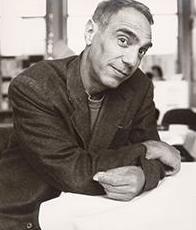
Over the last 20 years, writer-director Derek Jarman has achieved near-legendary status as one of the most controversial and confrontational filmmakers England has ever produced. His films Sebastiane, Jubilee, The Angelic Conversation, The Last of England, The Garden, and Edward II have all been full-scale assaults on conventional pieties of sexuality, social order, and artistic form. But with Wittgenstein, an investigation into the life and ideas of the Viennese philosopher Ludwig Wittgenstein, this provocative artist has made a work of sublime lightness and fascination – maybe the one Jarman film all your friends could enjoy. The Zeitgeist Films release is currently playing in select cities and will continue to roll out in 1994.
Despite ill health, Jarman recently made the trip from England to attend the New York Film Festival premiere of his most recent film, Blue, a personal memoir in which the only visual component is a hypnotic blue screen. A few weeks before his Manhattan appearance, he was kind enough to speak by phone with The Film Journal about his effort to bring one of the most formidable thinkers of the 20th century to cinematic life.
Q: There’s a passing reference to Ludwig Wittgenstein in the published script of Edward II. You say that “Wittgenstein thought [Shakespeare] second-rate compared with Michelangelo or Beethoven (though Wittgenstein could be seen as a mere stutterer).” Have you ever seen him as a mere stutterer?
JARMAN: Oh no, no, never. I think he’s bright as a berry, as they say. He’s not a stutterer.
Q: Was Wittgenstein a long-standing interest of yours?
JARMAN: Not really. Tariq Ali, who produced the film, asked me to do it. So it was one of those ones. He rang me up and he said, “Would you like to do a little film on Wittgenstein?” So I said, “OK, yes, all right.” And then the British Film Institute came in and turned it into a little feature – before, it was just a television film. They were doing a series on philosophers, of which Wittgenstein was one.
Q: Will this film be shown theatrically in England or is it for television?
JARMAN: Both. Wittgenstein was shown theatrically last year and was very successful. Everyone liked it. In fact, it’s still showing.
Q: Could you break down the contributions to the script which were made by you, Ken Butler, and Terry Eagleton?
JARMAN: It’s about a third each, I should think, when all is said and done. It was originally Terry Eagleton’s script, but we would have never been able to make a film out of it, with the amount of money we had and the situation. So I rewrote it with Ken – which did lead to a bit of a fracas.
Q: Was Terry Eagleton’s script more of a straight biopic about Wittgenstein?
JARMAN: Yes, it was very straightforward – straitlaced. There is a book of it all you know, both his script and our script. You should snatch that up, because it’s probably easy then to see what happened.
Q: In the film, John Maynard Keynes tells a fable about a man caught between the earth and a world of ice.
JARMAN: That was Terry Eagleton. Terry wrote that story and I liked it, so it went in. It was in the middle in the original script, but I put it at the end, you see. It was a good end; it seemed a very good summary for the whole film, you know?
Q: Were you at all hesitant about putting words into Wittgenstein’s mouth? Did you try to have him say only things he’d written or had said to others?
JARMAN: I did, more or less; there were one or two things.
Q: There’s a moment where Wittgenstein tells Lady Ottoline Morrell, “Everything will be different in the future… We’re mutating.” Is that an actual quote?
JARMAN: I think that is a quote from him. It’s difficult for me to tell you – I honestly don’t remember. I read the Wittgenstein, wrote the script, and quite honestly what is Wittgenstein and what is Terry or me or Ken, I’m not really certain any longer, you know? But I suspect that’s probably Wittgenstein; it’s probably a direct quote.
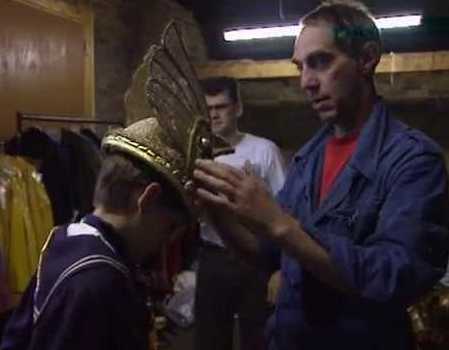
Q: When you introduce the Wittgenstein family at the start of the film, they’re all dressed up in Ancient Roman garb.
JARMAN: I sort of thought that Vienna at that time must have been like the end of the Roman Empire, do you know what I mean? I don’t know, I said, “What are we going to dress them up in?” I either had to get them into proper costumes of that period, or do something for fun. So we decided to do something for fun, as if they were at some sort of family party, you know, some family theatrical. The Roman thing gives you that feeling of the end of something.
Q: Karl Johnson does a spectacular job as Wittgenstein.
JARMAN: Karl’s very good, isn’t he?
Q: His crises regarding philosophy versus manual labor become a true spiritual dilemma, and not just naïve Romanticism or some neurotic projection. Was it particularly tough for you to dramatize this conflict and make it seem genuine?
JARMAN: I don’t know. I think we felt our way through the film. There were no plans for it, particularly – there wasn’t enough money to have all sorts of ideas of, “We’ve got to do this, that, and the other.” I think the whole thing was just sort of very carefully… We just looked to see what resources we had and did it. Then certain things came out a certain way, and others, others. You know what I mean? But I don’t really believe we had a plan, or even a notion of how the film would actually end up.
Q: Was there much improvisation in the actual shooting?
JARMAN: Not particularly. What happened was, it found its way of being, if you see what I’m saying, and so then we just did it. You know what it’s like in a film: The first couple of days are all over the place, but after that it settles down. Then everyone knows what we’re doing. I think this film was like that.
Q: Ken Butler was also your associate director on Wittgenstein. Did he direct any of it?
JARMAN: No, he didn’t want to. I suggested he did, but he said it was too complicated. He’s very good at scripts and things, he’s a film student – just graduated a year or two ago – and he’s a filmmaker as opposed to someone working in films.
Q: With this film, were you concerned about not including anything that could be censored or seen as objectionable?
JARMAN: I don’t think there’s anything in the film that could be censored or objectionable. It was for television, and it would have been very mad to have made something which had to be cut out.
Q: But The Garden was for television as well.
JARMAN: Yes, but not specifically, in the sense that Wittgenstein was an actual commission as part of a series of small television films. I don’t think anyone was too worried about what I was doing. But if I’d had to curtail something – although I didn’t – I would have done it. I’ve never done that before, but I would have done it in this case because I like the commissioning editors very much. They turned out to be incredibly charming. So if they’d said it was going to be really difficult for us to show whatever I might have been doing, I would have listened. I think films are like that. You do all talk about them and then they get made.
(This interview first appeared in The Film Journal, October/November 1993.)
Link to:
Film: Interviews: Contents
For more on Derek Jarman, see:
Book Review: At Your Own Risk
Film Review: Edward II
Film Review: Wittgenstein
 NICOLE V. GAGNÉ