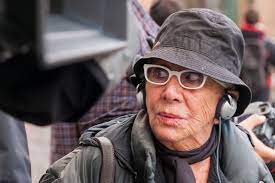
Wertmuller Back After Five Years With Comic Joke Of Destiny
When the films of Lina Wertmuller arrived from Italy in the 1970s, she meteorically became one of the most admired, controversial, and talked about filmmakers of the decade. Her fables of sexual and political exploitation were enthusiastically taken up here: The Seduction of Mimi, Love and Anarchy, Swept Away, and above all Seven Beauties, perhaps her finest film, a nightmarish saga of the triumph of survivalism over humanity. The films deftly and shrewdly counterbalanced savage comedy, comic-book grotesquery, and the appealing humanity of Giancarlo Giannini, her favorite leading man. But with the indifferent reception of her last two films, A Night Full of Rain and Blood Feud, the word-slinging about Wertmuller’s importance as an international filmmaker abruptly dropped off. Wertmuller herself indirectly contributed to this lull by waiting almost five years before making A Joke of Destiny. This new film hasn’t rekindled the rhetoric that greeted her earlier work, but nothing could: The trendy never cast lightning bolts twice at the same target. But Wertmuller is one of the supreme ironists of the cinema, and so she should relish the joke that one of her best films is being received cautiously. That’s also the standard reception for artists who decline to rework earlier formulae. A Joke of Destiny is an expert farce; the action continuously accelerates and is dense with funny, sharply delineated characters. Her obsessive themes – enslavement to illusion, the good-intentioned journey to disaster, the gender gap – are still present. But the imagery is new, and as vivid and disturbing as any she’s created: a major politico sealed in his super-duper terrorist-proof car, writhing soundlessly as bumblers struggle to free him.
The Film Journal spoke with the lively and engaging filmmaker during her brief stopover in New York. (Special thanks to Vivian Treves, who acted as translator during the interview, and to Frank de Falco, who helped prepare this article.)
Q: You co-authored the screenplay of A Joke of Destiny with Age [Agenore Incrocci]. How did that collaboration come about?
WERTMULLER: I wrote A Joke of Destiny – the first time – by myself, five years ago. Then I worked a little with Silvia D’Amico Bendicò. Time went by and nobody would make the picture, because they were afraid of me for various reasons. The producers prefer a little more “quiet” – my producers are always afraid. You need patience, like with terrified old uncles who only want to sell socks. So a companion tranquilizes them.
I now prefer this kind of arrangement. If I have a friend, a companion to work with me, I’m very happy. I have no problem of megalomania! I know Age very well; he’s a very good scriptwriter. Age-Scarpelli are like a father of Italian movies. I was very happy he and I worked together.
Q: Comedy was the forte of the Age-Scarpelli team. Was a good deal of Age’s contribution jokes or gags for A Joke of Destiny?
WERTMULLER: Not exactly gags. The tradition of Age-Scarpelli was “Comedy Italian Style.” I think my movie’s very different from Italian comedy. My work is never “comedy.” It’s funny, it’s grotesque, it’s ironic, it’s hard, it’s strange, it’s too much, but not only “comedy.”
Q: Your two films, A Night Full of Rain and Blood Feud, were not as successful in America, critically or financially, as the films that preceded them.
WERTMULLER: I think the problem came about because I was not as free to make my films. I wrote certain films that I like very much, and which I’m sure the public would have liked. But the producers didn’t like them. (I think that even the films that have had success in America would not have easily found producers in America.) Those two films were born when the big studios came in. They weighed very heavily on me, they blocked me; either we agreed or we couldn’t work together. They never wanted to make the films that I wanted to make. Time went by and I allowed myself to be convinced by my desire to work. I’m used to working, I don’t know how not to work; it’s a tremendous vice. They took advantage of this, and they damaged me greatly. But I’m a tough little soldier!
I allowed myself to be convinced to make A Night Full of Rain, which told the story of a crisis in Italy. But it lost some of the irony, so I agree with the public’s opinion. Not so the other; that’s another type of film, and for me I was completely successful. I wanted specifically to make a melodrama, to take Sophia Loren and transform her into a melodramatic character. I couldn’t use the Sophia of Bread, Love and Dreams, all happy and Mediterranean. I was taken by black; I wanted to tell the story of a black woman, a black spider from the South.
Q: A lot of your films deal with failed and inept terrorists: Pedro in Seven Beauties, Tunin in Love and Anarchy, and now Gigi in A Joke of Destiny. Do you think most terrorists are clods, and only a small minority get into the newspapers?
WERTMULLER: No, I’m not thinking that. What bothers me most is how a fragile young boy, an ignorant person, can be captured by a beautiful ideology where a pistol in his hand makes him an assassin. I’d like to solicit the sense of responsibility of those who arm the hands of children, with a syringe or a gun.
In A Joke of Destiny I describe all characters who are failures. The protagonist, the politician, is not a great politician; he was a professor who was swept away by a career. He’s failed as much as the terrorist has failed. They followed some images and betrayed themselves. The politician’s wife falls in love with the idea of a hero, and so this poor boy becomes a terrorist. It’s in the eyes of the “radical chic” bourgeoisie that young people have found this association of heroism with terrorism. It was a great inebriation. Speaking of it without irony, there were some great men that I knew: a journalist, very social-minded; a judge who was a just man, a wise man; a colonel of the carabiniere, a very proper person. Many friends, who have all been killed by these boys, whom I have pity for, but they give me great rage and pain. I’ve always had a great tenderness for the victim of this, which each one of us could be.
Q: Do you remember what you did as assistant director on 8-1/2?
WERTMULLER: I was in profound admiration of Federico [Fellini], who was an extraordinary presence: very enriching, an artist at work. He’s beautiful. He almost had me do nothing. The truth with Federico is that he runs, followed by the whole crew and the whole production; he runs to not let anybody know what he wants to do. And everybody’s running desperately behind him, trying to find out! So he gives false information to get them out of his way.
Q: You’ve been quoted as saying that you believe very profoundly in the concept of the growth of man.
WERTMULLER: Yes. I believe only in this. I hope only in this.
Q: Where would you say that belief is expressed in your films? Who grows in the films?
WERMULLER: No one. That’s why I said, “I hope.” However, in all my films, there is someone who speaks about this. But bad growth, false growth is the true theme of all my films. You have the feeling of having become a civilized man, but you’re not. This is the true theme of all my films – also of A Joke of Destiny. I’ve always made the same film, that one film, all my life.
(This interview first appeared in The Film Journal, November 1984.)
Link to:
Film: Interviews: Contents
For more on Lina Wertmuller, see:
Film Review: Ciao, Professore!
 NICOLE V. GAGNÉ