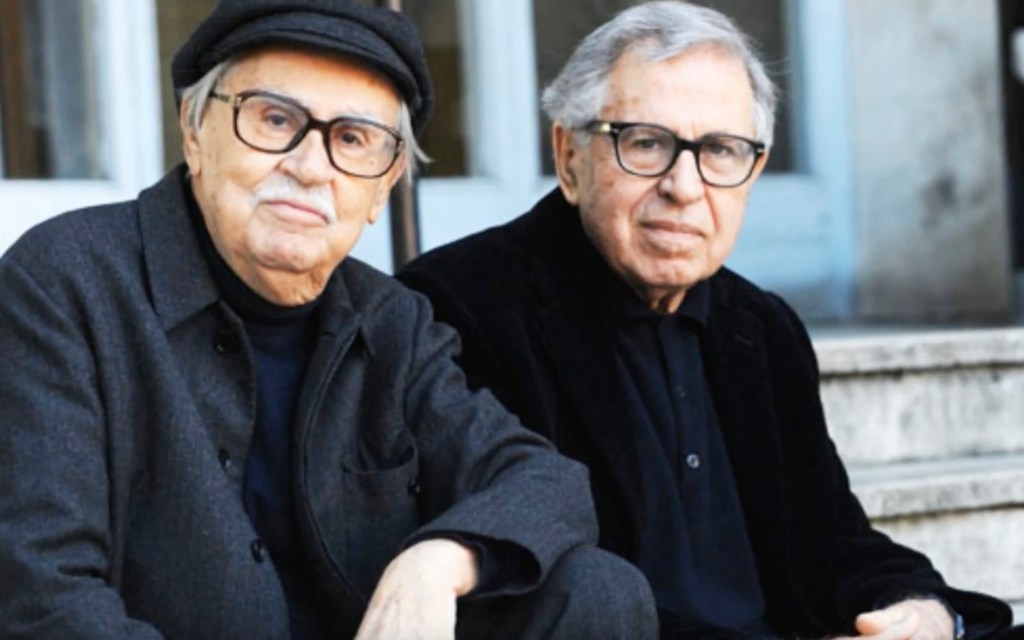
Italy’s Taviani Brothers Return With Film Of Pirandello Stories
One of the most unusual and fruitful collaborations in contemporary cinema is that of Italy’s Paolo and Vittorio Taviani. The Taviani brothers have been co-directing and co-writing films since the mid-1950s, but it wasn’t until 1977, with the success of Padre Padrone, that they achieved recognition in the States. Awarded Best Film at that year’s Cannes Film Festival, their adaptation of Gavino Ledda’s autobiography recalled the visionary daring of the early Soviet filmmakers. Ledda had overcome the poverty and brutality of his Sardinian childhood to become a doctor of linguistics, and the Tavianis related their neorealistic story with startling highlights of bold, surreal imagery. This magical balance also characterized The Night of the Shooting Stars, their second triumph in America (voted Best Picture by the National Society of Film Critics, 1983). Focusing on a group of Tuscan refugees during the chaotic days of the Nazi retreat from Italy, the Tavianis evoked the spectrum of human responses to that epic tragedy; the film memorably encompassed heroism and banality, silliness and horror in the same unblinking gaze, at once compassionate and objective. Far less chaotic – despite the title – are the principal events of their most recent film, Kaos. This three-hour adaptation of five short stories by Luigi Pirandello will be released by MGM/UA Classics in January [1986].
The Film Journal spoke with Paolo and Vittorio Taviani during their recent visit to New York. (Special thanks to Andrea Piazzesi for translating, and to Frank de Falco for helping prepare this article.)
Q: Was Kaos cut for American release, or is this three-hour film the full-length RAI-TV version?
VITTORIO TAVIANI: This is the full version of Kaos. We suggested to RAI to continue with other stories of Pirandello, directed by some young directors – in that project we can have the function of a supervisor. It’s a very good idea, but like all good ideas, it’s very difficult to realize.
Q: Had you long been interested in the writings of Pirandello? Was this a film you’d wanted to make for many years?
VITTORIO TAVIANI: In our youth, Pirandello represented a very traumatic encounter. Suddenly, we discovered that things are not what they seem to be; they’re also that which they aren’t. And if like every young person, we thought of suicide – Pirandello was leading us by the hand. My mother used to say in those days, “You’ll get ruined by Pirandello!”
Instead, Pirandello gave us great strength in our youth, when we saw Six Characters in Search of an Author at the theater. We understood how, through a play, a man can be the protagonist of his life. And that the capability of representing something on the stage is one of the greatest gifts a man can have.
Then, the years passed, and Pirandello became just a heritage that we’d left behind, forgotten. Neorealism had arrived; above all, the cinema arrived. And, as an important event for our development, melodrama. Also, the great thread of classic literature, from Homer to Shakespeare to Tolstoy. Pirandello was set aside.
After we started to tell stories of our land – about Sardinia with Padre Padrone, Tuscany with The Night of the Shooting Stars – we wanted to tell some Sicilian stories. So we went to Sicily to gather material, as we did in Sardinia and Tuscany. We were looking around in Sicily, and one night in the hotel, we found ourselves by chance once again with a book of Pirandello stories in hand. And we realized that Pirandello had already done much of the research for us. We certainly weren’t interested in his “city” stories, which are bitter and terrible against the incompetent and insipid petit bourgeois – these are stories that are, let’s say, under the sign of death.
Instead, we found those stories in which many of the characters were attached to the land. They were seen by Pirandello with complicity, with tenderness. Indeed, sometimes with these characters Pirandello assumed an epic tone, which was so difficult for him. (All you have to do is think of the collectivity of “Requiem” in Kaos.) We realized that, between the Sicilian Pirandello and the Tuscans, there was a meeting point. Then, as always, we had to break down these stories; the most important thing was to separate their elements and transform them into something out of which we could construct our film. If you asked me what Pirandello would think of the film, I wouldn’t know how to answer. Because in one way it was a meeting point between us and Pirandello, and in another way it was a confrontation.
Q: Could you comment on the contribution of Tonino Guerra to the scripts of Kaos and The Night of the Shooting Stars?
PAOLO TAVIANI: Our relationship with Tonino Guerra is a recent one, only our last two films. We’d go to Tonino and propose a story or a few scenes.
He uses a metaphor for our relationship: “You come to me and you have a ball in your hands, which is your film or your scene. I’m like a wall, and you throw it against me. It bounces off the wall and comes right back in your hands. I hope that, attached to the ball, is some of the dust from the wall.” That’s why, in our movies, the proper credit is, “Screenplay with the collaboration of Tonino Guerra,” not “Screenplay by Tonino Guerra.”
VITTORIO TAVIANI: First of all, Tonino Guerra is a marvelous man. He’s really a poet – a poet in the way a child is taught to imagine poets. And, as such, he’s often very different from us. We know therefore that we have to go to Tonino with a work that already has a structure that is absolutely ours. And it’s upon that that he can throw new light. But there already has to be a well defined structure.
Q: Has there been a Tavianis film that was more Paolo’s than Vittorio’s, or vice versa? One that engaged one of you more than the other, either as writer or director?
VITTORIO TAVIANI: The uglier one’s are Paolo’s; the more beautiful ones are mine!
PAOLO TAVIANI: Even if what you ask were the case, we wouldn’t say – maybe not even to ourselves. It’s clear that this relationship is the relationship of two crazy people. On average, in the story of humanity, brothers hate each other. It’s not for nothing that the best known story of brothers is that of Cain and Abel. So I think that we’re afraid of each other, and we try to control ourselves and stay together precisely to demolish this fear. But our style of working is now so tested, that it seems very normal to us. And it seems normal to people who work with us too. Many actors who come to make a film with us for the first time are worried and say, “Should I turn to Paolo or should I turn to Vittorio?” But when they interviewed Marcello Mastroianni after our film Allonsanfan, they asked him, “What’s it like working with two directors?” and he said, “Why, were there two of them?”
Now, I think it’s impossible to separate us – first, because we get results. Second, because if we separated, each of us would have to participate in the Venice Film Festival as new directors!
VITTORIO TAVIANI: It’s really a mystery, even to us. But then the cinema started with two brothers, the Lumières.
Q: Many of the artists who work in committee – especially musicians – do so to cancel out individual tastes and memories, and create from a deconditioned, group consciousness. Is that the case here, or are you actually working on the same wavelength?
VITTORIO TAVIANI: It’s a very complex question. I can tell you that, two years ago, an American university wrote to us because they wanted us to come to America, so that we could be studied like two guinea pigs! But we said, for the love of God, no!
Let’s say that we have the same blood, family, culture. We’ve had a life that has found the same course, both existentially and historically: the War, Fascism. Therefore you can talk in a certain sense about a wavelength.
PAOLO TAVIANI: But maybe, making a reference to chemistry, you could say this: The personality of one, uniting itself with the personality of the other, does not make one plus one equals two, but makes a new element. Or when you go to the café and order a cappucino, where does the coffee end and the milk start?
(This interview first appeared in The Film Journal, November 1985.)
Link to:
Film: Interviews: Contents
For more on Paolo and Vittorio Taviani, see:
Film Review: Kaos
Music Book: Sonic Transports – “Blue” Gene Tyranny Essay, part 5
 NICOLE V. GAGNÉ