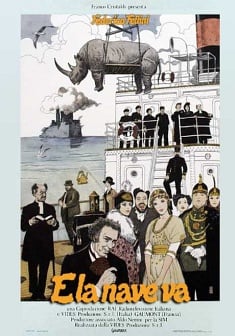
Federico Fellini describes And the Ship Sails On as “a happy film, a film that makes you want to make another one.” The picture indeed reflects a buoyancy and sense of potentiality which had been darkly absent from its immediate predecessors: Casanova, Orchestra Rehearsal, and The City of Women. Fellini’s obsession with the individual’s struggle for maturity and liberation was treated with despair in those films. They denied the possibility of growth and represented society as an endless series of oscillations between repressive authority and mindless chaos. And the Ship Sails On is another Fellinian indictment of the aimlessness and puerility that are the breeding ground of fascism. However, this film counterbalances denunciation with an affirmation of the indomitable vitality of people, both socially and as individuals.
And the Ship Sails On is set in July of 1914. A bevy of operatic oddballs (singers, conductors, vocal coaches) sets sail from Naples to scatter at sea the ashes of a divinely gifted soprano, the late Edmea Tutua. Also on board are a creepy Austro-Hungarian archduke and his entourage, a pining lovesick rhinoceros, and the journalist Orlando, who attempts the thankless task of keeping untangled all the narrative threads – with no more success than the narrator of Amarcord or Fellini himself in The Clowns. The solemnity of the funeral voyage does little to dampen the passengers’ childish penchants for one-upsmanship, bitchery, and sexual peccadilloes. Ugly class tensions arise when the ship picks up a load of Serbian refugees. Worse still, an Austro-Hungarian battleship comes along and demands custody of the Serbs – or else.
Like the trio of films that preceded it, And the Ship Sails On is heavy with a sense of impending doom. Unlike them, however, Fellini here unleashes his worst apocalyptic fears. Social unrest finally ignites into full-scale world war, and far from sailing on, the ship goes down. But in confronting his worst fears, the director frees himself from them – frees his audience as well. Nothing, not even global warfare, counts as more than just one more scene played out on this great soundstage of fools (to paraphrase Shakespeare). The unsinkable energy and persistence of humanity guarantees that something else – however modest – will follow.
And the Ship Sails On may disappoint some admirers of Fellini because it features no grand comic sequences in the tradition of Roma or Amarcord. Instead, Fellini employs an almost Visconti-like stateliness and objectivity. The film does have frequent comic flourishes, but basically Fellini relies on a deliberate use of artifice to lighten the atmosphere. In fact, the opening scene – one of the director’s finest moments – is presented as old, scratched silent footage that gradually swells into color and sound. The film is prodigiously inventive, its richness ranging from a wicked lampoon of Luciano Pavarotti to the magical delicacy of a mini-concert performed on water glasses to the apocalyptic sweep of the liner’s sinking. And the Ship Sails On is an outstanding film by one of the world’s greatest filmmakers.
(This review first appeared in The Film Journal, March 1984.)
Link to:
Film: Reviews: Contents
For more on Federico Fellini, see:
Film Review: Intervista
 NICOLE V. GAGNÉ