Mr. Sperelli ought to be teaching third grade in the Italan city of Corsano, instead, a bureaucratic error has shipped him off to Corzano, a dirt-poor, crime-riddled province of Naples. As Sperelli explores his new turf, he discovers that the children who should be in his classroom are instead full-time workers – legal and black market – whom he must drag bodily into school. And that’s the easy part of his job. Beyond actually trying to teach something to these cynical, foul-mouthed mini-adults, Sperelli must also learn how to deal with a corrupt janitor who runs everything in the schoolhouse (even charging the kids for toilet paper!), and an affable but useless principal, a woman who’s content to be a cog in a system that plainly doesn’t work.
All of which may sound rough, but Ciao, Professore! actually offers a kinder, gentler Lina Wertmuller. The writer-director eschews the grotesque ironies of her most celebrated films, Swept Away and Seven Beauties; even her later farces, A Joke of Destiny and Sotto Sotto, are more ferocious than this rather sentimental, not unpredictable story. Nevertheless, she remains a keen observer of human nature, and has cast her film with a sharp sense of characterization. The children all ring true, from the voluble teacher’s pet Rosinella (Maria Esposito) and the brioche-nibbling fat boy Nicola (Mario Bianco) to the gangster wannabes Toto (Luigi L’Astorina) and Raffaele (Ciro Esposito). Paolo Villaggio as Sperelli lets us see everything through his eyes, yet manages to imbue his role with real feeling. He effectively conveys a range of subtle emotions, from the teacher’s internalized consternation over the hardened townspeople, to his crushing sense of failure when he loses his self-control and slaps the insolent Raffaele. Among the other adults, Paolo Bonacelli is especially striking; the man who played the monstrous Duc of Pasolini’s Saló is here a classic vitellone, kindly and well-meaning but infantile and thoroughly ineffectual.
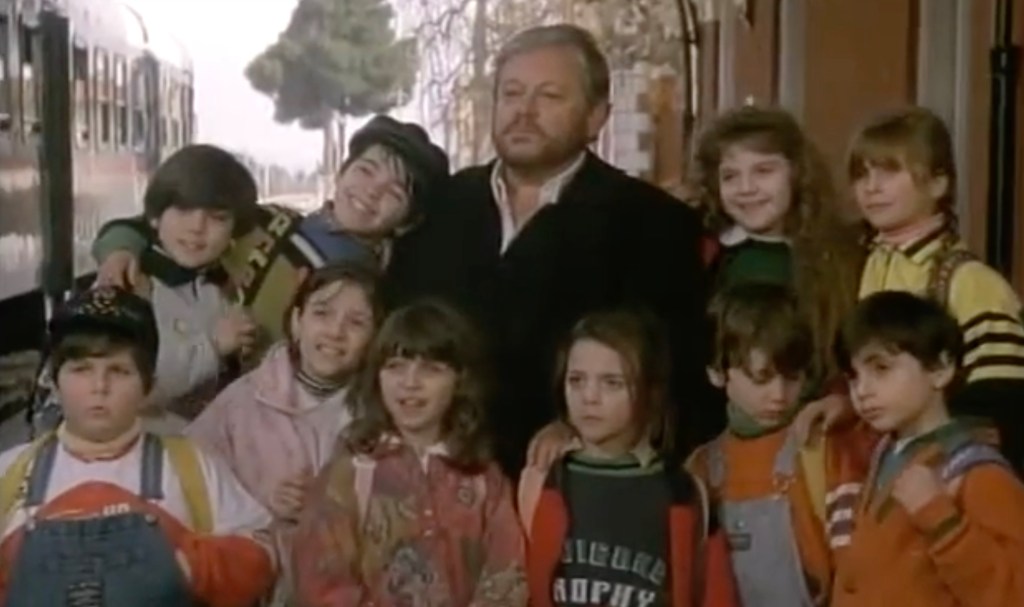
Some among the audience may be reminded of Meri Per Sempre (released here as Forever Mary), a drama of a northern teacher trying to bring meaningful change to a Sicilian boys’ reformatory. Unlike that film’s somewhat forced optimism, Wertmuller ends realistically, with Sperelli transferred back north by the same whimsical bureaucracy that deposited him in Corzano. By then it’s a toss-up as to who has been changed the most, Sperelli or his pupils. The adults of Corzano have already surrendered to the hellish limitations of their world, but these kids have been inspired by their teacher’s example – even troublemaking Raffaele hands in his homework just before Sperelli leaves. As for the man himself, his trip through the looking glass has revealed to him facets of his character which his comfortable northern life has hidden from him: In Corzano, he slaps a kid, steals a car, and roughs up a nun, having unconsciously absorbed the southern way of getting results. It’s up to him whether he’ll learn from these revelations after he returns to the north. Sperelli can only echo the last line of the film (its original Italian title), which is also the conclusion of Raffaele’s composition about getting into Heaven at the Last Judgment: “Me, let’s hope I make it.”
(This review first appeared in The Film Journal, July 1994.)
Link to:
Film: Reviews: Contents
For more on Lina Wertmuller, see:
Film Interview: Lina Wertmuller
 NICOLE V. GAGNÉ