Early one morning, a madwoman appears wandering aimlessly on the tilted rooftops of Rome, provoking an uproar that awakens tenants as well as the drowsing students in an adjacent schoolhouse. By the time she’s been whisked away, Andrea Raimondi has decided to flee his classroom in pursuit of an onlooker from across the courtyard, the beautiful Giulia Dozza. Madness, passion, and the revolt against authority arrive simultaneously, as plain and inseparable as the tones of a major triad, right at the start of Marco Bellocchio’s Devil in the Flesh; and as his film hammers away at this chord, it releases overtones that encompass comedy, politics, suspense, tragedy (Greek and personal), and eroticism.
Andrea tails Giulia to a heavily guarded courthouse where her fiancé, Giacomo Pulcini, is being tried for terrorist acts. But Pulcini has come to a sincere repentance that will lead his freedom. He has embraced the church, collaborated with the state, and accepted his own “ordinariness.” Not coincidentally, Giulia becomes increasingly involved with the smitten Andrea. Dodging Pulcini’s bloodhound mother as well as Andrea’s disapproving parents, the pair become more and more absorbed with each other, until their affair can no longer be concealed.
Devil in the Flesh focuses more on the explosive effect that this relationship has on Andrea and Giulia (and on everyone around them) than on their actual sex play. Bellocchio does provide some hot glimpses of what they’re up to, but all that footage would get in under that R-rated wire. The film was tagged X on a technicality, because of a brief scene in which Giulia goes down on Andrea. Within the context of the story, it’s a quiet, tender moment, and it’s filmed quite tastefully (no pun intended). Within the context of mainstream filmmaking, however, this is revolution. And if that isn’t a good enough reason on its own, Bellocchio is also justified in breaking this taboo because the scene elaborates Giulia’s character and heightens the film’s tension as well – after that, you can’t tell what she’ll do next.
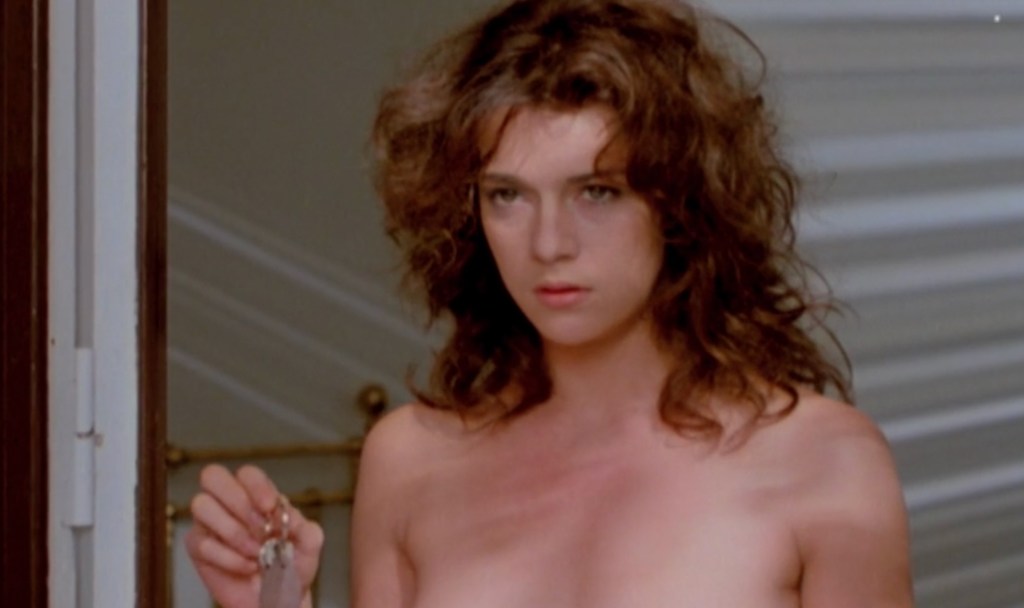
Very few actresses would attempt such a scene, largely because the inevitable notoriety could eclipse any perception of their talent. Maruschka Detmers has nothing to fear in this regard: She has triumphed brilliantly in this film. Bellocchio’s camera always returns to her face, scrutinizing Detmers throughout long, wordless shots in which she teeters from hope and courage to confusion and terror. Her Giulia Dozza is a spontaneous, volatile woman who defies convention naturally and unselfconsciously; Voices of Reason, such as Andrea’s psychiatrist father, insist that she’s mad, and their insistence has caused her to doubt her own sanity. And in those startling scenes where she teases Andrea with a pair of scissors, or dances by herself holding a knife, you realize that she’s staring into a pit as deep as the one that claimed the lost soul who was discovered weeping on the roof. But Bellocchio never loses sight of how the pillars of society are locked onto their ordinary madness: The film’s funniest material focuses on Mama Pulcini and her desperate efforts to catch the renegade lovers in the act, and on Dr. Raimondi’s wild sexual fantasy of Giulia – and his even wilder confrontation with Andrea.
A film of daring, imagination, and genuine beauty, Devil in the Flesh is a major film from Marco Bellocchio. It will be talked about and admired internationally for quite some time to come.
(This review first appeared in The Film Journal, June 1987.)
Link to:
Film: Reviews: Contents
For more on Marco Bellocchio, see:
Film Review: Henry IV
 NICOLE V. GAGNÉ