In an era when American movies offer up vulgarity, explosions, and stomach-churning sadism as substitutes for entertainment, story-telling, and honest emotion, Fat Rose and Squeaky stands as an unalloyed delight. A breath of fresh air in an increasingly fetid and decadent industry, the film is all the more extraordinary in that its cast consists solely of five actresses – with the two leading ladies both in their seventies. Thanks to Fat Rose and Squeaky, audiences have at long last been given a chance to rediscover for themselves the satisfactions of eloquent dialogue and intelligent, realistic characterizations. Whether this film is the beginning of a trend or one of the final flowers of classic American filmmaking, the fact remains that, when it comes to quality cinema, adolescent testosterone is simply no match for vintage estrogen.
Bonnie Ash Fitzpatrick (Louise Fletcher) is a cantankerous woman in her eighties, who’s struggling to maintain her independence and dignity despite the gradual erosion of her grip on such day-to-day realities as paying the bills or remembering what’s been left cooking on the stove. Her anchor and support is the French-born Celine Snow (Cicely Tyson), a former ballet dancer who has been Bonnie’s best friend for fifty years. Now well into her seventies, Celine makes it a point to visit Bonnie regularly, and the two gladly share meals and poetry recitations, despite their widely varying tastes, culinary and poetic. Besides keeping after her friend and making sure she doesn’t toss away her dinners from Meals On Wheels, Celine also provides Bonnie with opportunities to denounce the mooching troublemakers Fat Rose (Lea DeLaria) and Squeaky (Julie Brown), who she claims are responsible for stealing her money, keeping her home in perpetual disarray, and leaving pots burning on the range. Invisible to everyone else, Fat Rose and Squeaky are ne’er-do-wells generated by Bonnie’s own imagination, externalizations of her hostility and paranoia toward an outside world that she now seldom visits. Bonnie may keep an ancient .38-caliber police special strapped to her cane, but it’s Fat Rose who eggs her on to fire the tiny pistol; she may be patient with Celine’s Romantic effusions, but she can’t resist reminding her that Fat Rose regards Celine as “an artsy-fartsy weirdo,” or that Fat Rose, like Bonnie, admires the beat poetry of Jack Kerouac, which Celine derides in favor of her beloved Wordsworth.
The real threat to Bonnie’s existence is not the anti-social antics she attributes to Fat Rose and Squeaky, but the sudden appearance of a previously unknown relative: Christine Peek (Jo Anderson), the granddaughter of Bonnie’s sister. This 40-something Los Angeles antiques dealer has tracked down her legendary great aunt to her home in a quiet neighborhood of San Jose, California, and although she claims that her intrusion into Bonnie’s life is an act of familial affection, the truth is that she’s sniffing after whatever loot she can score. When she discovers that Bonnie owns a treasure trove of vintage furnishings, Christine begins taking steps to ensure that her legendary great aunt is properly looked after by professionals – in other words, shipped off to a retirement home once Bonnie has turned over all her belongings and power of attorney to Christine. However, an unexpected emergency forces reality into the lives of all three women, and Bonnie, Celine, and Christine are brought into a confrontation that defines the true depth of Bonnie and Celine’s friendship.
Although Louise Fletcher more than proved her outstanding talents with her award-winning performance as the steely Nurse Ratched in One Flew Over the Cuckoo’s Nest, she has had regrettably few opportunities to shine in the 30 years since that landmark film. One hopes that her compelling portrayal of the crusty Bonnie will open the door to new opportunities for this fine actress who has too often toiled in projects unworthy of her. Matching Fletcher every step of the way is Cicely Tyson, whose performance as the steadfast Celine deftly sketches in the warmth and common sense that underlie Celine’s affectations and nagging. Perhaps the greatest tribute to both of these gifted players is that they manage to hold their own against the scene-stealing shenanigans of Lea DeLaria and Julie Brown. As the crude and cruel “railroad trash” who bedevil Bonnie, the two play off each other beautifully: a distaff Norton and Kramden, with Brown’s goofy and childlike Squeaky balancing DeLaria’s butch and punkish Fat Rose. The film’s breakout performance, however, comes from Jo Anderson. She completely inhabits the role of the scheming Christine, whose self-absorption and avarice are barely papered over by her pleasing tones and politesse. Anderson subtly evokes the panic and futility seething within Christine, and creates real sympathy for what is in fact a thoroughly unlikable character.
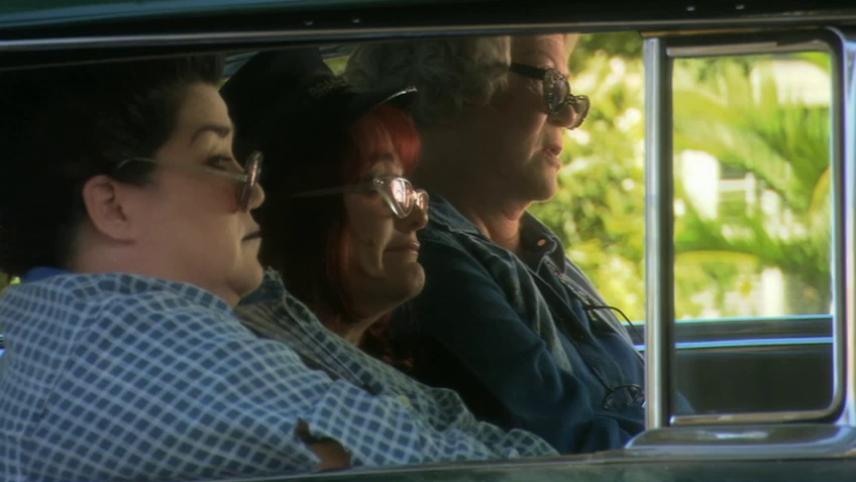
Playwright S. Virland Harris has wisely resisted the temptation to “open up” his stage play; instead, his script heightens the intimacy and immediacy of his story and reaches moments of great compassion and power. The steady hand of veteran director Sam Irvin is an expert complement to Harris’s screenplay, enlivening the film’s visual flow without compromising its restricted focus on these five women. Praise also must go to the handsome cinematography of Mickey Freeman (shooting on digital video), and the detailed production design of Brian Sharp. As a result, Fat Rose and Squeaky easily belies its theatrical origin, despite the near total reliance on Bonnie’s home for its location. Certain images in particular resonate with quiet force: Bonnie using her gun as an impromptu handle to lift the lid on Celine’s tofu casserole; Bonnie, Fat Rose, and Squeaky in the front seat of Bonnie’s antique car, all wearing sunglasses as they light up forbidden cigarettes in lockstep; a healing circle of diamonds laid out on an ailing woman’s bed. “Quiet force” is perhaps the best term to describe the narrative impact and emotional depth achieved by this lovely, heartfelt film. Fat Rose and Squeaky is certain to touch audiences more deeply than anything produced by Hollywood in many, many years.
(This review, written in 2007, appears here for the first time.)
 NICOLE V. GAGNÉ