“Intervista” is Italian for “interview,” and the interview subject of this film is its maker, Federico Fellini. Of course, more often than not he’s simply evading or ignoring the cheerfully persistent Japanese film crew that has come to question him. Instead of explaining himself, Fellini treats his documenters (and his audience) to spectacular images of memory and imagination. Intervista’s interviewers are ostensibly following Fellini as he shoots tests for an adaptation of Franz Kafka’s Amerika, but this film is no more a documentary on Fellini at work than his Roma was a documentary on the Eternal City, or The Clowns was a documentary on circus performers. All three films are essays about their subjects, filled with speculations, satire, flights of fantasy, and unexpected dollops of self-criticism, yet are still capable of keenly observing and capturing reality.
As he did in Roma, Fellini represents himself in Intervista as a callow youth making his first step into an arena from which he will eventually command worldwide attention. Once again, he’s entering a city: Movie City, or as the studio is more commonly known, Cinecitta. Sergio Rubini effectively plays the young Fellini, wandering through an asylum run by its inmates as he searches for the glamorous female star he’s been sent to interview. In his loving re-creation of the studio’s pre-war days, Fellini makes motion pictures seem even more wildly dreamlike and yet more cynically artificial at the same time. But none of the Cinecitta sequence, as good as it is, can top the business of the ride to the studio itself. Rollicking beyond realism and silliness, and taking off into childlike wonder, Fellini’s trolley trip travels further and further from civilization, past elephants and noble Indian warriors, until it at last arrives at the studio gates. (The sequence is all the more effective for beginning with a confession of how the trick is done, as Fellini shows the shell of the trolley being driven about on a flatbed truck.)
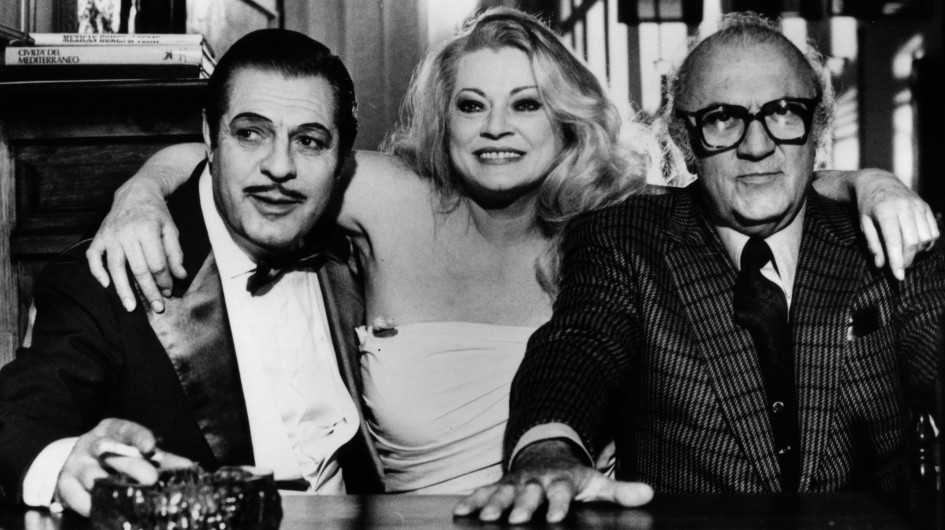
The high point of the film occurs when Fellini leading man Marcello Mastroianni, at Cinecitta to film a commercial, “surprises” the director and joins him on a visit to the home of Anita Ekberg. Although Fellini jokingly has the pair appear somewhat grotesque – Mastroianni dressed as Mandrake the Magician and Ekberg swathed in blankets, as though no manmade clothes could contain her still-volcanic form – his enthusiasm for both stars is greater than ever. Gazing off at Ekberg at one point, Fellini flatly states, “She’s mythic.” (Alas, the subtitles mistranslate his comment as “She’s epic.”) Eventually, he reprises a clip of the two in the fountain from La Dolce Vita, intercutting it with glimpses of them watching themselves as they were 25 years ago. The emphasis, however, is not on dissolution and loss, but rather on the magical incandescence natural to them both. La Dolce Vita was alert enough to use their uniqueness to tell Fellini’s story. Intervista has the maturity and compassion to celebrate that uniqueness for its own enduring value.
(This review first appeared in The Film Journal, October/November 1992.)
Link to:
Film: Reviews: Contents
For more on Federico Fellini, see:
Film Review: And The Ship Sails On
 NICOLE V. GAGNÉ