If Kaos, the tenth feature of Paolo and Vittorio Taviani, fails to achieve a success in America equal to their earlier films Padre Padrone and The Night of the Shooting Stars, the fault will lie in quantity, not quality. The film runs a little over three hours – a demanding length (even for the average foreign-film enthusiast), and one that doesn’t make it easy to secure bookings. But Kaos is also one of the Tavianis’ finest efforts, and could well become an enduring revival film, rivaling such classic marathons as The Tree of the Wooden Clogs and The (uncut) Leopard.
Kaos covers five short stories by Luigi Pirandello, giving it a range of action and characterization which effectively counterbalances its length. The first story, “The Other Son,” opens with a group of Sicilian peasants seeing off loved ones who are immigrating to America. With the deft precision that characterized The Night of the Shooting Stars, the Tavianis let us observe a spectrum of anger and sorrow, humor and naivete, in the group’s response to this upheaval. The story then focuses on an older woman (beautifully played by Margarita Lozano) and her drift into madness. Although two of her sons disappeared into America years before, she still has the devotion of her other son. But his physical resemblance to the rapist who fathered him has broken her capacity to love him and carry on with her life. The second story, “Moon Sickness,” also speculates about the invisible distinction between fate and individual choice, this time touching on the supernatural: a young husband suffering the tortures of the damned every full moon.
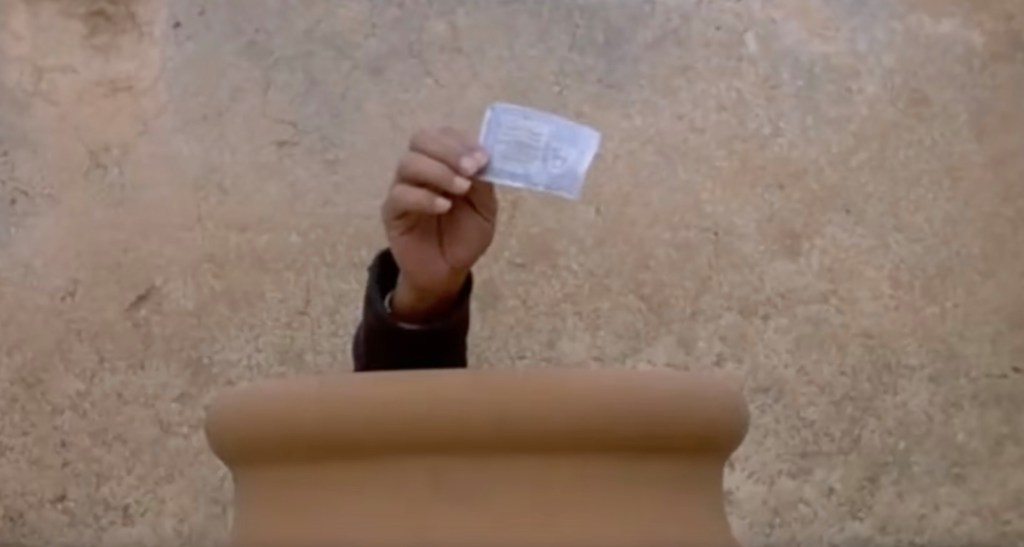
Perhaps the best story in Kaos is “The Jar.” A rich landowner finds his huge earthen jar mysteriously broken. An artisan repairs the jar, but unthinkingly imprisons himself inside it in the process. The jar must be smashed again, but which of the two will pay for the damages? Each waits for the other to surrender, in a battle of endurance that’s one of the funniest sequences the Tavianis have created. The fourth story, “Requiem,” emphasizes the Tavianis’ recurring theme of the strength of collectivity, as a group of peasants comes to the city to demand the right to bury their dead on the land they lease.
The epilogue-finale of Kaos, “Conversing with Mother,” is without doubt one of the Tavianis’ finest moments. The protagonist is Pirandello himself, affectingly played by Omero Antonutti (who previously scored with the Tavianis as the brutal father of Padre Padrone and the wise village patriarch of The Night of the Shooting Stars.) His gentle dialogue with his dead mother leads to a vision of an incident from her childhood: On their way to exile in Malta in 1848, her family stopped to rest on a tiny Mediterranean island. The film closes as the children blissfully play on a hillside of powdery white pumice, sliding down into the shallows of the sea. The whole story works toward that final image, yet you never feel the filmmakers striving for a set-piece. Such self-consciousness sometimes mars the impact of the Tavianis’ work, but the ending of Kaos ranks with some of the most haunting imagery this reviewer has seen.
(This review first appeared in The Film Journal, February 1986.)
Link to:
Film: Reviews: Contents
For more on Paolo and Vittorio Taviani, see:
Film Interview: The Taviani Brothers
Music Book: Sonic Transports – “Blue” Gene Tyranny Essay, part 5
 NICOLE V. GAGNÉ