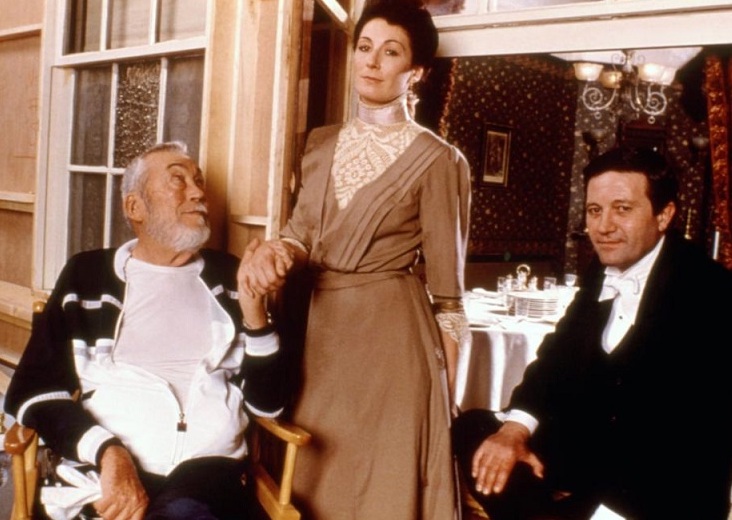
“One by one they were all becoming shades. Better pass boldly into that other world, in the full glory of some passion, than fade and wither dismally with age.” So thinks Gabriel Conroy to himself in his hotel room, gazing at the snowfall which is general all over Ireland on a late night in January of 1904. Beside him is his wife Gretta, asleep at last, emotionally spent from having admitted her long-hidden secret: the memory of her teenage love, a boy who died from the recklessness of his passion for her.
The words are by James Joyce, from the ending of his classic novella The Dead. Director John Huston, working from a script by his son Tony, has given them life in a film which will long be cherished by all admirers of both his art and Joyce’s. Admirers of Ireland too: Although filmed entirely in a California studio, with only some second-unit exteriors shot on location, The Dead is a touching love letter to the homeland Huston chose for himself. With a sense of period detail and atmosphere the equal of Stroheim or Visconti, he captures beautifully the mood of a bygone Ireland – its warmth and generosity of spirit, as well as its foibles, narrowness, and political troubles.
Also Visconti-like is The Dead’s focus on a single family gathering: a celebration of the Feast of the Epiphany at the home of Julia and Kate Morkan, Gabriel Conroy’s maiden aunts. In a cast that gathers together some of the finest talent in the Irish theater, it’s almost impossible to single out specific performers. American-born (but Irish-raised) Anjelica Huston would be considered a fine actress simply by not seeming out of place, but she does a lot more than just hold her own; in Gretta’s monologue about the death of her beloved Michael Furey, she gives her most moving and persuasive performance to date. Donal Donnelly is superb, both pathetic and admirable, as the inevitable relation with a drinking problem. Cathleen Delany’s Julia and Helena Carroll’s Kate are flawless characterizations, so detailed and assured as to provide surprises through repeated viewings. But special praise must go to Donal McCann as Gabriel. He has the rare ability not only to hold an audience’s attention with his own thoughts and behavior, but also to let our gaze pass through him, so we can watch with his eyes and learn as he learns.
The Dead is also an inspiring ensemble success from behind the camera. Production designer Stephen Grimes, production manager Tom Shaw, costumer Dorothy Jeakins, editor Roberto Silvi, and composer Alex North are all former collaborators with Huston and have contributed superbly to the jewel-like simplicity and elegance of this film. Matching them every step of the way are the two new kids on the team, Tony Huston and director of photography Fred Murphy. In his faithful yet inventive adaptation of Joyce’s not-so-pliable material, Tony Huston shows himself to be a writer with a true sense of film. Murphy displays a highly sensitive and subtle eye for light, and makes the film by turns clear and precise or soft and hazy, following the demands of the story. Above all, The Dead is John Huston’s triumph: a bold new development in his art, as well as a virtuoso summation of the contradictions that defined it. His last film is a sad romantic farce, a funny elegy on the death of certainty, and a vibrant, heartfelt affirmation of life, indomitable enough to embrace even the void.
(This review first appeared in The Film Journal, January 1988.)
Link to:
Film: Reviews: Contents
For more on John Huston, see:
Film Dreams: John Huston
Film Essay: Orson Welles and the Other Side of Nicholas Ray
Film Essay: Where Is The Other Side of the Wind?
Film Interview: Danny Huston
Film Review: Under the Volcano
 NICOLE V. GAGNÉ