British filmmaker Terence Davies first burst on the scene with a trio of short, autobiographical black-and-white films. Completed in 1983 and shown together under the collective title The Terence Davies Trilogy, they offered a touching but harrowing account of a gay man’s attempt to overcome the self-hatred conditioned into him by his Catholic upbringing. Winning numerous awards internationally, the trilogy promised even better work ahead, and Davies kept that promise with his stunning diptych, Distant Voices, Still Lives (1988). He wrote himself out of that particular journey into autobiography, focusing instead on the lives of his parents, sisters, and brother in Liverpool during the 1940s and ‘50s. The Long Day Closes returns the spotlight to Davies himself in the character of 11-year-old Bud (winningly played by newcomer Leigh McCormack). The film captures the lad in the years 1955–56, after the death of his brutal father, when he came to discover the cinema (mostly American musicals) and his own feeling of love and wonder toward the world. In those days the Church was just beginning to get its hooks into him; when Bud is caught staring too long at a handsome, shirtless bricklayer, he experiences some of the humiliation and guilt that he is destined to struggle with as a man.
Like its predecessor, The Long Day Closes is highly stylized in its treatment of time, its editing, lighting, and camera movement, and its choice of musical commentary on the soundtrack. But Davies again performs the near-miracle of persuading viewers that, for all the stylization, they are glimpsing people’s lives exactly as they were once lived – thanks in no small part to an excellent cast, the superb cinematography of Michael Coulter, and the painstakingly realistic sets of Christopher Hobbs. But that’s just one of the divine contradictions that make Davies’ film hum with vitality. How many other times will you see a self-referential project that’s perfectly willing to just watch the play of changing light on a carpet, yet which nevertheless seems devoid of self-indulgence? A spiritual heir to the traditions of Carl Dreyer and Satyajit Ray, Davies’ austerity and purity of focus bespeak the most exacting discipline; his love for the specific details of his people’s lives, the most universal kind of filmmaking.
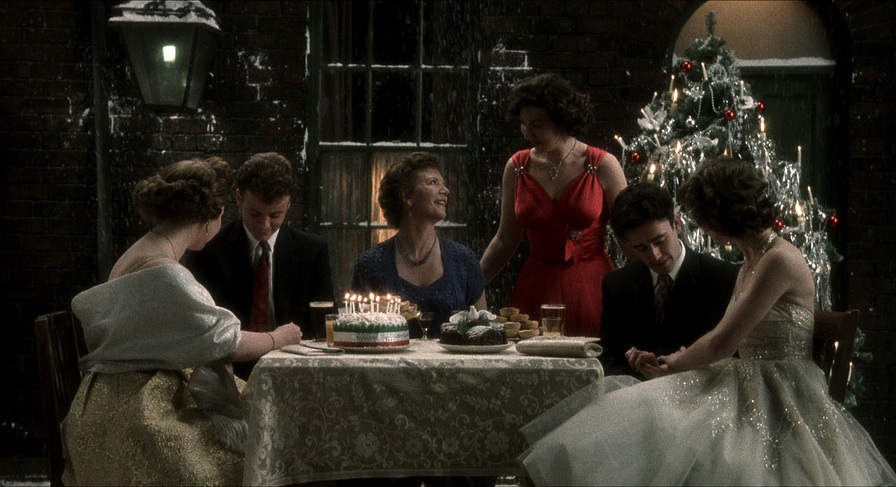
For all the goodness of that time of Bud’s life – the cane-swinging teachers and bullying pupils of his school are the only blights on the boy’s happiness – Davies’ film is suffused with a sense of loss, from the steadily wilting flowers glimpsed during the titles to the image of a vanishing sun which closes the film. A glimpse of his family partying at Christmastime, wedded to a searing excerpt from Gustav Mahler’s tenth and final symphony, sums up the tension between the love that makes the present meaningful and the realities lost forever in the past – the last and most irreconcilable of all the contradictions that fuel the vision of this gifted and original filmmaker.
(This review first appeared in The Film Journal, March 1993.)
Link to:
Film: Reviews: Contents
For more on Terence Davies, see:
Film Review: The Neon Bible
 NICOLE V. GAGNÉ