When John Kennedy Toole took his own life in 1969, he was an unknown 31-year-old college teacher in New Orleans. Among his effects was the manuscript of a satiric novel he’d never been able to publish. His mother enlisted the help of writer Walker Percy, and A Confederacy of Dunces was published in 1981 – and went on to win the Pulitzer Prize. Also discovered in Toole’s papers was a novella called The Neon Bible, about a boy growing up in the rural South during World War Two. This amazingly accomplished work – Toole was only 16 when he wrote it – finally saw publication in 1989, after years of wrangling among his heirs. Producer Elizabeth Karlsen immediately took it to the one filmmaker she knew could best realize its loving, elegiac tone: Terence Davies, the award-winning writer/director of Distant Voices, Still Lives and The Long Day Closes. He has justified her faith in him with this beautiful, deeply felt, and exquisitely acted and crafted film. The Neon Bible is also Davies’ most accessible work to date, thanks to its straightforward narrative and the star power of its cast.
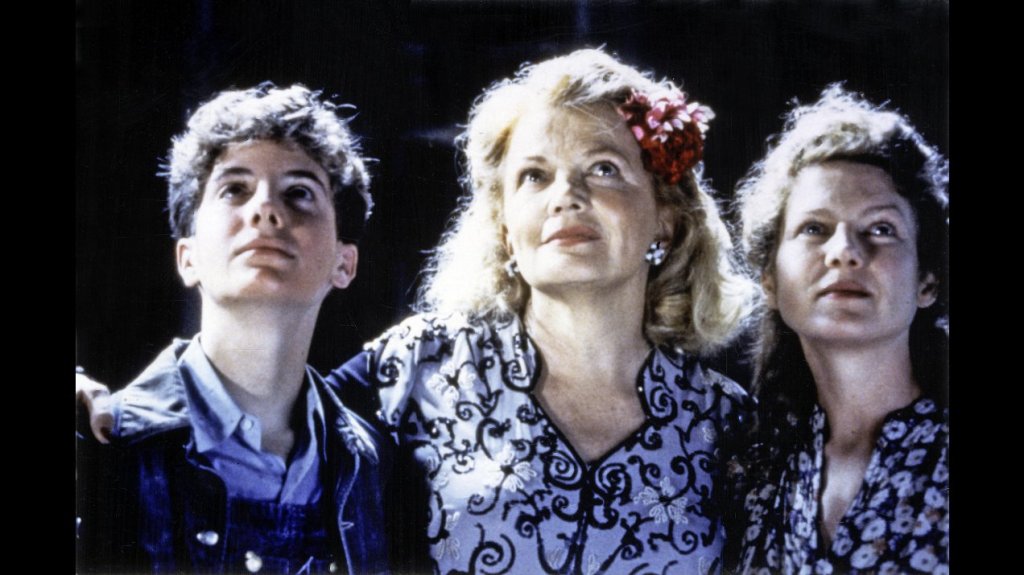
Gena Rowlands has the role of her career as Mae Morgan, a never-was singer in the backwaters of the 1930s Dixie circuit. Now at the end of her career, Mae moves in with her niece Sarah. Although Sarah and her young son David come to dote on Mae, her unemployed husband Frank wants Mae gone. But the expected confrontation is avoided when Frank is drafted to fight in World War Two. After he leaves, the two women and the now-adolescent David enjoy a new happiness and serenity – for a while. There is never a false move or look from Rowlands, who embodies Mae’s strengths and weaknesses, her goodness and her selfishness, with a perfect understanding and clarity. Matching her moment for moment is Diana Scarwid, who gives a nuanced, intimate portrayal of Sarah, a timid woman broken by life’s hardness. Jacob Tierney is just right as the laconic but sensitive and observant David, and there are fine supporting performances from Denis Leary as the embittered Frank, Drake Bell as the young David, and Leo Burmester as the oily revivalist Bobbie Lee Taylor. Davies has reunited with his collaborators on The Long Day Closes: cinematographer Mick Coulter, production designer Christopher Hobbs, and costume designer Monica Howe. They all know how to evoke the exalted, poetic realism, the idealization of memory, which Davies prizes.
This remarkable film will need critical support if it’s to reach an audience amid the flashy trivia currently filling theatre screens. Alas, it may wind up ignored, because the film is least persuasive at its end, and films with lumpy endings tend to get slammed harder than films with lumpy beginnings or middles. Moreover, the press likes to type filmmakers, so there will undoubtedly be confusion over Davies’ departure from Liverpudlian autobiography. Those who have never really understood what he’s been doing can be expected to jump ship; those who recognize his unique gifts will leave The Neon Bible convinced that Terence Davies is a genius. There simply has never been camera movement like this, not the way he’s imbued it with such tenderness and feeling. He isn’t making narrative points or revealing character; he’s attempting to ignite an all-encompassing love of the moment, particularly the commonplace, ordinary moments that are available to everyone.
This exquisite tone doesn’t omit instances of brutality and suffering. The unexpected violence at the end, however, sits uneasily against the rest of the movie (on first viewing, anyway). It feels like the film is straining too hard to make a metaphor. This weakness is shared by the book and would have proven tricky for any adaptation. Although Davies has spoken of a redemptive quality in the ending, audiences may wind up seeing a character who’s more lost than ever. But however problematic the film’s finale may be, it doesn’t compromise the purity and emotion of what has gone before. With The Neon Bible, one of the best filmmakers of his generation has reached a new level of discourse and poetry.
(This review first appeared in The Film Journal, March 1996.)
Link to:
Film: Reviews: Contents
For more on Terence Davies, see:
Film Review: The Long Day Closes
 NICOLE V. GAGNÉ