The modern phenomenon of transsexualism first seized the world’s consciousness in 1953 when Christine Jorgensen returned to the United States after undergoing sex-reassignment surgery in Denmark. By 1970, the sexual revolution that she helped launch had sufficiently penetrated Hollywood for a film to be made from her autobiography, and she appeared on “The Mike Douglas Show” to promote The Christine Jorgensen Story. During her interview, Jorgensen confessed her disappointment that the producers hadn’t cast the actress Sondra Locke as herself, and had instead given the role to a man. She knew perfectly well that her male existence had been awkward and inappropriate, but as a woman she truly became herself; by starring an actress, the film could have communicated the artificiality of George Jorgensen’s maleness, and the necessity for his transitioning to female. This sensible approach to casting the role of a transsexual woman has been followed by only a few subsequent films, most notably the 1986 made-for-television biopic Second Serve, with its virtuoso performance by Vanessa Redgrave. Otherwise, it’s still a rarity – but the exceptional work of actress Felicity Huffman as the trans woman Bree in Transamerica might well jump start a trend that’s been a long time coming.
Although Bree’s eagerly awaited surgery is only a week away when Transamerica begins, she is still struggling for the grace, physical and spiritual, to be at home within her true gender. Complicating her efforts is her unexpected discovery that she’d fathered a child some eighteen years ago, when she was still trying to live as a man. Her teenage son Toby (Kevin Zegers) needs someone to bail him out of jail in New York City, and Bree reluctantly flies out from Los Angeles and pays his fine; but she conceals her gender status and their blood relation, and pretends to be a Christian social worker. When she learns that Toby’s mother is dead and that the boy is permanently estranged from his abusive stepfather, Bree decides to take him to California, where he wants to relocate and begin a new life for himself. The bulk of Transamerica concerns their cross-country road trip together, during which they uncover the painful truths that they’re hiding from each other.
Transamerica is that rare quantity in American cinema, an entertaining and enjoyable film that treats its queer characters with affection and honesty. Writer/director Duncan Tucker mines humor not from Bree’s being transsexual, but from her being so uptight about being transsexual, and so audiences rock with laughter when Bree phones her therapist and sobs, “An eight-year-old just read me!” Of course, people within the gender scene know all too well that pre-adolescent children can be experts at “reading” a trans person, because they’re too unsophisticated to perceive the more complex indicators upon which adults rely for their gender presentation, and instead intuit the basics. Transamerica is replete with such insightful details about the realities of the transsexual experience, which the film incorporates to draw in mainstream audiences and enable them to empathize with Bree. To his credit, Tucker also knows how to employ the unique details of her life to further his narrative. An example: Bree makes frequent visits to the bathroom because, being preoperative, she still needs to take the testosterone-suppressant spironolactone, which is also a strong diuretic. When she has to stop the car and relieve herself by the side of the road, a howling coyote scares her and she jumps up, still urinating through her hated penis – a startling sight which reveals to Toby that Bree is transsexual.
The laughs provoked by this unusual image, or by her tears over being read by a child, aren’t unkind because Transamerica’s audiences come to understand Bree’s need for acceptance. Like all forms of neediness, however, Bree’s fixation on normalcy can lead her into ugly and self-defeating behavior. Her layering lie upon lie to keep her son in the dark is pathetic enough; sadder still is her nasty description of a group of partying trans people as “ersatz women,” in the hope that Toby will continue to see her as a non-trans woman. Toby however is disappointed by Bree’s bad attitude and mutters that he thought they were nice – which they were: Their genteel and friendly gathering was a perfect opportunity for her to come out to him, had she had the courage and self-acceptance to act on it. (Wisely, Tucker casts the party scene with real transsexual women and men, including one of his film’s advisors, Calpernia Addams.) Thus, the moment when Bree can look a police officer in the eye and declare that she is Toby’s father is a real milestone for her. So too is her wrenching breakdown after her surgery, when she admits to her therapist that her dishonesty with her son was a cataclysmic mistake.
Tucker has plainly done his homework for Transamerica, but research alone only goes so far, and his film is also flawed by compromises and misapprehensions. At one point Bree confronts her neurotic, intolerant parents, and insists that her gender condition is genetic and not a product of her upbringing, which is perfectly true. So why then has Tucker saddled her with the cliche parental dyad for producing queers, a controlling mother and an ineffectual father?
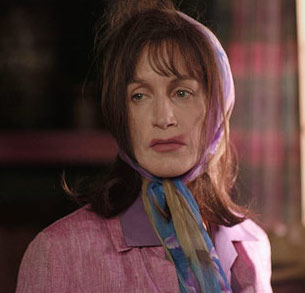
More problematic are the film’s opening scenes, where Bree has been made to look as ugly as possible. This lame attempt to extract laughs reduces her to someone trying to be something she is not. In real life, when a trans woman wears bad makeup, she inevitably appears over-painted, with mismatching colors and effects. She doesn’t seem aged and cadaverous, which is the Karloff-like effect drawn onto Huffman. Bree may be an insecure tranny, but she isn’t blind; rather, she’s shown continually scrutinizing herself in her desire to appear average. Her character would never walk out the door looking so grotesque. Tucker’s overkill is especially regrettable because Huffman needs no such gimmicks to play a trans woman. She has the voice and body language down cold, and throughout the film she skillfully expresses Bree’s efforts to ease the painful rigidity that inhibits not just her gender expression but her capacity to relate as well.
The distance between the filmmaker and his film’s subject is underscored by Tucker’s characterization of Toby as a gay hustler – an unrealistic choice, considering that the majority of queer parents have heterosexual children. Tucker, whose sole prior credit is the gay-themed short The Mountain King, is plainly more interested in Toby and his acceptance of Bree than he is in Bree and her acceptance of herself. Worse, Toby’s gay life has no narrative value and actually undermines the film’s most compelling scene, in which Toby, knowing Bree is trans but still unaware that she is his father, makes sexual advances to her, out of a sense of compassion for her struggles with her obtuse parents. Had the boy been straight, such a gesture on his part would have meant he was capable of maturing beyond his conditioned hostility toward transsexual women – a breakthrough that the film ostensibly seeks to encourage in its viewers. Instead, Tucker only reminds the audience of Toby’s polymorphous sexuality and further marginalizes Bree.
Even the film’s sweetest sequence is similarly compromised: At a low point during their trip, Bree and Toby are helped out by one Calvin Many Goats (Graham Greene), a good-natured Native American who takes a fancy to Bree. For once a man is treating her as a woman, and the sight of her relaxing her inhibitions and enjoying his affection is a real oasis for both Bree and the audience. (The encounter also gives her the best line in the entire film, when she hesitantly asks Calvin, “Is there a… Mrs. Many Goats?”) Still, one can’t help but detect an undertaste of corn (or more precisely, maize) with Tucker’s Noble Red Man, so much more kindly and open than any Paleface male in the film. Bree’s admirer is someone who is himself an outsider, and that characterization speaks volumes about Tucker’s attitude toward his transsexual protagonist.
For all its insights and good intentions, Transamerica tells Bree’s story from the outside in – a familiar pattern for films with transsexual characters, and one which so often results in errors and insensitivities. The reason why Ma Vie En Rose (1997) is still the gold standard for the representation of transgender people is because, unlike Transamerica, it tells its story from the inside out. Although neither the film’s eleven-year-old star Georges Du Fresne nor its director and co-writer Alain Berliner had gender issues themselves, the project originated with the script’s co-author Chris vander Stappen, a female-to-male transsexual. It was vander Stappen who kept Berliner to the realities of their character and refused any psychological or sociological explanations for young Ludovic’s belief that he is a girl; more importantly, by focusing on a child, he positioned the film’s transgender theme in a context of innocence and naturalness. Like Christine Jorgensen, vander Stappen understood that his gender variance came from a natural place within himself and was not merely some instance, however benign, of adult weirdness. No matter how much its audiences may come to like or even respect Bree, Transamerica does not know how to make real to them this fundamental truth.
(This review first appeared in Cineaste, Summer 2006.)
Link to:
Film: Reviews: Contents
For more on gender, see:
Film Essay: Gender Variance and Race
Film Interview: Holly Woodlawn
Film Review: Gun Hill Road
Film Review: Kokomo City
Film Review: Queeendom
Film Review: Seat 31
Music: KALW Radio Show #5, Gender Variance in Western Music, part 1: Male-to-Female Representations
Music: KALW Radio Show #6, Gender Variance in Western Music, part 2: Female-to-Male Representations
Other Writings: Book Review – Candy Darling
Other Writings: Essay – “A Working Model of Gender”
 NICOLE V. GAGNÉ