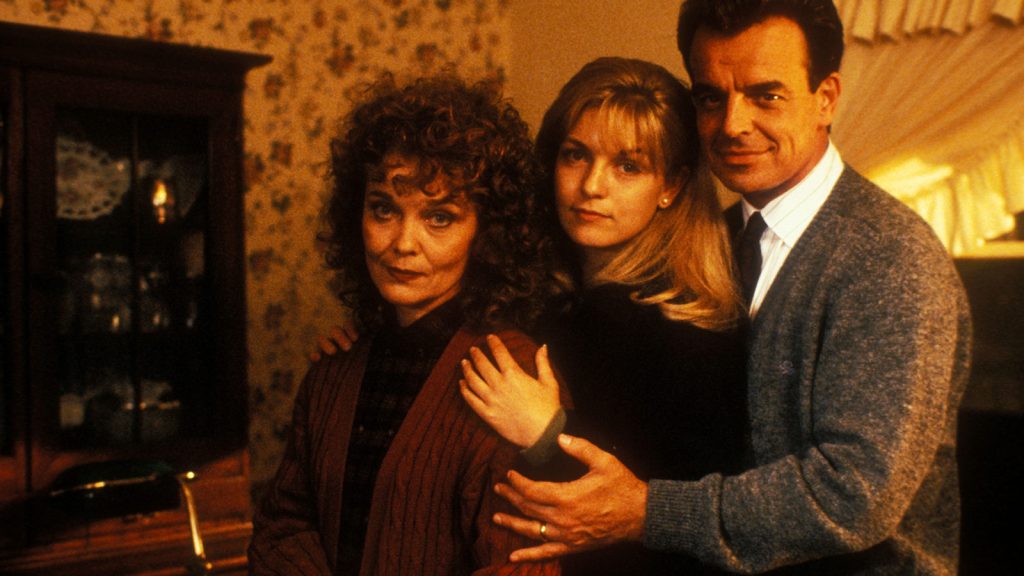
As a prime-time series on ABC, “Twin Peaks” demonstrated the axiom that you can’t be on television without turning into television. In its two-season run, the show went from one of the most provocative offerings ever made in the States to another late-night soap, only one that was more silly, arbitrary, and protracted than the rest. Exceptions would occur whenever David Lynch would return to direct an episode. Indeed, one of his last outings, in which Laura Palmer’s lookalike cousin Maddie was murdered, was among the most compelling dramas ever broadcast – whatever else it may have been, it was most definitely not television.
The good news is, Twin Peaks: Fire Walk with Me has none of the weaknesses and all of the strengths that defined Lynch’s show. The film focuses on the last week in the life of high-schooler Laura Palmer. (The discovery of her corpse had been the springboard for the original series.) Laura’s frenzied, despairing life of promiscuity and cocaine drags her inevitably to her doom, but her fate is shown to be the playground of a host of evil spirits who dog her steps, possessing (or being channeled through) her own father, who serves as the agent of Laura’s psychological, physical, and sexual abuse. To this unhappy tale, Lynch brings the refined sense of mood and menace which characterized his films Eraserhead and Blue Velvet. His feeling for unusual cinematic textures, weird juxtapositions of light and dark, and unexpected instances of comedy reaches a new high in this film. He has also cast it beautifully, with Sheryl Lee giving a heartbreaking performance as the doomed Laura. The film is one of Lynch’s best, and among the most unusual and disturbing works made in a long time.
The bad news is, the film has come along too late to capitalize on the series’ cult. The show’s status among the trendy quickly slipped from must-see to must-ignore, and so its pre-sold audience simply no longer exists (at least in America; internationally, “Peaks”-mania seems to be growing). Others may have stayed away, thinking they’d be confused because they never watched the show. However, except for a few passing allusions, Twin Peaks: Fire Walk with Me doesn’t require prior knowledge of the series. (In fact, some of the faithful may be upset that many favorite characters have been omitted, including Sheriff Harry S. Truman and his staff, Audrey Horne and her father, Pete and Catherine Martell, and psychiatrist Dr. Jacoby.) Which doesn’t mean that the film isn’t confusing. Frankly, it’s a head-scratcher no matter how carefully one watched the series, because Lynch works in dreamlike alternations of terror and calm, piling on his imagery of a malignant cosmogony that’s well beyond any single interpretation or conclusion. But in hinting at meanings it refuses to illuminate, his film becomes all the more frightening; far from being simply coy or unfocused – as the series all too often was – the film drags you to the edge of an abyss that cannot be rationally measured or defined. Not everyone’s idea of a fun night at the movies, granted, but Twin Peaks: Fire Walk with Me offers adventurous filmgoers something bold and original, with imagery that’s hard to shake.
(This review first appeared in The Film Journal, October/November 1992.)
Link to:
Film: Reviews: Contents
For more on David Lynch, see:
Film Essay: Cult Films
 NICOLE V. GAGNÉ