Within the last 20 years, John Huston’s filmmaking prowess has developed well beyond the remarkable talent of his official masterpieces, The Maltese Falcon and The Treasure of the Sierra Madre. Anyone doubting this after The Man Who Would Be King and Wise Blood need only see Under the Volcano. The film perfectly demonstrates Huston’s uncanny genius for balancing two contradictory qualities. Like Herzog, Huston can apparently go anywhere in the world and draw into the orbit of his film a special portion of what is unique to a country and its people. He has a keen eye for faces and geography, and an underappreciated ear for both environmental sound and the common idiom of people. But this documentarian scrupulousness envelops stories of extreme, near-surrealistic characters who riot in bizarre self-generated dramas. When Huston draws these disparate expressions together, each supporting the other with their peculiar tensions, he creates films with the resonance of dreams. From this perspective (or any other), Under the Volcano is one of Huston’s finest films.
Huston and screenwriter Guy Gallo have been miraculously successful in adapting Malcolm Lowry’s justly famed novel, one legendary in movie circles for being unfilmable. (Buñuel wrestled with eight different scripts before abandoning the project.) Rather than devise cinematic equivalents for Lowry’s dense poetic language, Huston and Gallo focus directly on the book’s events covering the last day in the life of ex-consul Geoffrey Firmin. Separated from his wife Yvonne after her brief adulterous affair with his half-brother, Firmin has elected to remain in Cuernavaca and drink himself into oblivion. The time is 1938, and the imminent apocalypse in Europe is spilling over into Mexico. That oppressiveness is heightened by the ghoulish fiesta of the Day of the Dead: people celebrating their departed with disinterred graves, candy skulls and coffins, and macabre street fairs and costumes. On this day, Yvonne has returned to Firmin, hoping to salvage their marriage despite his worsening alcoholism.
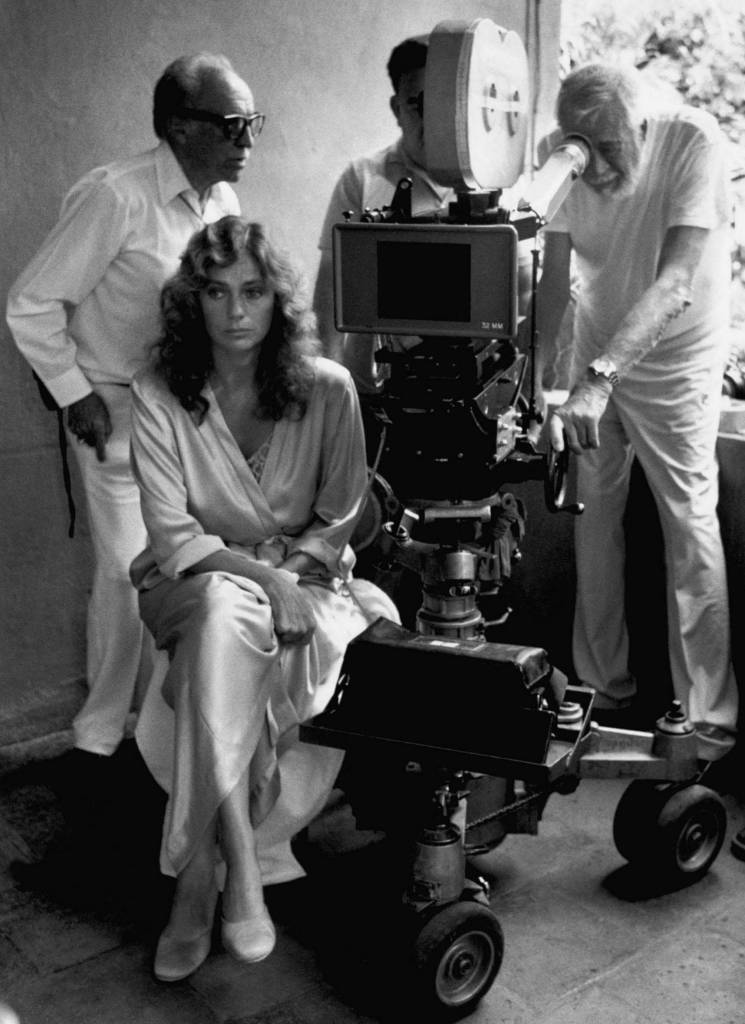
As Firmin, Albert Finney gives a flawless performance, veering from sprawling comedy to understated eloquence to a quasi-operatic grandiosity. He makes real the paradox of Firmin, whose drunken refusal to pick up the pieces of his life takes on heroic, celebratory, even life-affirming dimensions. The entire cast ably supports Finney with a solid realism, but Jacqueline Bisset is particularly remarkable as Yvonne. She employs an elegant restraint that suggests the desperation and passion the woman doesn’t dare express, providing the perfect complement to Finney’s bravura. Working with the great Mexican cinematographer Gabriel Figueroa, Huston has created a subtly hallucinatory atmosphere, using floating close shots and fluid, practically imperceptible long takes to evoke the downward spiral of Firmin’s final binge. Everyone connected with the picture seems to have understood that here was an opportunity to create a great film. They’ve realized that opportunity. We may be only halfway through the ‘80s, but this reviewer feels secure in offering Under the Volcano as one of the best American films of the decade.
(This review first appeared in The Film Journal, July 1984.)
Link to:
Film: Reviews: Contents
For more on John Huston, see:
Film Dreams: John Huston
Film Essay: Orson Welles and the Other Side of Nicholas Ray
Film Essay: Where Is The Other Side of the Wind?
Film Interview: Danny Huston
Film Review: The Dead
 NICOLE V. GAGNÉ