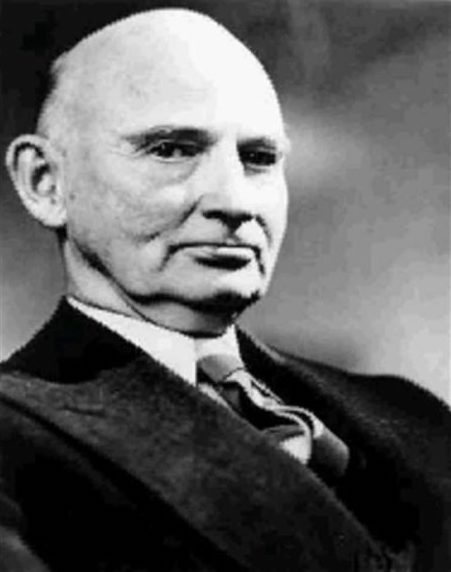
CARL RUGGLES
(1876–1971)
Another 22 days – the 11th of March – will mark the 100th anniversary of the birth of Carl Ruggles. Clearly, now is a good time to begin determining whether or not his music has withstood the test of time. Ruggles already decided that issue to his own satisfaction, of course. Composer Henry Cowell has told the now-famous anecdote of the day he went to visit Ruggles, only to find him obsessively pounding out the same chord on the piano for over an hour. When questioned as to what on earth he was doing, Ruggles responded that he was giving that chord the test of time.
This story is perfectly typical of Ruggles and his music. A fierce perfectionist, Ruggles ruthlessly destroyed any unsatisfactory works and perennially revised his scores. Pianist John Kirkpatrick, a close personal friend of Ruggles and a champion of his music, has commented that Ruggles would not have seen his life’s work as a career, but rather “as a whole series of gradually clarifying, tentative moves towards how to write the kind of composition he had in mind.” That particular composition was of a very special kind indeed. For Ruggles, its creation meant “soul-searching … bringing into being that tremendously deep emotion, that feeling of the sublime that only comes from the heart.”
There are few tasks which are more difficult than the genuine pursuit of the sublime. How else can one explain the fact that Ruggles, blessed with a spectacular longevity (he passed away on October 24, 1971 at the age of 95), produced only a dozen or so works. Most of these scores involved years in order to reach completion. But then, the gestation of Ruggles’ vision required even more time. It was not until 1919, at the age of 43, that Ruggles could create even 16 measures which he felt he could acknowledge as his first step on the road towards the sublime. This work is the song TOYS for voice and piano. TOYS is dedicated to Ruggles’ son Micah, four years old when his father wrote both the words and the music, the “little son” whom the singer addresses. TOYS, with its changing time signature and pungent dissonances, clearly indicates the direction Ruggles’ music was to take. Interestingly enough, the words are prophetic too, concluding with the image of “a wondrous balloon, that floats, and floats, and floats, way up to the stars” (“stars” being a high B natural, a dizzying height indeed!).
Ruggles of course did not wait until he was 43 to begin composing. He had been musically active all his life. Born in Marion, Massachusetts, he busied himself as a little boy by playing a violin he had fashioned from a cigar box. The local lighthouse keepers soon gave the young Ruggles a real violin which he quickly mastered. (At age 9 he played duets with the wife of Cape Cod’s summer visitor, President Grover Cleveland.) Music became a passion with Ruggles. He abandoned his shipbuilding studies in order to pursue both the violin and composition. In 1912 Ruggles went to Winona, Minnesota, where he founded and conducted the Winona Symphony Orchestra. Throughout these years he applied himself to composition, but he finally banished to oblivion all the works which had proceeded TOYS. An opera based on Gerhart Hauptmann’s The Sunken Bell and a waltz for orchestra number among the bridges he burned behind him. It was only recently that two early songs were discovered in the Library of Congress: ICH FÜHLE DEINEN ODEM (1898) and O HOW CAN I BE BLYTHE AND GLAD? (c.1899) The latter song was originally the first in a cycle of three songs published as the composer’s “opus one.” Ruggles presumably destroyed the other two. While neither of these two early songs offer much of a glimpse into their composer’s future, they have a certain charm in their own right and help reveal the young man who sat in on John Knowles Paine’s composition classes at Harvard.
It is with ANGELS that we first see Ruggles at his full stature. Composed in 1921 as a movement of MEN AND ANGELS and scored for six muted trumpets, the work emerged from revisions in 1939 by itself, in a version for four muted trumpets and three muted trombones. Despite its strong A flat bias, ANGELS clearly stands with Ruggles’ other masterpieces, PORTALS and SUN-TREADER. The thick interweaving of the seven voices, non-differentiated in expressivity, richly dissonant, makes ANGELS unmistakably Ruggles’ own work. Even more striking, however, is the mysterious burning intensity of ANGELS: the 47-measure score, marked “Serene,” is one of Ruggles’ major thrusts toward the sublime, and its success is of the highest order.
Thirty measures long and marked “With deep feeling,” LILACS is more rhapsodic and elegiac, and certainly less tonal, than ANGELS, although it does bear certain similarities to that earlier work. Scored only for strings, all exhibiting the same unity of purpose, LILACS again utilizes a dense network of voices, which concludes with a truncated reprise of the opening. LILACS gains its full impact in its proper context, the second movement of Ruggles’ orchestral score MEN AND MOUNTAINS, which was completed as a work for chamber orchestra in 1924, and revised for much larger forces in 1935. Heard by itself, LILACS is most fascinating when seen as a bridge between ANGELS (which can also be performed by seven strings) and PORTALS. PORTALS was originally composed for 13 strings in 1926, the first movement of a projected symphony. The other three movements never evolved beyond sketches, and PORTALS was later revised for full string orchestra in 1929. Like LILACS, its title derives from the poetry of Walt Whitman. The score’s inscription is the first line of Whitman’s poem “Portals”: “What are those of the known but to ascend and enter the Unknown.” This work fully adheres to Ruggles’ dictum that “in all works there should be the quality we call mysticism. All the great composers have it.” PORTALS’ 70 measures concern two themes which grow toward a collision, break off, and begin again. The entire work relentlessly approaches the fff second climax, only to close on a six-measure coda marked “slow and serene,” a postlude which Charles Seeger so accurately described as “one of the most exquisite pages in all modern music.”
The poetry of Whitman also figures in VOX CLAMANS IN DESERTO (A voice crying in the wilderness) for soprano and chamber ensemble, completed in 1923. Along with Whitman, Ruggles set poetry of Robert Browning (whose “Pauline” yielded the title for Ruggles’ SUN-TREADER) and Charles Henry Meltzer (whose English translation of The Sunken Bell had been the libretto for Ruggles’ projected opera). VOX CLAMANS IN DESERTO was originally to have been a setting of seven poems, but Ruggles was only able to complete three to his satisfaction. Similarly, EVOCATIONS, subtitled “Four Chants for Piano,” was originally envisioned as six chants. It took Ruggles 10 years, from 1934 to 1943, to complete these four, each of which he dedicated to a person close to him: the first to Harriette Miller, his patron; the second to John Kirkpatrick; the third to Ruggles’ wife Charlotte; the fourth to Charles Ives, who for Ruggles was the finest contemporary composer, just as Ives saw Ruggles as the summit.
One of the unfinished chants was to have been a march dedicated to Ruggles’ son Micah. But with each sketch for that piece, the march incorporates a long soaring line that finally dissolves into amorphousness. This love for the singing line (which he was unable to realize in that piece) characterizes all of Ruggles’ music and was for him its greatest virtue. The indication “singing” is constantly seen in his scores. It is a staple of his music, which, in both its sound and its ideals, is a super-charged romanticism. Although much has been made of his polyphonic virtuosity, and his great love for Handel and Bach, it would be absurd to ignore this essential factor in his musical make-up (a factor also indicated by his high regard for Wagner and Berg). Ruggles’ music is comparable, in this respect, to the expressionist middle period of Arnold Schoenberg. Although his music is redolent with such devices as canons and cancrizans, Ruggles had little sympathy for serial composition. He usually worked to avoid repeating a tone until the ninth or tenth progression, and even occasionally (as in the first two measures of the second EVOCATION) used what would be regarded as a twelve-tone theme, but Ruggles was adamant in his insistence that “a real composer should be able to bust hell out of a formula when necessary.” For Ruggles, serialism was “a worn out formula. They all sound alike because it all comes from here [the head] and not here [the heart]. They forget that the line must sing, always sing.”
ORGANUM, an orchestral work completed in 1945, carries on this tradition of the singing line. (In 1947 Ruggles completed the two-piano reduction which is performed in tonight’s concert.) The format of the 78-measure score is A-interlude-B-interlude-A-coda. The middle section states the A theme backwards and, as is the case with A, commences canonic imitation of the theme in the seventh measure. The title was a suggestion made by Edgard Varèse. He was impressed with the strong presence of fourths and fifths in the work, and felt that “organum,” the term for the earliest type of polyphony (parallel movement separated by the interval of the fourth or fifth), would be an appropriate name. Ruggles had been a friend of Varèse (whom he nicknamed “Goofy”) since they worked together on the International Composers Guild in the early 1920s.
EXALTATION, like the third EVOCATION, is dedicated to Charlotte Ruggles, who passed away in 1957 after almost a half-century’s marriage. Charlotte, a professional singer at the time of their wedding in 1908, was a constant source of advice and inspiration for her husband’s music. Protection as well, for, like Mahler, Ruggles strictly scheduled his compositional activities, and the converted schoolhouse in Arlington, Vermont, which was the Ruggleses’ home for almost 40 years, had a sign by Charlotte hanging on the door: “Don’t knock until one. Then come in and stay as long as you like.” EXALTATION was written in 1958, a wordless hymn in Charlotte’s memory. Ruggles conceived this plainly diatonic, G major piece for performance by a unison congregation with organ or brass accompaniment. Although he never included a text for the 16-measure hymn, John Kirkpatrick has prepared an addition which suggests Isaac Watts’ traditional paraphrase of Psalm 90.
In a certain sense, Ruggles’ music belies the composer. Like Ives, Ruggles was a paradoxical figure. Unlike Ives, however, his music is all of a piece throughout. It offers up one facet of the man, presumably the one he regarded most highly: the mystic. It does not reveal the man who delighted in smoking cigars and telling off-color jokes; the sports enthusiast who umpired many a baseball game; the man of strong passions, fierce loyalties, and unbridled enthusiasms. To an extent, the music even obscures Ruggles the painter, although the scores themselves do not. Ruggles frequently composed on huge sheets of wrapping paper, spacing staffs an inch apart and drawing in notes with a crayon. It was not unusual to find him with a score on the floor, down on his hands and knees like a workman, following out a polyphonic passage. Occasionally, he would color striking effects onto these scores. Ruggles always considered himself to be an amateur painter, but his friends Rockwell Kent and Thomas Hart Benton, along with such prestigious institutions as the Whitney Museum, evaluated his work more highly. In the summer of 1975, there was a show of Ruggles’ paintings in Manchester, Vermont, and John Kirkpatrick provided a warm and insightful tribute for that exhibition:
In music, Carl was a professional perfectionist; in painting, an untutored enthusiast, starting at 53 to integrate his varied experience in ways professional painters respected. A boyhood memory of infinite wave rhythms and sea colors; a violinist’s linear rapture; a theatre musician’s willingness to jump in; a music engraver’s spatial clarity, with title page’s center in calligraphy or vignettes; a student of boat design gauging balances and shaping wood to wave; a composer communicating within dimensions of time and polychrome sound. He always evoked substantial densities, often brilliant, but suggesting the mystery of an unseen spirit animating or surrounding what is seen.
(These program notes were written for a Continuum concert devoted to Carl Ruggles, given in New York City on February 18, 1976. Special thanks to Continuum directors Cheryl Seltzer and Joel Sachs for giving me the chance to write for them and for their assistance in retrieving these notes.)
Link to:
Music: Essays: Contents
For more on Carl Ruggles, see:
Music Book: Historical Dictionary of Modern and Contemporary Classical Music, Second Edition
Music Book: SONIC TRANSPORTS: Glenn Branca Essay, part 14
Music: SFCR Radio Show #16, John J. Becker and the American Five Plus One

