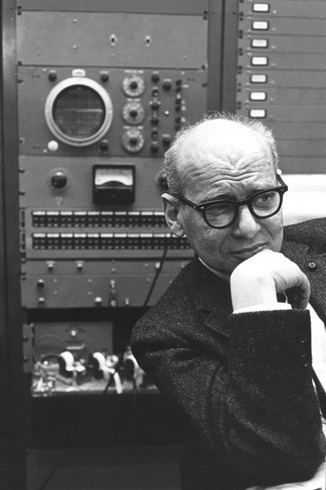
MILTON BABBITT
For over 30 years, Milton Babbitt has been busily working at the forefront of the two great musical innovations of the 20th century: serialism and electronic music. He has achieved several “firsts” in both realms, a fact which is of no small historical importance. But it is the high level of his artistic achievement which has prompted tonight’s celebration.
Alban Berg is reported to have said that the finest music resulted from “ecstasies of logic.” With respect to the contemporary music scene, that phrase would seem to have been written for Milton Babbitt. Other commentators have written explications of the incredibly rich and complex scores which Babbitt has produced. An unfortunate side product of their analyses has been to create an image of a composer who is hermetically sealed within his hopelessly mathematical music. When Babbitt attempted to write about his own music – and that of his colleagues – the article was subsequently edited and retitled, emerging as the now somewhat notorious “Who Cares If You Listen?” In reality, Babbitt has always cared about who was listening and how one was listening, but he is first and foremost a composer, and, therefore, his primary concern has been what one is listening to.
It is a music of astonishing clarity and elegance, possessing that widely envied gift of perfect balance and proportion; there is no sense of indecision, no straining to make the materials last for the duration of the piece in Babbitt’s music. As would be expected from a composer who has been involved with the development of electronic music since the 1930s, the music is striking for its subtly detailed and sophisticated sense of rhythm and dynamics. It is also a widely variegated music. As the composer has commented, “My thoughts on music change with every piece, are changed by every piece, and – thus – change each successive piece.” Babbitt’s polyphonic gifts, rhythmic virtuosity, and overarching organizational control have remained constants, but they are always revealing themselves in an ever-differing, ever-developing manner.
Milton Babbitt was born on May 10, 1916 in Philadelphia, but spent his youth in Jackson, Mississippi. It was in the South that he first began his musical activities, studying the violin at the age of five and the clarinet at eight. In 1934 Babbitt came to New York University to study with Marion Bauer, whom he had sought out because of her familiarity with the works of Schoenberg. The following year, she arranged for Babbitt to study privately with Roger Sessions. These studies would be of profound importance for him: “My whole musical life is very much indebted to Roger Sessions.” In 1938 Babbitt joined Sessions on the Princeton music faculty. He continues to teach there, as well as at the Juilliard School.
Babbitt’s enormous knowledge of the pop music dating from the mid ‘20s to the mid ‘30s has always been a rather legendary facet of his musicianship. Tonight’s performance of THREE THEATRICAL SONGS offers a rare public opportunity to hear music by Babbitt which springs directly from that early love. When Babbitt was growing up, he spent a great deal of time playing, arranging, and simply living the ubiquitous pop music. Tonight’s songs strongly reflect the style and atmosphere, the vintage, of this youthful preoccupation. The THREE THEATRICAL SONGS (which required a certain amount of reconstituting on the composer’s part for tonight’s performance) are simply “the remnants of my childhood” for Babbitt, holdovers from a youth devoted to writing songs both for contests and for pleasure. Nevertheless, two songs can be considered professional work, insofar as they were written for a Broadway musical (Fabulous Voyage, based on the return of Ulysses, a project which never reached fruition).
During World War Two, Babbitt was unable to apply himself to music; virtually all of his time was spent devoting his extensive mathematical knowledge to government activities which are still classified as secret. After the war, he found himself deliberating as to precisely what he should do. He worked for a time scoring a film, as well as writing his music for the stage. The THREE COMPOSITIONS FOR PIANO is the first work Babbitt completed after the war. It draws on mostly unfinished works that date from just before his prolonged hiatus. In these pieces he sought to make the simplest statement of those compositional concerns which were to preoccupy him throughout his career – the two fundamental factors in music: pitch and time. Babbitt’s intimate knowledge of the music of Arnold Schoenberg formed the basis of his own more complex and ramified use of the twelve-tone system. Serial techniques had yielded for Babbitt the richest method of ordering pitch, but the whole temporal situation in music was still a largely unexplored, even somewhat mysterious realm. His solution was to apply to time relationships methods of organization which had been hitherto reserved solely for pitch. He posited as analogous the interval between two pitches and the duration between two points in time. His procedure was to take a limited, ordered collection of time points and utilized them as he had utilized pitches, retaining the intervallic structure. Much of Babbitt’s early style – its traditional grounding and its new directions – can be heard in these pieces. Each is in a different way a virtuosic display of contrapuntal wizardry. The outer movements, with their very restricted rhythmic vocabulary and motoric dynamism, are the most obvious descendants of the period of Bach. The middle piece is a highly complex counterpoint of time-scales, in which slowly moving, full-bodied chords contrast with quiet, yet energetic, phraselets that almost seem to move in their own world. All three pieces share one important feature, however: Each individual angular line or chord implies a multiplicity of levels and layers, connected by impeccable voice-leading, which function, as in Bach’s case, to create the illusion of a texture denser than it actually is. This interlocking of phrases within phrases and levels within levels begins Babbitt’s long development toward works as different and separated in time as the COMPOSITION FOR TWELVE INSTRUMENTS and SONNET 71.
In its original version, the COMPOSITION FOR TWELVE INSTRUMENTS was written one year after the THREE COMPOSITIONS FOR PIANO, an indication of Babbitt’s interest in applying his musical concerns to larger media. This 1948 score had a guitar as one of its 12 instruments, but the inability to find a guitarist who could accurately follow a conductor required Babbitt to re-score the peace. The replacement of the guitar by a harp led the composer to a substantial revising of the work in 1954. The work folds into two sections, played without pause. The first part, a very rarified texture, suggestive of Webern, is largely devoted to a single line, each note of which is stated by a different instrument. The second section is the complement of the first, moving along in large chordal blocks; to an extent, a vertical statement of the earlier horizontal material.
The COMPOSITION FOR VIOLA AND PIANO (1950) operates in a basically more conventional textural manner. The work opens with long, gradually changing chords on the viola, sounds sustaining well beyond the piano’s inherently percussive nature. Eventually, both instruments assume more of a percussive role, only to return to the format of the opening. The work has seven distinct sections: slow, with instruments muted; fast; piano solo; fast, scherzando-like; viola solo; fast; slow. Each has its characteristic textural features changes, which arose naturally as elements clarifying relationships of pitches and rhythm. A further striking aspect of this work is its jazz-like rhythmic propulsion, an important element of much of Babbitt’s writing, and a part of him since his earlier days as a jazz clarinetist.
The STRING QUARTET NO. 4, commissioned by the Library of Congress and completed in 1970, came very soon after his THIRD QUARTET. As opposed to the homogeneity of textures in that preceding work, this quartet offers strong contrasts in its four sections. Each instrument dominates a different section of the FOURTH QUARTET, which is played without pause. The work as a whole can be seen as four passages through the same pitch-class material, with different rhythmic assignments characterizing each passage.
THE WIDOW’S LAMENT IN SPRINGTIME for soprano and piano is a short, modest work of Babbitt’s which eschews the rhythmic complexity of his later vocal scores. The song was written for the widow of Roy D. Welch, who had been the chairman of the music department at Princeton. Although the nature of the circumstances influenced Babbitt’s choice of the text, and equally decisive factor was the rich assonantal relationships in Williams’ poem, which provided the composer with the sonic suggestiveness he so desperately looks for when selecting texts. Finding satisfactory English-language poetry for his texts has been a chronic problem for Babbitt, one which has occasionally compelled him to write pieces in which the voice functions as a wordless instrument. In fact, the FOUR CANONS for two voices offers its singers the option of foregoing both its German and English words and simply vocalizing instead. The FOUR CANONS were written in 1969 as Babbitt’s contribution to the Festschrift Princeton published to honor its music historian, Oliver Strunk (with whom Babbitt had studied when still a graduate student). They draw upon a birthday canon written in 1943 by Schoenberg for Carl Engel, the chief editor at Schirmer’s Publishing Company and a good friend of Oliver Strunk. Babbitt chose the opening notes and the opening line of Schoenberg’s lighthearted tribute in order to pay this tribute of his own.
The poem “Vision and Prayer” by Dylan Thomas had interested Babbitt for a number of years, since an initial attempt at setting it for voice and piano in 1954. The composer settled on Thomas’ poem because of its unique shape, which suggested to him certain structures of pitch groupings. The setting for voice and tape was completed in 1961 and is the first work for live vocal performer and synthesized accompaniment. (Tonight’s performance marks the work’s second hearing with the tape in its full four-track version.)
SONNET 71 is the first section of a six-part requiem for the late Godfrey Winham, Bethany Beardslee’s husband, who had been a member of Princeton’s music department. The entire work will be completed by this fall, and its texts will consist of poems by Shakespeare, Hopkins, Stromm, and a dialogue on death by metaphysical poet Henry Vaughan. The final version may well expand the two-piano accompaniment to include tape – not the synthesized accompaniment of VISION AND PRAYER, but a manipulated tape of Bethany Beardslee’s voice, perhaps of a chorus as well. In SONNET 71 the voice is treated in quite a straightforward, relatively sustained manner, and set largely in a moderate register. The pianos vastly extend the musical space – often to the extreme ranges of the instruments – and produce a quality of multi-dimensionality in the intricacies of rhythm and counterpoint which underscore the text. The effect of the piano writing and its relation to the voice is not unlike that of the synthesized accompaniment in VISION AND PRAYER.
“I have presumed to pursue the goal of attempting to make music as much as it might be, rather than as little as one obviously can get away with.” The pursuit of that goal has compelled Milton Babbitt to write scores which have seemed to be as complex as music might be, and as difficult to perform as might be. That is good, respectively, for other composers and for musicians (at least those who subscribe to a Puritan work ethic). But Milton Babbitt has at the same time written scores which have seemed as dazzling, or as mysterious, or as delightful, or as beautiful as music might be. That is good for everybody.
(These program notes were written for a Continuum concert devoted to Milton Babbitt, given in New York City on March 24, 1976, and were co-authored by Continuum directors Cheryl Seltzer and Joel Sachs. Special thanks to Cheryl and Joel for giving me the chance to write with them and for their assistance in retrieving these notes.)
Music: Essays: Contents
For more on Milton Babbitt, see:
Music Book: Historical Dictionary of Modern and Contemporary Classical Music, Second Edition
Music Book: Soundpieces: Interviews with American Composers
Music Lecture: “Intense Purity of Feeling”: Béla Bartók and American Music
Music: SFCR Radio Show #35, Electro-Acoustic Music, part 3: Musicians and Synthesized Sound

