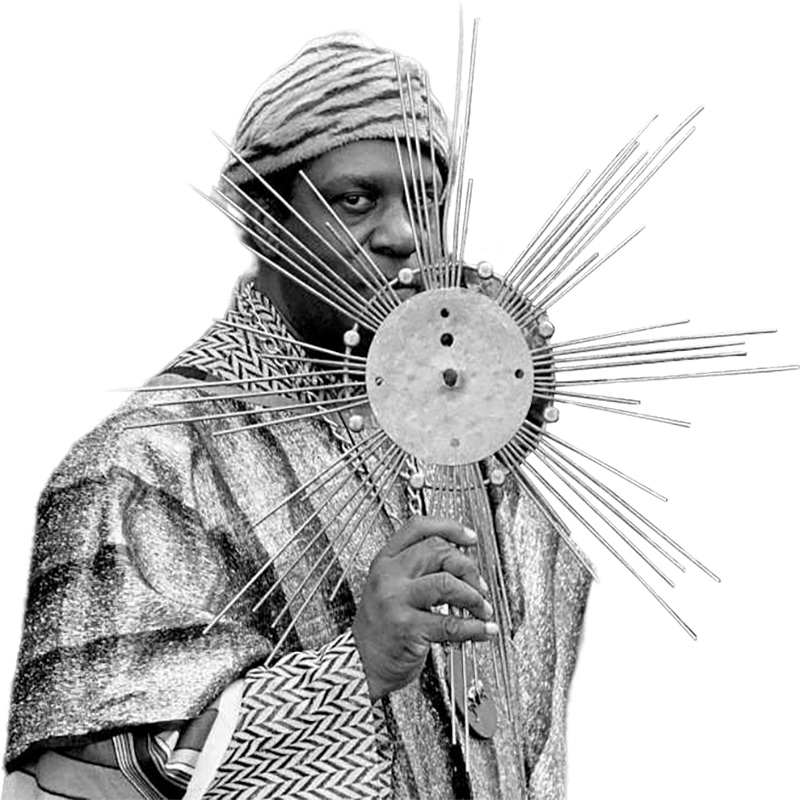
King of the Omniverse: Sun Ra and His Arkestra
When the world was in darkness
And darkness was ignorance
Along came RA!
Like the poet Dante Alighieri, who described his journeys through Hell, Purgatory, and Heaven in his 14th-century masterpiece The Divine Comedy, Sun Ra was also a poet and a maker of masterpieces and a traveler of the cosmos, an analyst and commentator on mysteries both worldly and extra-terrestrial. Dante’s birthdate is unknown, but he did acknowledge that he was born under the sign of Gemini. Sun Ra frequently made the same admission – it was the only detail he cared to discuss about his personal nativity, preferring to insist that his planet of origin was Saturn, not Earth. Keep in mind that Saturn is the farthest planet from Earth, which is still visible to the naked eye – our discoveries of Uranus, Neptune, and Pluto would all have to wait for the invention of the telescope. In other words, Saturn is the bridge, the gateway from the known to the unknown, from the personal to the transpersonal, from our order of being to other orders of being. Hence Sun Ra’s insistence on drawing a distinction between himself and humanity.
Sun Ra developed an entire persona and way of life based on his vision of intergalactic travel and his studies of the Bible and Egyptology. We know that he was playing piano by age 11 and that, as a teenager in the early 1930s, he was leading his own band and touring the South. When he was 21, 22 he studied music at Alabama A&M University for a year. About ten years later, by 1946 he was serving as pianist and arranger for Fletcher Henderson in Chicago. And it was in Chicago that his studies of space, ancient Egypt, and the Bible merged into a dynamic personal philosophy, and in 1952 he legally changed his name and began performing as Le Sony’r Ra, or more simply Sun Ra; he also formed his own band, which he called the Arkestra. Three major saxophone players were soon enlisted long-term: John Gilmore, who played tenor, joined in 1953; not long after, so did Marshall Allen, altoist, and Pat Patrick, who played baritone. Sun Ra’s first LP with the Arkestra, entitled Jazz by Sun Ra, appeared in 1957.
I referenced what I described as Sun Ra’s “philosophy,” but that terminology is in fact something he rejected. He once said, “Philosophy is conjecture. I’m dealing with equations. That’s different from philosophy. Philosophy is something like religion, it’s a theory. It could be true or not. But I’m not dealing with theories, I’m dealing with equations. And these equations are very important for people to know. If people on this planet had one thing to hold onto that they know is true, they’d have something to work with. But they don’t have any equations, you see – except how to make a nuclear reactor.”
Sun Ra was also fond of pointing out what any astrologer could tell you, that Saturn was the planet of discipline. And discipline was more than just a keyword for him, it was the source of the precision and beauty that characterized his music. If you google the word “discipline,” you’ll be offered links to endless websites concerned with disobedient schoolchildren – along with numerous sites about S&M and B&D role-playing. But the English root of the word “discipline” is “disciple.” And to be a disciple, to be capable of learning, of obedience, of openness, one must have discipline. One of Sun Ra’s musicians, the bassoon player James Jacson, made a very telling observation: He said that “The dismissal of everything non-spiritual, that is Sun Ra’s discipline.”
Now I’m going to quote Oscar Wilde: “Things in themselves are of little importance, have indeed […] no real existence. The spirit alone is of importance.” Wilde wrote that in 1897, when he was in prison, and all the things that he had surrounded himself with, that he had been diverting himself with, had been stripped from him. And let’s not forget that the room in which a monk or nun sleeps is also called a cell. From his cell in Reading Gaol, Wilde also wrote, “Only that is spiritual which makes its own form.”
So you can see why Sun Ra consistently sought to break down his musicians’ education and training, and replace all that with the guidance of spirit. James Jacson recalled, “What Sun Ra had to do was reverse that state of bodily control, and he would demonstrate it with music and the Arkestra. He proved that you could do it by taking individuals and teaching them to do it – even people with no experience, no ideals, no intelligence … and once you achieved what the spirit could lead you to, you were hooked … you wanted to do it forever.”
And now you know how Sun Ra was able to inspire and motivate and maintain and create for and document through his own record label, which he called Saturn, the Arkestra, a real-live big band, for 40 years. He didn’t do it through the support of patrons or grants or fellowships or the academy or the recording industry. Instead, he made this impossible thing possible by creating a disciplined situation, artistically and socially, in which his musicians discovered a way to get beyond themselves – a way to get way beyond themselves.
Sun Ra had different methods for enabling them to evoke spirit. He might say, “Play that apple” or “Play the warmth of the sun” or “How does water feel? Play that.” He told the saxophonist Wendell Harrison that he’d “have to learn to feel all over again.” Sun Ra once admonished the trombone player Tyrone Hill, “Tyrone, you playing what you know, play something you don’t know.” Hill said, “Sun Ra always taught us to do the impossible. To do something you don’t know. That you don’t know about. That’s totally impossible.”
In other words, Sun Ra taught them how to access spirit, how not so much to do the impossible, but rather how to facilitate the occurrence of the impossible. For Sun Ra, employing the impossible was just common sense. Like Oscar Wilde before him, Sun Ra also dismissed material reality, insisting, “Reality equals death, because everything which is real has a beginning and an end. Myth speaks of the impossible, of immortality.”
Sun Ra knew that what he could do with his musicians, he could do with anybody – with everybody. He once said, “My job is to change five billion people to something else. Totally impossible. And that’s why I’ve played the low profile. Because it can’t be done, but I have to do it. I’m told by superior forces, ‘It has to be done, and you can do it.’ So who am I to doubt it? Everyone else can do the possible things, why should I waste my time with that? Everything that’s possible’s been done by man, I have to deal with the impossible. And when I deal with the impossible and am successful, it makes me feel good because I know that I’m not bullshittin’.”
Friends, let’s be honest: The word “impossible” is just a condensed way of saying “I’m possible.”
In 1969 Esquire magazine asked Sun Ra for his thoughts on the moon landing. And he sent them this poem:
Reality has touched against myth
Humanity can move to achieve the impossible
Because when you’ve achieved one impossible the others
Come together to be with their brother, the first impossible
Borrowed from the rim of the myth
Happy Space Age To You….
I want to play for you two short examples of what the Space Age meant to Sun Ra in musical terms.
The first is Sun Ra at the piano with Arkestra musicians in a very rare recording, made probably sometime in the 1970s. The quality is not great – this is a recording of Sun Ra playing a cassette of this music for Peter Hinds, a researcher devoted to Sun Ra and his music, who along with his brother John has greatly enhanced our knowledge and appreciation of Sun Ra. You’ll also hear a little bit of Peter and Ra’s voices discussing this truly haunting music, which Sun Ra called “Children on Mars.”
The next piece I’m going to play for you is from a 1970 recording, a work called “The Invisible Shield.” You’ll hear other Arkestra members participating in this performance, but the music is dominated first by Marshall Allen on alto saxophone and then by Sun Ra, who plays both electric organ and the Mini-Moog. And the equality of these two soloists strikes me as the plainest way Sun Ra could imply the equivalency of acoustic and electronic sound in Space Age music. “The Invisible Shield.”
Sun Ra’s love of electronic music is especially impressive because it meant moving beyond his own virtuosity as a pianist. He was in fact greatly skilled at numerous piano idioms, as well as a born improviser who was also right at home in polyrhythm, dissonance, clusters, and resonances – he was even adept at playing string piano, playing directly on the piano’s strings rather than its keys. Yet Sun Ra also maintained a lifelong reliance on electric keyboards.
He played one of the first synthesizers that became available, buying a preproduction Mini-Moog in 1969. Over the years, Sun Ra’s arsenal included Wurlitzer organ, Farfisa organ, Rocksichord, Yamaha organ, Spacemaster, electronic celeste, DMX. The history of electronic music has generated a considerable literature, and yet a shamefully large number of these historians have managed to ignore Sun Ra completely, even though he produced one of the great bodies of work in the real-time performance of electronic music.
The combination of acoustic and electronic keyboards became a staple of Sun Ra’s music in his performances of the 1970s, ‘80s, and ‘90s. A synthesizer would be placed on top of or alongside his piano, so he could play both instruments simultaneously, if he desired, one with the left hand and the other with the right. I’d like to play for you now the first recorded example of his work in this direction: a recording made in Chicago in the late 1940s of the Peter DeRose song “Deep Purple,” played by the great jazz violinist Stuff Smith.
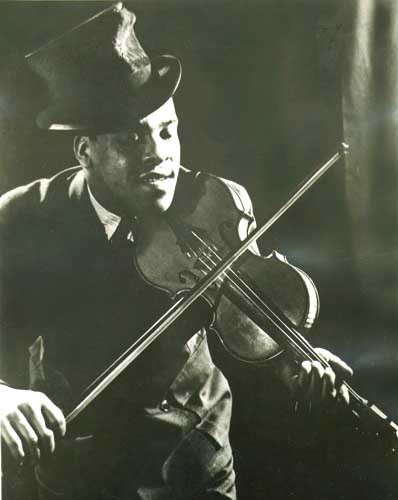
Accompanying Stuff Smith is Sun Ra – although he had yet to name himself Sun Ra at that time. But he WAS Sun Ra even then, as you can tell by his keyboard playing, as he is performing on both piano and Solovox – often simultaneously.

The electronic Solovox was manufactured in the States by the Hammond Organ Company during the 1940s. It was a monophonic instrument, capable of producing only one tone at a time, with a three-octave keyboard that was designed to be mounted just below the keyboard of a piano, so that pianists could accompany themselves with the various string-, woodwind-, or organ-like sounds that the Solovox could produce from its oscillator and metal reeds.
Stuff Smith was one of many outstanding musicians who performed with Sun Ra. Coleman Hawkins played tenor sax in a trio with Stuff Smith and Sun Ra around that same time; so did another young tenor saxophone player, who then called himself Bill Evans but later changed his name to Yusef Lateef. Sun Ra also performed with the singer LaVern Baker, who was then billing herself as Little Miss Sharecropper. He would later make a few recordings with vibraphone player Walt Dickerson. He performed with the drummers Andrew Cyrille and Milford Graves. And there were notable musicians who became temporary members of the Arkestra, such as tenor saxophone player Pharoah Sanders, drummer Beaver Harris, trumpet players Lester Bowie and Don Cherry, guitarist Stanley Jordan, bass player Peter Kowald, alto saxophonist Dave Sanborn, alto and soprano saxophonist Archie Shepp, singer Syd Straw.
But the most unusual and unique musician to ever perform with Sun Ra had to be John Cage: the most influential American-born composer of the 20th century. And their sensibilities were not as far apart as you might think. In his 1972 poem “The Other Side of Music,” Sun Ra wrote:
EVERY PLACE THERE IS IS MUSIC. CHAOS
IS MUSIC AND HARMONIOUS PEACE IS MUSIC […]
Silence is music.
There are different kinds of silences:
each silence is
A world all its own.
When Sun Ra performed with John Cage, I’m proud to say that I was part of the audience that packed their performance space to the rafters. That afternoon remains one of the high moments of my life in music.
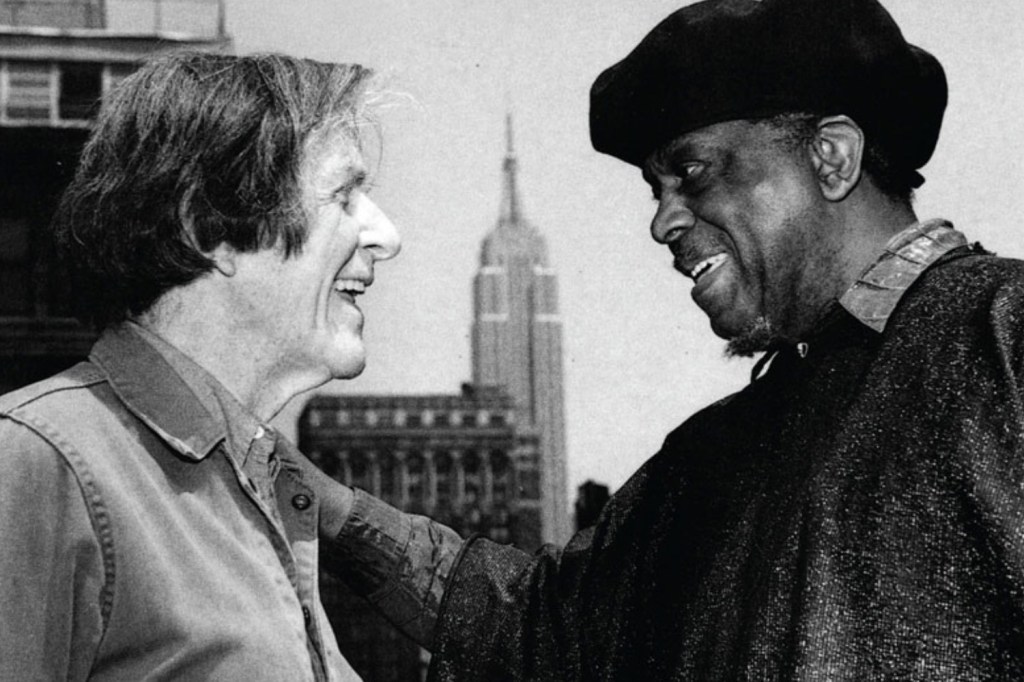
The publicity for Coney Island’s Sideshows by the Seashore screams to its visitors, “They’re here, they’re real, and they’re alive! Freaks, wonders, and human curiosities!” On June 6, 1986, two living wonders were definitely present at Brooklyn’s Coney Island, for a special concert that had been advertised simply as “John Cage Meets Sun Ra” – both men, new to each other personally, felt more comfortable with the idea of a meeting rather than any official attempt at collaboration. But whatever it was being called, however it was being positioned, I knew it would be an historic encounter between two masters, and there was no way I could miss it.
John Cage, with the simplicity that defined his later concert performances, sat at a table with only the pages of his text, a stopwatch, and a microphone. Sun Ra tunneled in through the other side of the mountain, entering with a royal fanfare from Marshall Allen, an electro-acoustic call played on the wind-controlled EVI (electronic valve instrument), rather than his alto saxophone. Dancers accompanied Sun Ra the few short feet from the wings to his Yamaha DX7 synthesizer, everyone solemn in demeanor.
The two composer/musicians alternated their performances. Cage, following his watch with precision, carefully read from his 1974 text Empty Words, which used chance procedures to reinvent word fragments from the journals of Henry David Thoreau. Cage intoned the soft guttural sounds and noises dictated by the rearranged clusters of consonants and vowels from Thoreau’s writings, his vocalizations punctuated by oases of silence, in a performance that came to resemble the ambient sounds of some remote nocturnal landscape rather than a man’s amplified voice. Sun Ra played short, ecstatic, noisy improvisations, moving through a spectrum of sounds. Again offering Cage’s complement, he turned his gaze inward as he performed, listening intently while his hands danced across the keyboard as though independent of him.
Back and forth the two sounds worlds went, with John Cage and Sun Ra respecting each other’s boundaries. But toward the end of the concert Sun Ra got up from his instrument and went over to Cage. The two spoke quietly for a moment, Cage nodded, and Sun Ra returned to his seat. Then they performed together for their conclusion, the high, simple electronic tones of Sun Ra’s synthesizer reinforcing the nature-like effects of Cage’s recitation.
After they stopped, the crowd that had been so silent for so long was on its feet, and the cheering was epic.
A few years after his performance with John Cage, I had the opportunity to interview Sun Ra for my book Soundpieces 2, and I want to share with you some of the things he told me.
Sun Ra said,
“I saw a picture called Unheard Melodies, and that should be in every school. They were investigating something with some statues from ancient days, and they proved that each statue made a different sound from the other. And they did it because when the wind came by, the wind made a sound: Pfeewww. And this statue made a sound, the same sound every time. So that means that people who are worshipping some kind of statue, they are being frequencized, you might say. They keep on standing in front of that statue, and the vibrations are coming at them, and they’re being made into the frequencies of their statue, whether it’s Buddha, Jesus Christ, whatsoever. They before that image, and being before that image can really do something to them. And that’s how delicate the situation is. We like in a magic kingdom, magic. I mean the whole thing is like magic. They have to get to the point to see that the greatest magician in all the universe is the Creator. ‘Cause He made all of this up out of nothing. And only a magician can do that. He made it out of nothing.
[…]
“It’s the only way you can talk to God now: through sound. You got to talk in pure language. The other languages are confused; every language is confused. Everything is confused except sound, purity of sound. So you find some pure musicians playing pure sounds, you can reach God.”
Let me stop here for a moment. I remember once I was backstage at some New York City venue where Sun Ra and the Arkestra were performing – this must have been when I approached him about doing this interview, so sometime in late 1989, early 1990. He was seated in a chair, and at his feet was a musician. I don’t know who that man was, but he was not part of the Arkestra – not that evening anyway. And he was pleading with Sun Ra to let him play with the band that night. I remember he had a little toy trumpet that he would blow in occasionally. He was clearly high as a kite, on whatever. And Sun Ra kept telling him no, he couldn’t play with them. He asked repeatedly why he couldn’t, and Sun Ra kept giving him the same answer: “You’re not pure.”
To resume from our interview: Sun Ra told me that music is “the only thing that can reach people. Music is a universal language, so you can speak to them too. ‘Cause their languages are different, and their frequencies are different. But music don’t care nothing about no frequencies, it covers all frequencies and all planes. It’s eternal. It goes on up and it keeps on going. That’s what sound does, it keeps on going. It does not stop here; it does not stop in a room. It goes out there and keeps on going. Well then, people out there, other beings, they’ll hear it. They’ll hear it. It’ll reach a point where, if they don’t hear it, they will feel it. They have to. So then you can reach any type of being with music. It’s the only thing that’s left. But this planet has regarded musicians as a luxury, entertainment as a luxury, when actually it’s a necessity. It is a vital necessity at this point. In fact, in the Bible, where it’s talking about the end of time, it does say, when you see all these troubles and everything, rejoice, have a good time. Folks are supposed to be partying 24 hours a day now, because it’s the end of the age. And it tells them to do that, be glad that the age is over.
[…]
“I never sought to be famous or nothing like that, I’m really trying to keep from being part of humanity, ‘cause I don’t like what’s happening to them. And I never wanted to be like them, ‘cause I knew where it’s all headed. I knew it was gonna be just like they are now. I could see that as a child, and I didn’t want to be part of this. I knew everything about people: where they were headed and why they was gonna get there. I knew that. And I knew they could stop it too. So I just stepped back. I watched my so-called generation be a complete failure, because they believed the status quo and they believed what they were doing was right. But I watched them as they died and as they left the planet. They didn’t know what I was thinking, but I was thinking that beauty and music and sincerity is the answer. That’s what I was thinking. And I was seeing people neglect that with their children, I saw that. I saw them bypass jazz and other forms of art and culture, I saw that. And I saw that their children was gonna be left with no way to turn, I saw that. Because they were neglecting some basic things that their children were gonna need in this age. So I stepped back. I didn’t offer what I had to offer. Just now and then I put something out there. But my basic thing, I kept it.
[…]
“I’ve made research on humanity to see why they in this condition. And I have been taught by outer-space beings and the Creator the real truth, and I got it. I can’t back away from it and say it is not true. It is true. I’m not dealing with faith and hope; I’m dealing with wisdom. I’m not even dealing with knowledge; I’m dealing with the unknown and ignorance. Because I’m ignorant: I don’t know what’s happening here. I’m just a student of things, and I learn every day. And I got so much to learn, it’s amazing. I’m just getting started learning things, about music and other things, to what to do with it. To have talent is all right, but what you gonna do with it? A lot of people got talent, but they’re here today and gone tomorrow, they’re not able to do anything with it, they don’t stay here long enough to do it. The water in the river evaporates every day. People are the same, they evaporate: They here one day, the next day they evaporate and go somewhere.
[…]
“So you see, people should wake up. Something is going on. And they sit there and look at these movies, it’s very instructive. TV’s instructive. Radio is instructive. And you’ve got a lot of things that are trivial and ridiculous, but you’ve got some things out there that are sincere and life-giving; even better than life being given. You got it out there. Everything is here.”
Sun Ra’s concern was to stake out a beachhead right here and now, a transformative sensibility that could be available to anyone residing on the third rock from the sun, a way to imbue the immediate and mundane with the mythic and the transcendental, a way to live in space right here on Earth.
I once got a glimpse of how he achieved some of that for himself and his musicians. Back in 1987, 1988, I had the pleasure of meeting and speaking with June Tyson, who sang with the Arkestra for many years – a wonderful artist, whom you saw and heard in the film clip that opened this talk. As I was leaving, I turned and waved to her and said goodbye, and her reply to me, holding her hand up, was, “Space.” And immediately I said to her, “Space is THE place!” And I meant it. There’s really no way NOT to live in space here on Earth, is there? After all, where IS the Earth? In space! What’s the line from the old dishwashing-liquid commercial? “You’re soaking in it”? But you’re not living in it unless you know it. You know?
In 1961 Sun Ra and his Arkestra left Chicago and relocated to New York City, and over the 1960s they would play sets at a small East Village club called Slugs’; then in 1968 he and his musicians settled for good in a house in Philadelphia. But it was those New York performances that established the Arkestra’s method of operation. Their sets were multimedia events, complete with dancers, film projections, light shows. The musicians dressed in colorful, glittering costumes, and would often march around the audience joyfully as they played or chanted. “A costume is music,” Sun Ra once commented. “If the musicians dress creative, instead of wearing overalls and jeans, people can appreciate that. The average person, you see, they have a hard time working, they wear their work clothes. But musicians don’t need to be in competition to the working man. They need something else, so the working man will say, ‘That’s beautiful.’”
And just as a costume is music, so too, dance is music. Sun Ra insisted, “There comes a point where musicians, being limited by manmade instruments, can’t bend to a certain thing you want to express. The dancers know how to bend, so they can express music the band can’t. The dancers become a note by the way they stand or move, and the people can feel it.”
The performances of Sun Ra and his Arkestra were a form of didactic music theater, as Sun Ra sought to wake people up to the need for discipline, the possibility of opening and freeing the mind – “Space is the place,” which became his classic chant. The Arkestra’s sets were also unpredictable excursions over the history of creative African American music. Unpredictable sometimes for his own musicians – you’d see each member of the Arkestra take their seat with a sheaf of score parts as thick as a phone book. When Sun Ra would start to play an opening phrase or melody at the piano or synthesizer, the veteran Arkestra musicians would reach into their books and pull out just the page that Sun Ra was introducing, and the newer band-members would be looking over at what was on their stands so they could see what piece they were about to play. Arkestra performances would include arrangements of classics by W.C. Handy, Jelly Roll Morton, Fletcher Henderson, Fats Waller, Duke Ellington, Billy Strayhorn, Mary Lou Williams, Thelonious Monk. And as “Deep Purple” demonstrated, Sun Ra was also devoted to the great American songbook, playing covers of George Gershwin, Kurt Weill, Jerome Kern, Harold Arlen. But he was just as quick to play one of his own songs or a driving hard-bop original or a roof-raising collective free improvisation. Extended performance techniques were regular features as well, especially multiphonics and overblowing with the saxophones. Many Arkestra musicians also became adept multi-instrumentalists – one of Sun Ra’s record albums included this notification: “As all Marines are riflemen, all members of the Arkestra are percussionists.”
And with all the percussion innovations Sun Ra incorporated into the Arkestra, his music’s rhythmic freedom increased drastically. He once pointed out, “Most jazz will lay out over one rhythm, but my music has two, maybe three or four things going, and you have to feel all of them. You can’t count it.” The Arkestra’s percussion section also grew multiculturally, incorporating at various times Indian drumming and a Brazilian capoeira troupe alongside the band’s multiple drum sets, African drumming, and homemade percussion. A perfect example of how Sun Ra put his musicians in touch with spirit is how he got the bassoonist James Jacson, who had never built an instrument, to construct his own drum.
The Daoist sage Zhuangzi, writing in China sometime around the early third century BCE, told the story of King Wan-hui who congratulated his cook for having expertly butchered the carcass of an ox with no fuss or effort:
The ruler said, “Ah! Admirable! That your art should have become so perfect!” The cook laid down his knife and replied to the remark, “What your servant loves is the method of the Dao, something in advance of any art. When I first began to cut up an ox, I saw nothing but the carcass. After three years I ceased to see it as a whole. Now I deal with it in a spirit-like manner, and do not look at it with my eyes. The use of my senses is discarded, and my spirit acts as it wills. […]
“A good cook changes his knife every year – it may have been injured in cutting; an ordinary cook changes his every month – broken. Now, my knife has been in use for 19 years; it has cut up several thousand oxen, and yet its edge is as sharp as if it had newly come from the whetstone. There are the interstices of the joints, and the edge of the knife has no thickness; when that which is so thin enters where the interstice is, how easily it moves along! The blade has more than room enough. Nevertheless, whenever I come to a complicated joint, and see that there will be difficulty, I proceed anxiously and with caution[. …] Then, by a very slight movement of the knife, the part is quickly separated and drops like a clod of earth to the ground. Then, standing up with the knife in my hand, I look all round, and in a leisurely manner, with an air of satisfaction, wipe it clean and put it in its sheath.”
The ruler Wan-hui said, “Excellent! I have heard the words of my cook and learned from them the nourishment of life.”
Sun Ra had the same understanding when he urged his musicians to rely on spirit. The best explanation I’ve found of what Sun Ra meant by spirit was written by John F. Szwed, derived from his extensive conversations with Arkestra musicians, and detailed in an excellent biography of Sun Ra, which Szwed called Space Is the Place: The Lives and Times of Sun Ra, published in 1997. Szwed wrote, “The key to understanding […] is through the spirit, not through the body or the mind … but by allowing your spirit to take control and guide your actions. The spirit is part of the Creator, a small spark of that originating force. […] The spirit can be located by stopping thought, abandoning knowledge, trusting intuition. You can’t do it with your mind alone. Ignorance, in fact, is a form of spirit. Human beings have more ignorance than knowledge, so if you let the ignorance take over, release yourself from your defenses, […] the spirit will take over … and you’ll make beautiful music. You won’t make mistakes. To err is human, to be human is to make mistakes; but the spirit never errs. Everything should be done with the spirit because the mind can’t be trusted: You can always lose your mind, but never your spirit … the spirit can help you be what you really are. […] Nor can the spirit die, because it was never born. It is not even part of the created world but is as old as the Creator of which it is a part. […] Life and death were both put into question by Sun Ra. […] If death is to be defeated, then life itself must be denied, because those who weren’t born will not have to die. […] This ‘life’ is death pretending to be life. […] But life and death didn’t interest [Sun Ra]; he was talking about ‘being,’ a third state, which forms a triangle with life and death. Being gave life and death permission to exist. […] Life is not the same as being, and a human life and a human being aren’t the same, because a human being can never die. ‘Being’ is the better term – beings don’t die. The eternal part has no name. […] It’s not about life; it’s not about death; it’s about being. Even when they speak about a Supreme Being, they don’t say, ‘Supreme Life.’ To [Sun Ra], the best thing about jazz was that the idea, or being, of jazz is based upon the spontaneous improvisation principle. Pure jazz is that which is without preconceived notion, or that which is just being, and that was really his definition of jazz.”
All of these ideas come together in an extraordinary moment from a performance at Town Hall in New York City, a few days before Xmas in 1973. This concert was for the Comet Kohoutek, which was then passing close to the Earth. First you’ll hear Sun Ra at the synthesizer. Then he takes the microphone and asks some questions, the vocalist June Tyson backing him with great feeling and urgency; you’ll also hear other women’s voices behind hers. After Sun Ra finishes, John Gilmore takes his tenor saxophone into a very strange zone that hushes everything else.
Two of the most familiar – and cherished – concepts of our time are equality and freedom, and Sun Ra was very dismissive about both. He told me, “Equality means you don’t need a leader, everybody’s a leader. [… I]f you go out there in the forest, you won’t find no two animals alike; you won’t find no two leaves alike; you won’t find two blades of grass alike; you won’t find two stones alike. In all of nature, you cannot find any two things exactly alike. So then, what are they talking about? They talking about some man-made doctrine, trying to do something for humanity, but making a most dreadful mistake, because they don’t have the truth on their side.”
As Sun Ra said to Peter Hinds, “I don’t believe in equality, and that makes me real different. I don’t believe in freedom either because I’ve never had any. I have to work for the Creator whether I want to or not, and that’s discipline. I have to do like the Sun and the stars in the sky, they have to be ready in place all the time. That’s what I have to be. And I don’t know what people are talking about when they talking about freedom. All superior beings have no freedom, they have to be obedient to the Creator. Somebody talk about freedom, biggest lie that been told, because it can’t be, you see? No one is free down here, they never have been and really, they never will be, ‘cause if they was free they would not choose to die, so since they die they’re not free. So I’m talking about discipline, you see, that made it kind of difficult for me, particularly in this country that’s talking about freedom. But I’m talking about discipline.”
I interviewed Sun Ra in Cambridge, Massachusetts, where he was giving a series of performances. That was in September of 1990. Later that year he suffered a stroke that impaired his ability to talk and get around. But the Arkestra was soon performing again, with their leader in a wheelchair. On May 30, 1993 – eight days after his 79th birthday – Sun Ra died in a hospital in Birmingham, Alabama, leaving the planet from the city where he had first arrived.
In one of his poems, Sun Ra wrote,
In some far place
Many light years in space
I’ll wait for you.
Where human feet have never trod . . . .
Where human eyes have never seen,
I’ll build a world of abstract dreams
And wait for you.
After Sun Ra’s departure, leadership of the Arkestra was handed over to John Gilmore.
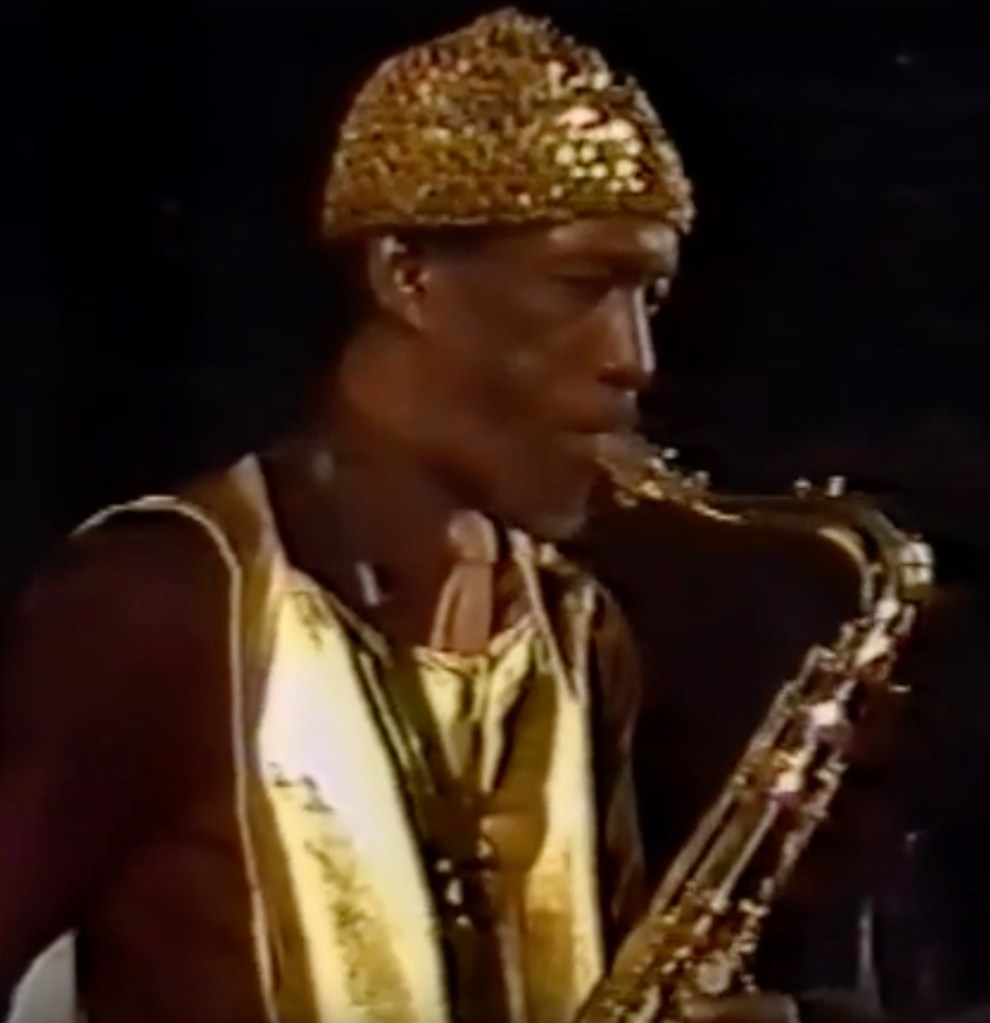
This great tenor saxophonist had been Sun Ra’s right-hand man, but emphysema claimed his life in 1995 at age 63. The mantle was then passed to Marshall Allen –
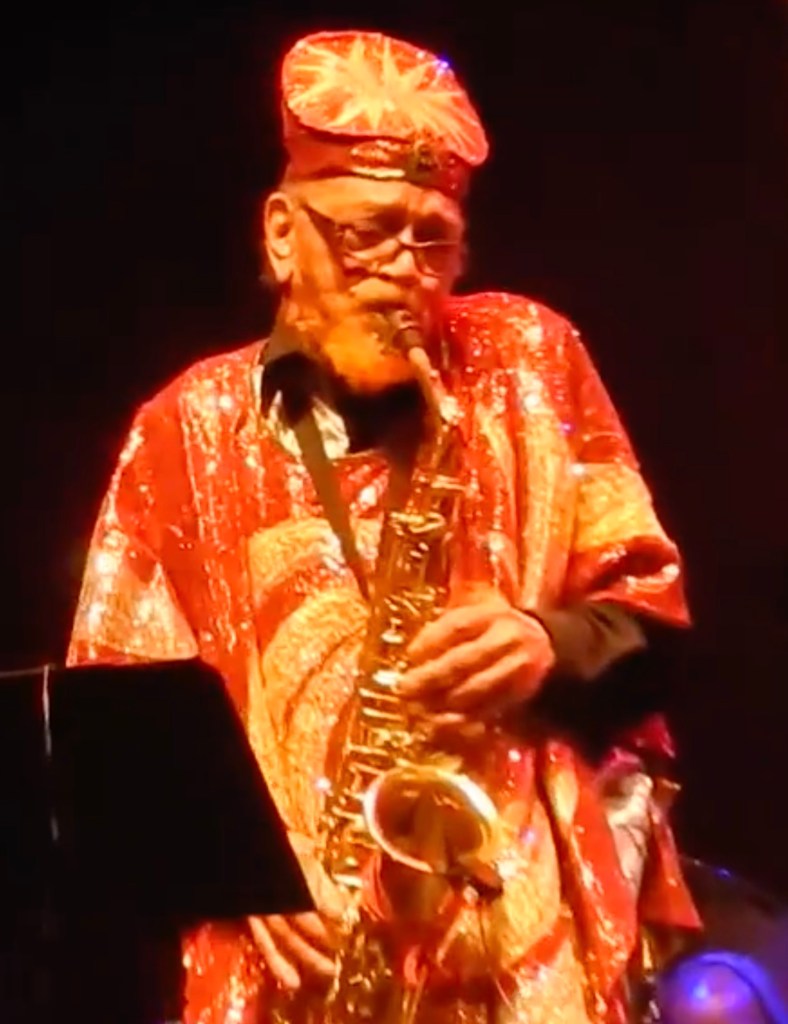
– who has continued to lead the band to this day. He is now 100 years old, and last year the Arkestra performed some 47 engagements, playing around the country – including visits to New York, Los Angeles, San Francisco, Philadelphia, Washington D.C., New Orleans, Baltimore, Newport, Hot Springs, Jersey City, Chicago, St. Louis, Portland Maine and Portland Oregon – as well as trips to The Netherlands, Turkey, Germany, Poland, Sweden, Norway, Spain. Bless them all.
Earlier I related to you how Sun Ra had told me, “I didn’t offer what I had to offer. Just now and then I put something out there. But my basic thing, I kept it.” When he said that to me, he also added, “I wanted to bypass the planet ‘cause they were trying to bypass me. So I helped them; I helped them to bypass me.” And when he told me that, I said to him, “So the recordings you’ve released and the performances you’ve given are just a fraction of what you could have shown people.” And he responded, “Just a small fragment. With a lot of empty space and narrow voids in that.”
I mention this now because I want you to understand that today I’ve shared with you just an infinitesimal fraction of the small fragment that he did put out there.
And that small fragment of Sun Ra’s is available to you in an enormous discography. Sun Ra released some 200 EPs and LPs on his own label, Saturn. But his music has also appeared on recordings from such notable labels as Evidence, Delmark, Leo, Savoy, Blast First, ESP, Black Lion, Rounder, A&M, Black Saint, hat Hut, Impulse, Atlantic, Shandar, and Elemental.
I regret that there wasn’t time for me to play for you any of his brilliant longer compositions, such as “The Magic City” or “The Cosmic Explorer” or “Strange Celestial Road.” You haven’t heard his delightful 1950s excursions into doo-wop music, creating sensational short songs for such vocal groups as The Cosmic Rays, Crystals, and Nu Sounds. I’ve played almost nothing of his piano performances and shared very little of his poetry. I’ve given you just a hint of the talent of John Gilmore, of Marshall Allen, of June Tyson, of James Jacson. And I’ve stiffed completely so many of the brilliant musicians who played in the Arkestra over the years: baritone saxophonist Pat Patrick, trumpeters Ahmed Abdullah and Michael Ray and Akh Tal Ebah, violinist Billy Bang, bass player Ronnie Boykins, wind multi-instrumentalists Danny Davis and Eloe Omoe and Danny Ray Thompson, trombone players Tyrone Hill and Julian Priester, percussionists “Bugs” Hunter and Jorge Silva, drummers Clifford Jarvis and Buster Smith, and so many, many others.
Above all you need to understand the joy in this music, performances that concluded time and time again with the entire audience lifted to its feet, clapping and chanting along with the Arkestra musicians who would march through the performance space, performers and listeners transformed by the power and beauty of the vision of Sun Ra. Transformed… transformed…
(This lecture was first given at the main branch of the San Francisco Public Library in March of 2025. Special thanks to Michelle Jeffers, Sam Genovese, Mike, Kenny, and all the wonderful people at SFPL! Extra special thanks to Fotis Tzanakis and Phil Bonner for their assistance!)
SOURCES
“Philosophy is conjecture.”
Butt Rag #5, 1989, p. 25.
“The dismissal of everything non-spiritual, that is Sun Ra’s discipline.”
Sigrid Hauff, “Thought Is a Mental Force” in Sun Ra, The Immeasurable Equation. Compiled and edited by James L. Wolf and Hartmut Geerken. Stuttgart: Waitawhile, 2005, p. 18.
“Things in themselves are of little importance”
Oscar Wilde, De profundis in The Soul of Man and Prison Writings. Edited by Isobel Murray. Oxford: Oxford University Press, 1990, pp. 126–127.
“Only that is spiritual which makes its own form.”
Oscar Wilde, De profundis, p. 99.
“What Sun Ra had to do was reverse that state of bodily control”
John F. Szwed, Space Is the Place: The Lives and Times of Sun Ra. New York: Pantheon, p. 298.
“Play that apple … have to learn to feel all over again”
John F. Szwed, Space Is the Place, p. 113.
“Tyrone, you playing what you know … Sun Ra always taught us to do the impossible.”
K W Billerts, “Tyrone Hill: His Story,” https://sunraarkive.blogspot.com/2008/06/tyrone-hill-his-story.html
“Reality equals death”
John F. Szwed, Space Is the Place, p. 316.
“My job is to change five billion people to something else.”
Butt Rag #5, p. 26.
“Reality has touched against myth”
Sun Ra, The Immeasurable Equation, p. 323.
“EVERY PLACE THERE IS IS MUSIC.”
Sun Ra, The Immeasurable Equation, p. 289.
“They’re here, they’re real, and they’re alive!”
“I saw a picture called Unheard Melodies”
Nicole V. Gagné, Soundpieces 2: Interviews with American Composers. Metuchen, N.J.: Scarecrow Press, 1993, pp. 376–377.
“It’s the only way you can talk to God now: through sound.”
Gagné, Soundpieces 2, p. 371.
“the only thing that can reach people”
Gagné, Soundpieces 2, p. 373.
“I never sought to be famous or nothing like that”
Gagné, Soundpieces 2, p. 373.
“I’ve made research on humanity to see why they in this condition.”
Gagné, Soundpieces 2, pp. 380–381.
“So you see, people should wake up.”
Gagné, Soundpieces 2, p. 382.
“A costume is music”
John F. Szwed, Space Is the Place, pp. 174–175.
“There comes a point where musicians”
John F. Szwed, Space Is the Place, p. 251.
“As all Marines are riflemen, all members of the Arkestra are percussionists.”
Space Is The Place, Impulse! IMPD-249 1972.
“Most jazz will lay out over one rhythm”
Val Wilmer, As Serious as Your Life: Black Music and the Free Jazz Revolution, 1955–1977. London: Serpent’s Tail, 2018, p. 106.
“The ruler said, ‘Ah! Admirable!’”
The Writings of Kwang-sze, Book III, in The Texts of Taoism. James Legge, translation and notes. New York: Julian Press, 1959, pp. 247–248.
“The key to understanding”
John F. Szwed, Space Is the Place, pp. 298–300.
“Equality means you don’t need a leader”
Gagné, Soundpieces 2, pp. 369–370.
“I don’t believe in equality”
“Sun Ra 12/4/85 Oakland” on Sun Ra Research CD Two, SRR002 2006.
“In some far place”
Sun Ra, The Immeasurable Equation, p. 213.
“I wanted to bypass the planet … Just a small fragment”
Gagné, Soundpieces 2, p. 374.
Link to:
Music: Lectures: Contents
For more on John Cage, see:
Film Review: Prism’s Colors, The Mechanics of Time
Music Book: Soundpieces: Interviews with American Composers
Music Book: Sonic Transports – Glenn Branca essay, part 1
Music Book: Sonic Transports – Glenn Branca essay, part 15
Music Essay: The Beaten Path: A History of American Percussion Music
Music Lecture: “Intense Purity of Feeling”: Béla Bartók and American Music
Music: KALW Radio Show #3, Ancient China in 20th-Century Music
Music: SFCR Radio Show #8, Daoism in Western Music, part 1
Music: SFCR Radio Show #19, The Percussion Ensemble
Music: SFCR Radio Show #22, Neo-Classicism, part 3
Music: SFCR Radio Show #25, Schoenberg in America
Music: SFCR Radio Show #29, Electro-Acoustic Music, part 1: New Instruments
For more on John Cage and Sun Ra, see:
Music Book: Historical Dictionary of Modern and Contemporary Classical Music, Second Edition
Music Lecture: The Secret of 20th-Century American Music
Music: SFCR Radio Show #4, Postmodernism, Part 1: Three Founders
More Cool Sites To Visit! – Music
For more on Sun Ra, see:
Music Book: Soundpieces 2: Interviews with American Composers
Music: KALW Radio Show #1, A Few of My Favorite Things…
Music: SFCR Radio Show #9, Daoism in Western Music, part 2
Music: SFCR Radio Show #35, Electro-Acoustic Music, part 3: Musicians and Synthesized Sound
And here’s a video of the March 2025 lecture (film clips and musical examples have been deleted due to rights issues):
 NICOLE V. GAGNÉ