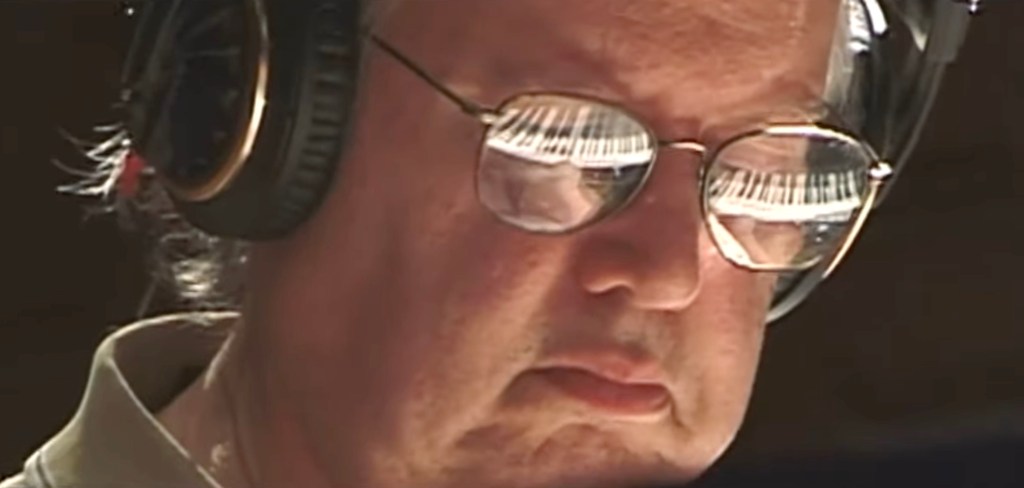
Those Postmodern “Blue”s
Articles about “Blue” Gene Tyranny usually start by discussing the origin and meaning of his colorful cognomen. Seeing as how he explains all that in the interview, I’m going to begin instead with another name, one that’s been all things to all people: postmodernism. For the pundits who’ve never appreciated modernist ideas, postmodernism means anti-modernism, only with the Good Housekeeping Seal of Approval: No matter how lazy, derivative, or reactionary your work may be, you can hold your head up high because the celestial steamroller, History Itself, has finally arrived to squash all the weird stuff (so cold, so inhuman, and nobody ever really liked it, anyway).
After all, “modernity revolts against the normalizing functions of tradition; against all that is normative.”[1] How is America supposed to Stand Tall with all that negativity going on? And what’s even more threatening to the tight-asses is that the glass is also half-full: Modernism attempts to free us from our conditioning by discovering/creating beauty, lucidity, and feeling through materials and structures that tradition has deemed ugly, meaningless, naughty…
That modernist impulse is central to Tyranny’s music. But what’s special about his sound is his unexpected gift for expressing that impulse through his love of familiar materials – his music can sound not just reassuring, but downright cozy. Once you’ve settled into it, however, you can start feeling strangely uncertain about what’s going on. Not from any sneak attacks of dissonance or atonality, although both these modernist devices are in a lot of his music. It’s a more unusual, more virtuosic surprise created by the cumulative effect of the piece. Sometimes in a dream, an everyday landscape is suddenly unfamiliar, even though it still looks the same. His music contains reversals which are a lot like that – you realize that those familiar features are only the iceberg tip of vast crystalline patterns and meanings. “The particular manifestation is not the real thing; the parts are not the whole; there’s an existence behind the existence; there’s a continuity behind the discontinuity you see,” says Tyranny. Homely materials are redefined by Tyranny’s attitude toward them and by the methods with which he combines them into a new whole. He takes what he knows and loves – the common musics and everyday sounds – and transforms them after his own bone-deep commitment to self-alteration. Which is for him the fundamental vision of new music: “a very serious investigation into ways we can communicate together, make new languages, overcome our social problems, and find new solutions that are more humane.”
His music is a breakthrough of enormous importance to an era in which modernism’s freedom can be explored without dependence upon established modernist gestures.[2] It exemplifies what’s been called resistant postmodernism, “which seeks to deconstruct modernism and resist the status quo […] a critique of origins, not a return to them.”[3] Modernism reveals the arbitrariness of aesthetic norms; Tyranny turns modernism’s X-ray onto itself – you don’t have to sound modern to be modern. That’s how he can use pop materials to un-pop purposes: “There was a lot of discussion about whether the avant-garde ideas were being popularized or circumvented or bastardized or whatever. (That’s certainly a good discussion to have.) But it’s not a combination or fusion of pop-music styles and something else. The sounds are there, but the same thing isn’t going on. I may be understanding this incorrectly as far as art-historian stuff goes, but I think it’s part of postmodernism to be able to say the same things with familiar images or sounds, without changing or bastardizing them – because I’m certainly not in favor of that, that’s just ridiculous. (You can also be emotional, pop, and non-representational in a work, which is more interesting to me.)”
That parenthetical idea seems to have been holding his interest since he was a kid. He was in Michigan working with the legendary ONCE Group by the age of 17, after several years of playing and composing avant-garde scores in his native Texas.[4] But that San Antonio high-schooler who made electronic music and performed Morton Feldman and La Monte Young was also playing in rock bands on the concession-stand roof at the double-screen drive-in theater. He must have been able to sense (and extend, the precocious rascal) pop’s capacity for unexpected releases of character and communication. After working on scores by John Cage and Dick Higgins and Yoko Ono, he’d have to start reading between the lines of the activity all around him: adolescent rockers metamorphosing from Jerry Mathers to Jerry Lee Lewis; beat jazz musicians on the road between New Orleans and California, stopping to gig in a dark, smokey Texas icehouse; the night parades of Fiesta week, where people celebrated the musical and geographic borderlines of Texas and Mexico; the impromptu instrumentations and transported performances of the Baptists, where “they’d keep encouraging you to be wilder and wilder.”
But Bob Sheff (as he was then called) was raised in the Lutheran faith – he just dug playing piano for the Baptists, and being part of “all this stuff going, just a wild sound.” This of course was after he put in some pre-kindergarten time at a Temple Beth El. Well before he discovered the avant-garde, Tyranny was enjoying and exploring the equality of different musics – and in San Antonio in the early ‘50s, that meant being exposed to different peoples. His awareness of being adopted may have given him a special perspective on difference: a box seat from which he could observe connections without losing sight of uniqueness or separateness; a tempering of his complacency, which kept him from taking things for granted. Realizing you’re gay can do that to you too. But you can also be adopted and gay and a Texan, and still be a jerk. His environment could only present him with these possibilities – it’s his character to have learned from them, and to share his insights with others. As the man has said, “You can never improve an idea. The idea is there, you improve the technique for the expression of that idea.”
For most of his life, Tyranny has been improving his expression of an idea that he once alluded to in describing how the musicians of his Country Boy Country Dog Variations “separate out into numerical division until they get to be individuals again – the idea of the ensemble of soloists, which is John Cage’s expression.”
That’s the key, to my mind the unifying idea behind all his music: the ensemble of soloists. It suggests Tyranny’s devotion to jazz, but the picture of a group of jazz musicians playing together only points to that idea. The image has to be revved up into an inspired jam session, freed of defensiveness, competition, and ego-tripping; into a howl-in, where instead of just demonstrating what you can do, you’re discovering what you never knew you had. The Narrator in Out of the Blue speaks of “peaceful co-existence, the way the waves travelled through the same medium, the water, and crossed through each other transparently, without destruction.” That cooperation comes to life in The Intermediary, where Tyranny weaves computer music into his piano improvisation, representing his solo as part of an invisible ensemble. More literal illustrations are The Song of the Street of the Singing Chicken and his music for Andrew Lugg’s film Black Forest Trading Post: miniature closed universes that bristle with activity. Even his less dense, more tuneful works, such as David Kopay (Portrait) and The World’s Greatest Piano Player, are glimpses of perpetual dialogues between characters. The hubbub may become comic or bizarre, but no one’s colliding with anyone else.
Tyranny says it in plain English in his notes for Harvey Milk (Portrait): “There are other solutions than seeing the world just in terms of order and anarchy, or defensive freedom and teeth-grinding, eye-squinting dependence.” In the Portrait, by generating electronic music from the voices of Milk and the crowd attending his speech, he describes our ensemble with unseen fellow soloists, the magical balance which buoys us up even in the humblest of our daily affairs. The more consciously we recognize it and work with it, the more it intensifies, and the more we can realize the “many understandings between people that we don’t promote nearly enough, that we may not even have words for. People can see the reality of the things that are often relegated to, say, ESP or the flurry of the moment or coincidence – fairly artificial language words and terms that in fact are real things. Then people could make a language that would hopefully make a better society or a better relationship between people.”
Without pushing the comparison too far, I think of shamanism in Tyranny’s approach, insofar as he’s attempting to publicly manifest the inner dynamics of external events. He describes them spontaneously, assuming an alternate state of consciousness, in his keyboard improvisations. He realizes them through ‘magic,’ employing unique materials in accordance with study and inspiration, in the electronics of The Intermediary, Harvey Milk (Portrait), and the Country Boy Country Dog pieces. Whatever method he uses, he doesn’t pretend to define the event – the event transcends the definitions we give it, that’s the point. If you hold a magnet under a sheet of paper sprinkled with iron filings, the resulting pattern is not magnetic force; it’s evidence of the presence of magnetic force, an expression of the paths magnetism travels… partial evidence… fragmentary expression…[5]
But that’s a hell of a lot better than scratching your head over why the iron wiggles for the magnet. It’s a stab at communication, and communication is the way ideas are realized, are made real. Communication is also the lifeblood of the ensemble of soloists. As a performer Tyranny has experienced “certain very shocking events, where people have seemingly almost communicated by ESP: People do this on-the-spot arrangement, they all stop suddenly at a place they’ve never stopped before to do something. […] they’ve raised themselves to another type of communication.”
In Tyranny’s music, the ensemble of soloists goes beyond the interaction of musicians, or of events within a piece. Step back a little, and you’ll see this same heightened communication threading together his natural assured movement through different genres and media. Which brings us back to postmodernism. New music, old music, jazz, rock, electronics, speech, song, acoustic and electric instruments, environmental sound, computers, improvisation, notated compositions, conceptual scores, film scores, video, theater, dance: Each is a soloist in the ensemble of “Blue” Gene Tyranny’s music. He isn’t synthesizing or fusing anything – not unless you think of two people talking on a telephone as being synthesized or fused. He’s just feeling his way through the plethora of techniques and languages unleashed by modernist freedom.
We’re still flying outwards from that Big Bang, modernism’s “explosion into a host of distinct private styles and mannerisms.”[6] Intensifying the shock waves is the unimaginable growth information systems and, yes, communications, which has made virtually all the surviving cultural history of the world available to whoever wants to investigate any of it. Add to that the ever-expanding technology of performance, and approach it all from modernism’s revelation of freedom. What you get is the inheritance of modernism and the challenge of postmodernism: not just to do your work, but to choose your work. “The artists of the past were not burdened with the necessity of making basic decisions,” says Charles Wuorinen. We must make fundamental choices. They had security. We have freedom.”[7]
Yet a weird notion continues to crop up, in which the unprecedented diversity of today’s music (and cinema and art and writing and dance and…) is described as a kind of interregnum in the eternal march of lucidity; invariably, it suggests that our time needs to be set right by the healing touch of the Beethoven or Wagner to come (or who’s already here but twagicawy negwected). In reality, our situation is far too complex and decentralized for any individual to exert a stylistic influence comparable to that of Big Ludwig or Little Richard.[8] Such potentiality can be kind of scary, judging from the musicians and critics who prefer to wait for a Savior to separate the wheat from the chaff, synthesized the few Good trends, stake out the boundaries of art, and dunk us into a mainstream.
This quasi-fascist longing is, for Tyranny, the inevitable result of the desire for a continuity of consciousness. As an alternative to that urge, he relies on an idea that also happens to be the philosophical foundation of postmodernism: “Discontinuity is not broken linear continuity, but a potential single character waiting to unfold in time.” If you can’t be objective, if you’re protecting a vested interest in some sliver of technique or ideology, you’ll keep on missing the forest for the trees. Free yourself from your conditioning, and you’ll see a landscape more vast than any forest; a landscape as limitless as yourself. Tyranny’s music is a series of dispatches from the new world, illuminating it – and us – with a new understanding and beauty.
FOOTNOTES
1. Jurgen Habermas, “Modernity – An Incomplete Project” in The Anti-Aesthetic. Hal Foster, ed. Port Townsend, Washington: Bay, 1983, p. 5.
2. Just as Gustav Mahler’s postromanticism explored and redefined romantic feeling without simply restating traditional romantic gestures. Come to think of it, no one would call postromantic music anti-romantic. Why then should postmodernism be reduced to anti-modernism?
3. Hal Foster, “Postmodernism: A Preface” in The Anti-Aesthetic, p. xii.
4. The legendary ONCE Group – which included Robert Ashley, Gordon Mumma, Donald Scavarda, George Cacioppo, and Roger Reynolds – was formed in 1963, as an outgrowth of the annual ONCE Festivals of contemporary performance arts and music, which began in Ann Arbor, Michigan, in 1961.
5. Tracing the magnet’s energy is a favorite technique of Tyranny’s. His music often achieves non-intentionality by becoming a high-tech aeolian harp or wind chimes. Music is triggered by everyday sounds in Country Boy Country Dog; by recorded voices in Harvey Milk (Portrait); by piano playing in The Intermediary. This sensibility can be spotted in atomic events as well as underlying structures: in Out of the Blue a train roars by, raising a cloud of chattering instruments, all sounding their natural harmonics; The World’s Greatest Piano Player has violent piano glissandi that leave wakes of chirping electronics.
6. Fredric Jameson, “Postmodernism and Consumer Society” in The Anti-Aesthetic, p. 114.
7. Charles Wuorinen, Simple Composition. New York: Longman, 1979, p. 13.
8. The only body of work in the second half of this century, which has come close to exacting such an effect, aesthetically and socially, is the music of The Beatles. But even their impact has been more that of Cage or Partch, more a demonstration of potentiality, than the Beethoven/Wagner effect of codifying methods for keeping the patient alive.
Links to:
SONIC TRANSPORTS: “Blue” Gene Tyranny Essay, part 3
SONIC TRANSPORTS: “Blue” Gene Tyranny Contents
SONIC TRANSPORTS: Contents
For more on “Blue” Gene Tyranny, see:
Music Book: Historical Dictionary of Modern and Contemporary Classical Music, Second Edition
Music Book: Soundpieces 2: Interviews with American Composers
Music Essay: You Can Always Go Downtown
Music Essay: 88 Keys to Freedom: Segues Through the History of American Piano Music by “Blue” Gene Tyranny
Music Lecture: “Intense Purity of Feeling”: Béla Bartók and American Music
Music: KALW Radio Show #1, A Few of My Favorite Things…
Music: SFCR Radio Show #6, Postmodernism, part 3: Three Contemporary Masters
More Cool Sites To Visit! – Music
And be sure to read David Bernabo’s book Just for the Record: Conversations with and about “Blue” Gene Tyranny
 NICOLE V. GAGNÉ