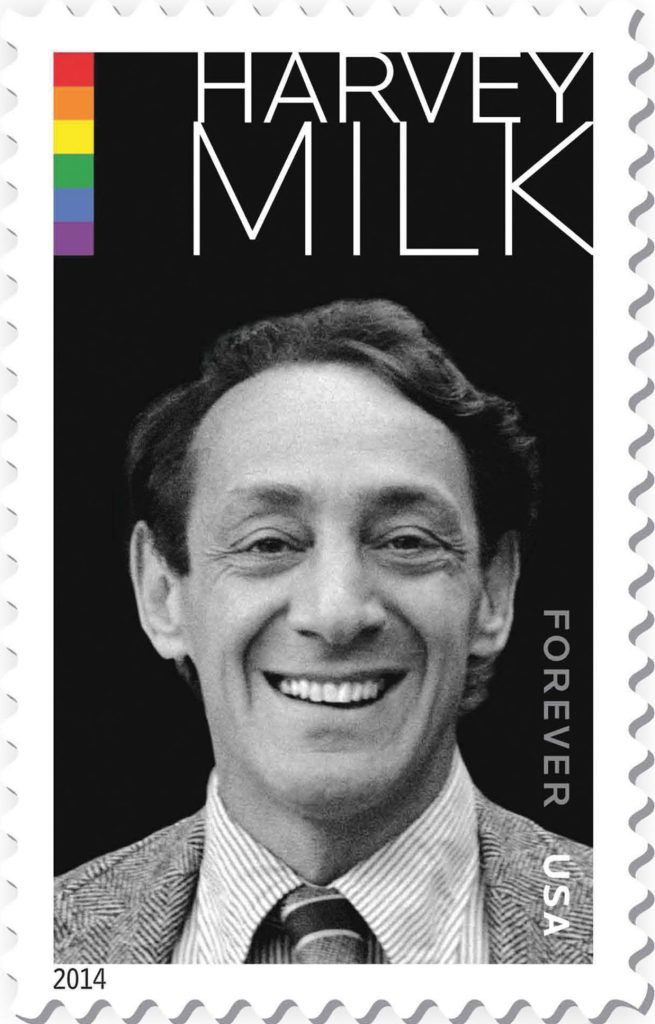
Harvey Milk (Portrait)
“I guess one thing that’s been in all the music, no matter what form it is, is that I want to find ways in which everyday life is magical,” says Tyranny. “That’s my Capricorn thing, which is this love of experience that can be common – in the sense of available – to all of us.” His most beautiful realization of this idea may well be Harvey Milk (Portrait) (1978), where he takes a politician making a speech and electronically re-scans it to uncover some of its hidden magic. This begin-again piece is one of his most electronic works; unlike The Intermediary, The World’s Greatest Piano Player, or David Kopay (Portrait), Harvey Milk (Portrait) has nothing to do with pop music. Instead, it’s Pop music, a blood brother to Andy Warhol’s illuminated photographs of Marilyn and Elvis. Tyranny expresses his love of common experiences as a Pop artist would, by altering their contexts to reveal just how special, how charged they are.
Beyond its homage to Harvey Milk, the Portrait is Tyranny’s meditation on the feeling that was available to a group of people on the afternoon of November 4, 1978. Milk gave a speech in San Francisco that day, speaking out against “the repressive Proposition 6, which had been placed on the state ballot by Senator John Briggs. This measure would have started a witch-hunt to fire public-school teachers having any connections, or rumors of connections, with homosexual persons (can you really hide it, do you want to, was it how often, who you are, or what?). Even for talking about homosexuality. Talk about Briggs turning people into sex objects.”[1]
For Part I of the Portrait, “The Action,” Tyranny takes a recording of the speech and gently highlights it with two electronic sounds. One, suggestive of distant bells, froths steadily alongside Milk; it’s generated by “ringing filters tuned in micro-intervals and triggered by his voice.” The other sound, which frames and intermittently punctuates the speech and its bells, is a high, cleanly articulated fragment of melody. Spontaneous cheering by the crowd occasionally compelled Milk to stop speaking, and at these moments in Part I “the negative-going envelope shadowing his voice shuts down the circuit […] and then there is a small melodic sweep as the filter rests for a moment (I imagine it saying, ‘Whew, that was a good one’).”
It’s not easy to dig the music when you’re also hearing Milk’s intelligent, passionate speech, and so “The Action” can sound as though Tyranny is doing very little. Actually, he does a great deal in Part I; he just does it without distorting the integrity of the event itself. His electronic music has a subtle distancing effect, depersonalizing both speaker/speech and the crowd of listeners. It throws their essential characters into relief, enabling you to see how they mirror each other. The bell-like sounds reflect Milk’s voice but have no rhythmic connection to it – what they really resemble is the constant hubbub of a crowd. The melodic sweep, which reflects the voice of the crowd, stands out for the singularity of its character – like a bird flying overhead, or like the speech and ideas of an individual. In other words, listeners couldn’t grasp Milk’s ideas if they didn’t already have those ideas themselves – or as the Versifying Chorus says in Out of the Blue, “who you talk to is not separate.”
In Part II of the Portrait, “The Feeling,” Tyranny reworks the electronic sounds of Part I, using “a resonant and constantly changing memory circuit which accumulates the bell-like sounds, re-cycles and intermodulates them in waves butterflying across a stereo field.” Tyranny created this music solely through passive techniques, just as in stop it Part I. He didn’t tinker with or reshape any of the results. All he did was set up the situation and let it go. His art is to let nature take its course – or, if you prefer, his nature is to let art take its course. However you look at it, his methods release the best of both worlds, and “The Feeling” miraculously takes on qualities of natural and played sound.
The bell-like sounds are the basic stuff of “The Feeling,” only this shadow of Milk’s voice now has its own shadow, a low crackling noise. After an initial eruption of the two-headed sound, “The Feeling” becomes quiet and calm. For a moment, the crackle weirdly suggests distant voices, like some last fragment of the rally of Part I. But as you listen to the gentle oscillation of the crackling bells, you can hear the rhythms and even the timbres of the lapping of waves. This oceanic effect then takes itself over the top, into honest-to-goodness nature painting, when some sweeps soar by: Their melodic curve, dynamic profile, and reiteration all add up, pure and simple, to birdsong. Tyranny’s laissez-faire techniques free the music into a dreamy evocation of a calm, midday seascape, complete with gulls.
As the music becomes busier, this image disappears, and you get a chance to really hear those bells – which pretty soon stop sounding like bells, and start sounding like marimbas, almost, perhaps, or some of Harry Partch’s Cloud Chamber Bowls (whether they’re glass or wood or ceramic is up for grabs). Sometimes they don’t sound random or windswept at all, but seem to be played by a couple of percussionists. Similarly, the crackling starts sounding more like something coming to a boil – except for those moments where you’d swear it was an old, scratched record being played too softly for you to make out precisely what’s on it. And just when all of this starts to sound really strange, there’s a striking sweep variation – if you can have variations when nobody’s playing anything. It’s followed by a familiar sweep that then sounds on into this variation and dies away echoing: your first complete glimpse of how the sweeps have mutated in the new atmosphere of “The Feeling.”
The crackling belts also lift themselves by their bootstraps into imitations of variation technique, falling into a regular motto that’s complemented by sweeps. This phrase disappears as the music becomes more dense, and the crackling releases an even more present popping.[2] Soon a second phrase crops up. It’s quiet and brief, easy to miss in this appearance, so it naturally decides to make a second, louder statement. “Naturally.” Well, Part II really does wind up playing itself as it nears its climax. There’s a momentary burst that sounds exactly like sonar (or exactly the way sonar sounds in B movies and “Voyage to the Bottom of the Sea”), and then everything erupts. The popping becomes extremely loud, the bell tones take on a new resonance and power, and the feeling surges in a rhapsodic, jazz-like voice, escorted by sweeps, into a variation of the earlier motto. Repeating this phrase over and over, the piece takes a long gradual fade out.
Part II is an apotheosis of not only the materials of Part I, but also the spirit, the emotion – the feeling. Even if Tyranny had released only Part II, and called it Electronic Composition, you’d still respond to the power of its finale. That’s just one more serendipity of Harvey Milk (Portrait): The action at the end of “The Feeling” equals the feeling at the end of “The Action.” In Part I, Milk ends his speech by reminding the San Francisco crowd that they showed up for the rally because they felt safe – “but there’s a 14-year-old child, a lesbian or a gay man in Fresno, who is terrified.” Tyranny remarks, “I can hardly hold back the cheers and the tears when Harvey Milk says, ‘You’ve got to give them hope!’ Thank you, Harvey.” “The Action”‘s representation of Harvey Milk is naturally charged with emotion, and that emotion is just as naturally there in the non-representational climax of “The Feeling.” Thank you, “Blue.”
FOOTNOTES
1. This quote is taken from Tyranny’s notes to Harvey Milk (Portrait), as are his other descriptions quoted in this section.
2. What, no snapping? Sorry if I seem to be describing a high-tech Rice Krispies. (Actually, the sound strongly resembles the rapping noise at the end of Out of the Blue.)
Links to:
SONIC TRANSPORTS: “Blue” Gene Tyranny Essay, part 10
SONIC TRANSPORTS: “Blue” Gene Tyranny Contents
SONIC TRANSPORTS: Contents
For more on “Blue” Gene Tyranny, see:
Music Book: Historical Dictionary of Modern and Contemporary Classical Music, Second Edition
Music Book: Soundpieces 2: Interviews with American Composers
Music Essay: You Can Always Go Downtown
Music Essay: 88 Keys to Freedom: Segues Through the History of American Piano Music by “Blue” Gene Tyranny
Music Lecture: “Intense Purity of Feeling”: Béla Bartók and American Music
Music: KALW Radio Show #1, A Few of My Favorite Things…
Music: SFCR Radio Show #6, Postmodernism, part 3: Three Contemporary Masters
More Cool Sites To Visit! – Music
And be sure to read David Bernabo’s book Just for the Record: Conversations with and about “Blue” Gene Tyranny
 NICOLE V. GAGNÉ