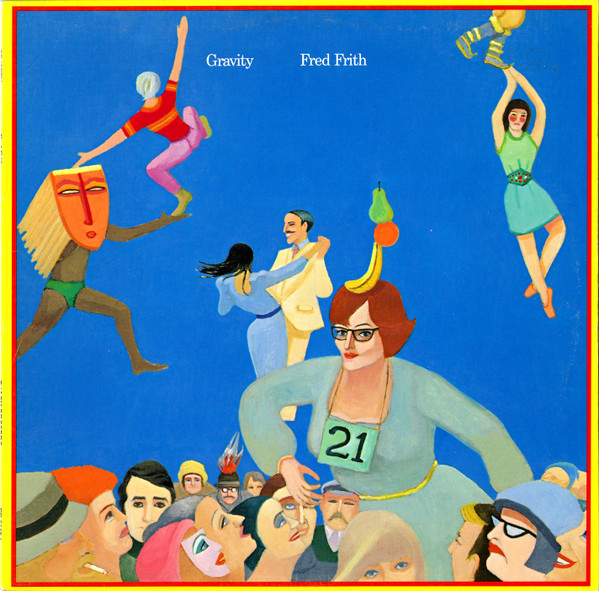
Gravity
The first thing you hear on Gravity is Frith’s laughter. What follows is, in a sense, a series of enlargements of that laugh, through dance musics from all over the world, take after take on the delight and discovery and fun and energy which dancing releases – “the victory over gravity, over all that weighs down and oppresses, the change of body into spirit, the elevation of creature into creator, the merging with the infinite, the divine,” as Curt Sachs says (also Frith, who includes this quote and Gravity‘s album notes).
A triple burst of sound immediately follows that laugh, and one of the three strands is a major warp in Gravity‘s woof: a drum track that actually runs straight through to the end of Side One. “Sometimes it’s present, sometimes it isn’t, but in terms of its temporal relationship to the other music, it’s continuous,” explains Frith. “The track was done on a large drum that I started playing very slowly and then gradually accelerated for 20 minutes. While I was doing that, Etienne Conod was slowing down the tape on which the drum was being recorded. So when the tape was played back at normal speed, the speeding up of the drum was even more exaggerated.” By the end of Side One, Frith has turned over Gravity to The Drum. Before then, you hear it only intermittently, usually at the bridges between pieces – The Drum just suddenly sprouts up amidst the unrelated tempi and rhythms of whatever other music is going on, and in every incarnation it’s faster and higher in pitch. “We had all the music for Side One in order, and then I just recorded the drum in one go, all the way through. It was a very emotional experience, actually. It seemed subjectively to last forever while I was doing it. I was in a trance-like state by the end of it.” With The Drum, Frith threads together all the cuts of Side One into a single suite. “For me, the drum contains all of the music within it. It’s also a dance reference, derived from the type of dance which just gets faster and faster – an archetype, if you like.”
The other two strands of sound which kick off Gravity make it only through the opening piece, “The Boy Beats the Rams (Kluk Tluce Berany).” (The title refers to a Czech fertility dance, according to Frith.) One is the windlike rush of whirling guitar strings; the other, the fancy footwork of one Olivia Bruynhooghe’s tap dancing. (It’s an album of dance music, so why not include the sound of someone dancing?) “Rams” comes off almost as a prologue for Gravity, insofar as a lot of it sounds like an ensemble warming up – warming up inside a hurricane, that is, thanks to those whirling winds. Within them you get glimpses of instrumental music, distorted voices, unidentifiable noises… I’m reminded of the debris and people that hurtled past Dorothy on her way to Oz: Here too, there’s a genuine sense of taking off on a weird new journey. And not simply because Frith has spliced and diced a travelogue of ethnic dance musics into Gravity. That’s part of it, of course, but the album is something more. He’s charted a new secret landscape, like a storybook treasure map. And at the end of Side One, X marks its spot in the place that there’s just no place like.
The twister effect of the “Rams” guitar strings is also elaborated into three visceral passages of ascent, each stronger than the last, which punctuate Side One. The first is in “Rams,” when Frith temporarily displaces the wind-tunnel sounds with a rough-edged rock band. Repeated figures in his bass give their music a feeling of upward movement, as well as a sense of expectation, of something impending. What it is that’s really coming doesn’t arrive until the end of Side One. Here, Frith wants to leave you with just the anticipation, and so he brings back the winds, now more weirdly debris-laden than ever. Eventually, their non-associational sounds become so kaleidoscopic that you’re no longer sure what you’re hearing.
Before you can recover from that bizarre trip, Gravity dives straight into its next cut, making its official opening with “Spring Any Day Now.” The onset of this Hello Music is always irresistibly funny: After the noises of “Rams,” you’re steeled for a real art-attack with the next cut, but instead there’s what sounds like the theme song to a kiddie show. And a good one it is too – there’s no sarcasm in “Spring”’s appealing melody, consonant harmonies, and open arrangement. Despite the quirky metrical changes and syncopated winds typical of Frith, the piece never seems complicated; if anything, its peculiarities make it all the more beguiling and attractive. The secret of “Spring”’s buoyancy is its apparent effortlessness, the Look, I can do this too! magic of Frith’s quick change.
His enthusiasm for chameleoning is the heart of Gravity’s range of different ethnic musics. But Frith hasn’t taken the easy way out, he isn’t just mimicking other people’s musics. Neither has he gone the exploitation route of spicing up ordinary pop tunes with foreign instruments or musicians. The brief, intact cultural allusions that glint throughout Side One – singing Bulgarians, the “13th Street Puerto Rico Summertime Band,” a Native American ceremony, the dance music of a Renaissance consort – throw into relief his imagination and skill as a composer. “Each of the pieces, especially on the first side, is based on a number of culture clashes. I didn’t ever try to reproduce the ethnic music of anywhere; that would be a singularly pointless exercise. […] My intention was to draw on ethnic music and other sources to try to revitalize my approach, to explore new forms.”
The perfect example is “Don’t Cry for Me,” the first and probably the goofiest of Gravity‘s hybrids. “That piece is based on Latin American rhythms that I have truncated. The basic rhythm that’s heard in the three-beat clapping which runs all the way through the piece is actually never altered, but the overall beat changes in relation to it, depending upon which one of the three it falls on. So it’ll go one-TWO-three or one-two-THREE or ONE-two-three. That’s continuous, so every now and again there’s a bar with a half-beat in it, and that changes the emphasis all the time. Now, the first part of that song was actually transcribed by me directly from an Icon Festival on an island in Greece. I took the first phrase of my tune from that and wrote the rest of the tune myself. The superimposition of that on top of the Latin American rhythm is quite weird, actually. There’s a third element which is also quite incongruous: a kind of fake Caribbean organ!”
That’s why when you listen to “Don’t Cry for Me,” you hear only one country: Frithville. Where else would you get the desperate joke of that guitar, the halting sprightliness with which it tries so desperately to join a clapping pulse that keeps changing? (The wild effect of Frith’s two icily hot electric guitars also comes with the territory.) “It has a very strong dancing rhythm, and then every 5-1/2 bars or so the beat changes, leaving you wrong-footed, as it were. You have to readjust, and by the time you’ve readjusted, you have to readjust again. It goes around in a circle like that all the way through. Fun to watch in discos, not that it’ll ever be played in them!”
Two beautiful, world-music-derived sections open “The Hands of the Juggler,” but they’re topped by a lengthy driving crescendo: Side One’s second climb. This time around, Frith builds tension against the ascent by including a repeated series of guitar chords with mysteriously uneven pauses. Toward the climax of this crescendo, a violin and accordion (Frith and Lars Hollmer) can be heard champing at the bit to get out there, and when the music finally bursts, they soar into a radiant duet, a Middle Eastern seizure that’s one of the high moments of the entire album. The headlong energy of the build-up, funneled through Hans Bruniusson’s drumming, explodes into a gleeful dance by Frith and Hollmer, with heated exchanges between rhapsodic ornamentation and arcs of voluptuous sustained tones. Gravity has plenty of memorable ethnic-derived music, but “The Hands of the Juggler,” at this intensity and after that ascension, goes beyond any cultural allusion. It’s a celebration of a spirit, a release into the Folk. There’s an indestructible, larger-than-life vitality in the fleet-footed rhythms and transported playing of “Juggler.”
Frith can also express this sensation in an idiom a little closer to home – he surpasses that cut with the extraordinary “Norrgarden Nyvla.” This knockout instrumental may be as close as Side One gets to traditional rock, at least instrumentally and melodically; “Norrgarden Nyvla” wriggles through a meter of 15 in ways that are anything but traditional. “15 is one of my favorite signatures to write in. It’s fun to improvise in because of divisibility by fives or threes – makes for quite different kinds of body rhythm.” Expansive declarative playing and the changing, ever-more expressive arrangement (check that lion’s roar bass he brings in) alternates with knotty passages for a rabid electric guitar. Thanks in part to “Norrgarden Nyvla”’s unhurried tempo, the two sections seem strangely oblivious to each other. Rather than suggesting tension or drama, Frith is swinging a pendulum that could just as well go on swinging indefinitely.
It doesn’t (alas), and with the startling cry of a Native American performing a ritual dance, Frith abruptly bails out of “Norrgarden Nyvla” and segues into Side One’s last dance, a loony waltz on guitar and piano. “Year of the Monkey” is also shot through with snippets of other musics and sounds – a recollection of “The Boy Beats the Rams,” furthering the suite character of this side. Frith closes the circle with the final statement of The Drum. Accompanied by the sound of spinning recorders, it returns with a vengeance, elbowing out the waltz and taking us on our last visceral ride, the wildest one yet. The Drum gets faster and faster, until it’s unbelievably, inhumanly fast, until Frith has to stop it, and all at once in one loud BANG. And after that insane revving, the effect is like being shot out of a cannon. Happily, he lands you on terra firma, cutting directly to the sound of a street fair in his own NYC neighborhood. This final bow to the Folk is perhaps the most heartfelt, insofar as Frith hasn’t interfered with the music at all: it’s “ten seconds of the real thing,” according to the album notes. Side One’s tour ends back in the real world, and like Kansas after Dorothy’s return, it seems richer and more magical than before. Gravity shares the discovery of how beautiful, how valuable it is to hear people walking and talking and leading their lives on an afternoon street where some nearby band is playing, naturally enough, dance music.
Side Two of Gravity dispenses with suite structures, and so what’s outstanding in it tends to stand out more. Most of the privileged moments revolve around the playing: the fiendish electric-guitar dissonances of “What a Dilemma”; “Crack in the Concrete”’s rubbery dances, improvised by Frith (guitar), Paul Sears (drums) and Billy Swan (bass); the country quartet (Frith to the fourth power) of “My Enemy is a Bad Man.” Marc Hollander’s soulful bass clarinet highlights two of the album’s strongest cuts, “Slap Dance” and “Come Across.” “Slap Dance” intercuts stirring passages for Hollander with yet another kind of dance, hurriedly threading its way through yet another metric minefield – and it finishes with Frith on a mean stereo guitar. “Come Across” is based by Frith “entirely on its drum track, and that track is actually the drum track from a completely different piece of music, which was recorded by a Belgian group called Aqsak Maboul. Frank Wuyts, the keyboard player, did it, although he’s not a drummer at all. I really liked what he did. It had a certain quality to it that I thought was excellent. It’s in mono, actually, all on one track. Aqsak Maboul used only excerpts from this drumming on their record, but I had it in mind to use it all. So I kept a copy and wrote the entire piece based on the drum track, fitting the tunes and the choruses to its different sections.” To Frith’s credit, there is nothing lapidary about this driving cut, “Come Across” sounds all of a mad beautiful piece throughout. The only thing that does jut out is Hollander going nutz at the finale, and that may be the best moment of all.
In honor of Gravity‘s dance fixation, Side Two includes a loving stab at American pop. Frith’s “Dancing in the Streets” is just that, the old warhorse itself, played on drums, organ, bass, and guitar, all against a whirlwind backdrop of a backwards tape of Aqsak Maboul. Essentially, this cover is a blood brother to “Come Across”: another approach to using an aural found object. What’s uniquely wild about this “Dancing in the Streets” is the way Frith’s combination of rock band and tape noises taps into the charm and exuberance of the song itself (qualities absent from some of its recent, more lead-footed covers).
“Crack in the Concrete”’s trio – now with an even more manic rigidity – takes an encore that kicks off “Dancing in Rockville, Maryland,” the last cut on Gravity. A leisurely dissolve into Fritz lovely, somewhat countrified piano solo refracts the music of the three improvisers as they slip away. In a sense, it distills them into a tangibly intimate image, where one person is sitting playing a piano. Rain on the roof is heard as the piano fades, dilating your ears for the album’s last, quiet sounds of a few dogs barking in the distance. Side One ended by waking you up into a happy, active world. As Side Two departs, it wraps you into a calm new dream. I’ve never seen anyone in a hurry to get up and put on another record after the needle lifts off Gravity.
I prize one afternoon when I was listening to this album, and the dogs at the end of Side Two faded imperceptibly into the distant barking of dogs in my neighborhood, along with, a few moments later, the idling of a car and some faraway voices. It was more music, all of it: worldmusic, if you like. The porous ending of Gravity is just one more way in which this album realizes the one-world, one-spirit impulse that’s so basic to Frith’s character – and so freeing for ours.
Links to:
SONIC TRANSPORTS: Fred Frith Essay, part 2
SONIC TRANSPORTS: Fred Frith Contents
SONIC TRANSPORTS: Contents
For more on Fred Frith, see:
Music Book: Historical Dictionary of Modern and Contemporary Classical Music, Second Edition
Music: KALW Radio Show #1, A Few of My Favorite Things…
Music: SFCR Radio Show #6, Postmodernism, part 3: Three Contemporary Masters
 NICOLE V. GAGNÉ