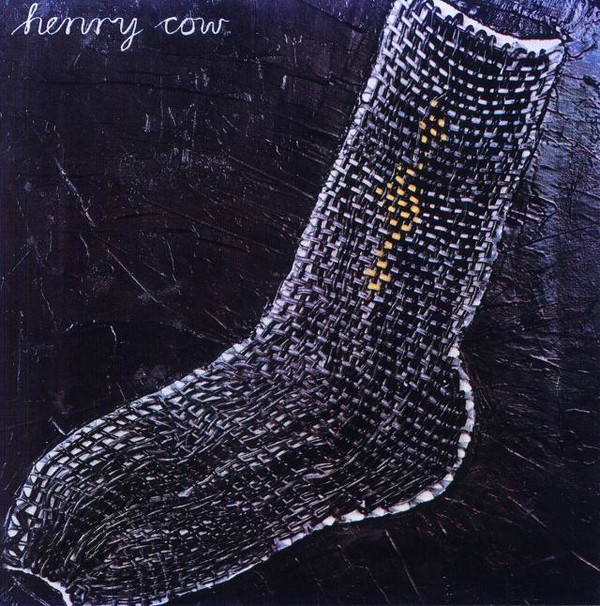
Henry Cow / Art Bears
There are six different Frith compositions on the first two Henry Cow albums, Leg End (1973) and Unrest (1974), and what’s always surprised me about them is how much they resemble each other, and how the little they resemble anything Frith has done since Henry Cow split up. His talent as a composer obviously matured over the ten years he spent working with the band, but there’s more going on here than just gestation. Frith says, “When I presented music to Henry Cow, there was much more give and take of ideas. Tim might say, ‘This bar is not worth keeping in the piece.’ Working with Zamla and The Muffins [on Gravity], it was very clear that I was the composer and that they were working for me.” Listening to Frith’s Cow numbers – especially “Nirvana for Mice,” “Extract from ‘With the Yellow Half-Moon and Blue Star,’” “Bittern Storm over Ulm,” and “Ruins” – I can only wish he had enjoyed more autonomy. The music might not have been significantly better, but at least it would have been different. That in itself would have been an improvement, because his Henry Cow pieces not only sound too much like each other, but they almost also sound too much like the rest of the band’s music.
Of course, individual autonomy wasn’t the point of Henry Cow – the band was a very deliberate attempt at collective composing (and management). So even though certain pieces may have been credited to Frith, Hodgkinson, Greaves, or Cooper, they were made with the active collaboration of everyone in the band. But what I hear in almost all of those individually signed pieces is a too-many-cooks homogeneity and garrulousness. Of course, even with the input from the others, Frith still did a healthy amount of composing, and thanks to his fondness for shifting meters and his clean, open arrangements, his Cow pieces always have interesting qualities. Occasionally, there’s even his sense of humor: the woodwinds’ concluding squawk in “Bittern Storm,” or the distant bass and organ that have to fend for themselves after the guitar drops out in “Teenbeat Reprise.” Otherwise, humor is painfully absent from most of the Cow’s music, including Frith’s pieces. (Only someone who thinks he’s Seriously Composing would actually bother writing a fugue for the band, as Frith does in “Extract.”)
The pieces credited solely to the band are usually Henry Cow’s liveliest and most original work.[1] Leg End’s all-Cow “Teenbeat Introduction” is far more distinguished (especially in its crescendoing finale) than the uneven Frith/Greaves “Teenbeat” that it introduces. To my mind, Henry Cow’s finest music is Side Two of Unrest, which consists of a Frith piece and four Cow cuts. The Frith opener, “Solemn Music,” may be his best Henry Cow composition even though (because?) it runs a mere a 69″. (“Teenbeat Reprise” on Leg End is a close second – a lot of it is really hot.)
Frith claims that Henry Cow’s breakup was traumatic for him, but it sounds to me like he’d already been somewhat traumatized by the Cow itself. He got to do a lot of things with the band, but it also alienated him from essential features of his musical character: “When I was first playing the guitar, I used to play in folk clubs a lot, and I completely negated this part of me when I got into Henry Cow. I pushed it aside and didn’t think about traditional music at all, in terms of what I was doing – not until the last couple of years of the group’s existence, or in my improvisations.”
In the interview, Frith explains how The Art Bears, his trio with Chris Cutler and Dagmar Krause, came into being during the split-up of Henry Cow. Frith wrote most of the music for the Bears’ Hopes & Fears (1978), and whatever deficiencies that premiere album may have, his composing is much more imaginative and original than anything he’d done with the Cow. Here’s where you are first here Frith doing his own digging into the studio as a compositional tool and exploring structures from pop and world music. Perhaps most importantly, he’s writing songs – it’s no accident that The Art Bears, which he defines as “a song-writing group,” is where Frith finally came into his own as a composer.[2]
Paradoxically, it’s in the Hopes & Fears instrumentals, “Terrain” and “Moeris, Dancing,” that Frith begins to sound most like himself. You hear it right off in “Terrain,” when he weaves unintelligible vocals into the opening dance-like rhythms. “Moeris” is an even stronger cut – and as its title implies, even more dance-like, especially in the joyous, rhapsodic passages where the world-music influences are strongest. But “Moeris” also stands out for its weird finale, a coup unique and Frith’s music: He sits for a full two minutes – a long time, especially for a five-minute piece – on a noisy stretch of Cutler’s percussion (which is also in the Hodgkinson/Cutler “Labyrinth” earlier on that side). Unexpected violin crescendi counterbalance the minimalist effect: They hold your attention, teasing you to anticipate something more, while the music slowly and inexorably fades away.
Recorded under hasty and difficult circumstances, Hopes & Fears is The Art Bears’ least representative album: only seven of its 13 cuts are Frith/Cutler collaborations.[3] Of these, the strongest are “The Dance” and “Maze,” which both stand out for Frith’s deft combinations of different kinds of musics: “The Dance” juxtaposes a weird waltz with a stirring march; “Maze” combines a solid solo from Cutler, a low brooding music in cello and bassoon, and an exciting march finale. The other cuts are uniformly disappointing. The opening instrumentals of “The Tube” are sensational: Explosions (spiked with piano chords) accompany two blistering tracks of Frith guitars, howling out of sync and dripping with high sustained tones. Then Krause starts to sing and you go to sleep. “Piers,” “Riddle,” and “Dividing Line” also have powerful instrumental passages, but sag in the vocals.
However, Krause isn’t the one who dropped the ball. Her harsh, sometimes abrasive voice may be an acquired taste, but it’s a wonderful acquisition – Frith’s reverence for her abilities is completely justified. Her unique sound has illuminated a range of characters along the spectrum from innocence to experience, and she has recorded certain songs with such insight and precision that they’re inconceivable without her voice. But even a Lost One incapable of appreciating her can tell that the fault with “The Tube” or “Riddle” isn’t Krause but what The Art Bears do with her. A song is only as good as its vocal line, and Frith and Cutler’s Cow days didn’t sufficiently prime their pump to pour forth an albumful of songs. Most of Krause’s material is shapeless and meandering because of Frith’s rustiness at song-writing and Cutler’s overwritten lyrics.
These deadly companions are most evident in the appropriately titled “In Two Minds.” Frith and Cutler crush the delicate, complex subject of a young woman sliding into a nervous breakdown in this overblown (8 minutes!), repetitious cut. Presumably to ensure that every syllable of the text would be sung, the song’s slender materials have to work at least two shifts, and the same setting is clumsily welded onto both the tormented heroine’s inner thoughts and a verbose indictment of state-run institutions.
This gaffe underlines a frequent problem in the songs of The Art Bears and Henry Cow: Preachy, overblown lyrics are rammed down your ears because they’re good for you. Everything winds up taking a back seat to the words. But a song has to be more than politically correct; it has to be direct and eloquent, realizing the words in some kind of effective musical setting. What on earth is Krause supposed to do when Cutler asks her to sing “when parent secretly conspires with parent / to discredit conscience and reject all criticism / – as a shameful sickness”? (I have to sweat just to type it.) Don’t ask Frith. His solution is to shoehorn all of it into the same measures used for “if she keeps doing it, they will have to call the doctors.”
Too much of Hopes & Fears is just as musclebound: Instead of the natural, spontaneous expression in song of anger and defiance, its artistes rummaging through their grievances for something to denounce. The good news is that The Art Bears’ work improved drastically with Winter Songs (1979). This time the band was creating an album instead of being created by one, and the results are not only more concentrated and coherent thematically, but also more sophisticated technically.
Frith scores some real points as a melodist, most notably in two folk-inspired cuts, “The Hermit” and “The Skeleton.” “The Hermit” may rework the melody from Hopes & Fears’ “The Dance,” but what’s original here is the evocation of calm and repose in the vocal sections, with a quiet, sustained organ chord and the gentle doubling of the voice by acoustic guitar. “The Skeleton”‘s melody is durable enough to sustain its insistent repetition in voice and electric guitar (which dramatizes the lyrics macabre tale of a possessed man who danced himself to death).
But the real glory of Winter Songs is Krause. Sometimes she’s hushed and intimate, as in “Winter War,” “Summer Wheel,” and “The Hermit.” On other cuts she’s an arresting, grandiose presence, particularly in “Force” or her God-knows-what-language intro for “First Things First.” Her singing also enjoys more flexibility with studio techniques: There’s some nifty double tracking, most notably the combination of her high-register singing with whispered speech in “The Bath of Stars,” and the choral-like rounds for “Three Figures.” The Art Bears even realize the value of transforming her voice into near-noise events for “Rats and Monkeys” and “Man and Boy.”
Alas, they manipulate vocals only coloristically, rather than as a fundamental element of a song. In most rock music, vocal treatments are humdrum because the songs are written to project the vocalist. But The Art Bears aren’t Dagmar Krause & The Pips. What’s still holding them back is the music’s death grip on the lyrics. Cutler does have some accomplished lyrics on Winter Songs, particularly in “The Bath of Stars,” “The Summer Wheel,” and “The Skeleton.” But the songs periodically repeat the falling off of interest that marred Hopes & Fears. “Man and Boy” has gorgeous tape effects and a rich array of noise – and they totally outclass the vocal line, which becomes almost annoying as it intrusively competes with the rest of the music. “First Things First” is another cut that never tops its opening.
But with “Rats and Monkeys” The Art Bears top everything they’ve done before. It’s one of the finest songs Frith has ever worked on, and he probably thinks so too: “Rats and Monkeys” was Winter Song’s single and was also adapted by Frith for live performance with Skeleton Crew. Nothing gets The Art Bears hot like the thought of the bourgeoisie going down the toilet, and they’re inspired to new heights by the “Rats and Monkeys” lyrics: “Rats & Monkeys / crowd the city / as it crumbles / into Ruin / Walls are loosening – / true but gates / are blocked.” The song is an apocalyptic whirlwind, with Krause obsessively repeating the desperate vocal line, her voice intercut with snakey, dissonant violin passages by Frith. But there’s no monotony here, as voice and violin alternate with instrumental sections of ever-mounting frenzy, until the piece finally bursts with a nightmarish explosion of noise.[4] A loop of Krause’s cracked voice slowly fades up within this din, and the music suddenly coalesces and evaporates with a high-pitched hum reminiscent of a television set being switched off. (Is there a better sound for the extinguishing of consumer society?)

The apocalyptic juices that began flowing with Winter Songs are a tidal wave with The World as It Is Today (1981). Which, as Frith has pointed out, is no real virtue in itself: “I don’t see much point in people sitting in their rooms at home, getting a nice little frisson of horror at how awful it all is. I’d rather cheer them up in a way that also provides a door to imaginative possibilities, uncertain but positive.”[5] The World includes only one song suggestive of that energizing optimism, but the album is still far and away the best Art Bears effort, building on all their strengths and banishing almost all their weaknesses. And the songs stay in your memory.
The World is The Art Bears’ angriest and most explicitly political album. It’s also their most eloquent, thanks to their restraint in deploying words. Krause sings in ten of the eleven songs, but only in three does her voice dominate as it did in the Bears’ earlier albums. In all the other cuts, her vocals are confined to the opening, and the rest of the song is instrumental. Occasionally her voice appears in the closings, but always as another instrument: either singing wordlessly, as in the Yoko Ono-indebted cries of “Freedom,” or skirting unintelligibility, as in “The Song of the Monopolists” or “The Song of Investment Capital Overseas.” The Art Bears have wised up to a basic dramatic principle: a character who rarely speaks can rivet your attention when he or she says something. For once we aren’t steamrolled by Krause, and she gains some new urgency and power.
I’ve never heard her do anything that was more moving than her singing on “The Song of Investment Capital Overseas.” Even that turgid title is an effective irony, because the lyrics are terse and plain, certainly one of Cutler’s finest efforts. “My work takes me out of town,” she sings, and the phrase is used like a scalpel. With each repetition, its ordinariness cuts deeper into the complicity all ordinary employees and consumers share with the padrones who explore other people’s lands and labor. It also captures the bureaucratic banality, the Kaopectate-toting fragility of the flunkies at the front. But there’s nothing ordinary or banal about the setting of these lines. The melody is strong and completely natural to the words; the harmonies, richly expressive. And in a stroke that beautifully intensifies the drama of the song, Krause sings with all the anguish and despair the Bears feel, rather than with the blindness of the lyrics’ persona.
The instrumental finale of “Investment Capital” is a nightmare train ride that peaks in intensity not through an expected crescendo and accelerando, but by the slow fading up of Krause whispering the song’s concluding couplet. The rhythmic repetition and sibilance powerfully strengthen the train image: “the roads & rails run like cracks / and carry me upon their backs.” With the reintroduction of her voice, the music can then perfectly accommodate a restatement of the opening lyrics, which she repeats into a threnody: “out of town, my work takes me / out of town.” The reemergence of the voice also gives the propulsive music a logical opportunity to halt, rather than just fade away.
The “roads & rails” line, suggesting the fragmenting of a network of power, is The World’s first apocalyptic image. Frith and Cutler proceed to work this theme relentlessly and, on the whole, successfully. Sometimes the inspiration flags, as in “Truth,” “Freedom,” and “(Armed) Peace,” but even these songs contain few out-and-out lapses. (The corny, ‘heavenly’ consonances Frith uses in “Truth” to set the words “prosperity,” “Eden,” and “truth” are the only real banality on the album.) And the best songs are truly inspired. Eerie sounds – distant thunder, unintelligible speech muted in radio static, low sustained piano tones – frame and surround Krause in “Civilisation”; “Law” has a delightful brevity and wit, with Cutler’s pithy lyrics perfectly complemented by Frith’s kiddie-song melody; and there are the tape effects in “The Song of the Martyrs,” the sorrowful electric guitar in “The Song of the Dignity of Labor under Capital,” the violin and viola commentary for “The Song of the Monopolists”…
“Monopolists” is also Krause at her best. Her reassuring, almost annoyed tone of voice expertly realizes Cutler’s conversational lyrics, where we overhear the rich stroking each other in the face of setbacks: “that’s the way of the world / – All Right! / Sit tight, til it’s all / blown over.” Wisely, the Bears don’t set the concluding lines, “then we’ll rise again / & rule” – redundant lyrics that wouldn’t fit the song’s just-between-us atmosphere.[6] The Art Bears actually didn’t set all their lyrics – talk about the world coming to an end! Before you can get over that shock, the album launches its final and finest song, “Albion, Awake!”
Reading “Albion”‘s lyrics sets you up for a rehash of Frith and Cutler’s first recorded collaboration, “Beautiful as the Moon – Terrible as an Army with Banners” from the Henry Cow/Slapp Happy album In Praise of Learning (1975). Once again Cutler is summoning the workers of the world to Armageddon, this time in the voice of a Marxist King Lear: “Tumble you cedars! Owls / begone, beaks tear / the fabric of the night / to sparks!” etc. But the Bears decided to give Krause a rest and realize the text instrumentally. “Albion, Awake!” is a brilliant collage of animal sounds and instrumental tracks, clearly a development from Frith’s first two Ralph albums (especially Speechless, which he finished recording just before working on The World as It Is Today). At the center of this hurricane are two tours through a melody which, if you consult the text, is a clear, skillful setting of the thorny lyrics. The first statement is caught up in the activity all about it, but the second bursts into the foreground with a sudden eruption of a loud, electronic timbre. At first it just sits there, humming with the pulse of a huge machine that’s kicked on and is about to operate. And then, quite simply, it sings.
“Albion, Awake!” is a triumphant conclusion, a cheerful apocalypse in which nothing is lost but the things that should have died a long time ago. It’s ironic that this song should be the high point of The World as It Is Today: the three musicians have all outdone themselves with this album, but for all the power of Cutler’s lyrics and Krause’s vocals, The Art Bears achieved their finest moment by going speechless.
FOOTNOTES
1. I don’t think it’s a coincidence that Henry Cow’s weakest record is also their only opus devoid of ensemble pieces – all the music on Western Culture (1978), their last album, is by Hodgkinson or Cooper.
2. It’s too bad Henry Cow didn’t really get into writing and performing songs until their third album, In Praise of Learning (1975), a collaboration with the trio Slapp Happy (Peter Blegvad, Anthony Moore, and Dagmar Krause). Learning features three songs for Krause, including Henry Cow’s only Frith/Cutler piece on record, “Beautiful as the Moon – Terrible as an Army with Banners.” Essentially, it’s the first Art Bears song: beyond Frith, Cutler, and Krause, the only musician is bassist John Greaves.
3. “On Suicide” is by Bertolt Brecht and Hanns Eisler; “Labyrinth” and “Pirate Song” are by Hodgkinson and Cutler; “Dividing Line” is by Frith, Cutler, and Lindsay Cooper; “Terrain” and “Moeris, Dancing” are instrumentals by Frith.
4. Frith says that the finale uses a tape of a herd of pigs bellowing for their food, as well as the sound of nearby church bells (distorted by a malfunction in the original recording).
5. Bob Buika, “Ramblings with Fred Frith” in Tabloid, Fall-Summer 1982, pp. 28–29.
6. The extra text is included in the album’s booklet.
Links to:
SONIC TRANSPORTS: Fred Frith Essay, part 6
SONIC TRANSPORTS: Fred Frith Contents
SONIC TRANSPORTS: Contents
For more on Fred Frith, see:
Music Book: Historical Dictionary of Modern and Contemporary Classical Music, Second Edition
Music: KALW Radio Show #1, A Few of My Favorite Things…
Music: SFCR Radio Show #6, Postmodernism, part 3: Three Contemporary Masters
 NICOLE V. GAGNÉ