Speechless
When Henry Cow split up in 1978, more than just a band ended for Frith. For years, his life had revolved around those people and their work together. “I certainly found it pretty traumatic,” he says. “This was partly because, when you’re in a group for 10 years, it becomes an enormous security blanket, even with all its problems.” An argument can be made for Gravity as the initial high of his being away from the group: Frith celebrating a new phase in his life, exploring ideas that he couldn’t integrate into Henry Cow. With that long-delayed wad finally shot, Speechless is the chilly what’s next?; a Day After that’s even scarier when you realize that ‘I can’t say it’ is only one stop before ‘I’ve got nothing to say.’
Most of Speechless was recorded in Europe in the summer of 1980. Later that year, Frith came to live in the states. In a sense, the album takes all his French and Swiss studio work and filters it through a New York Experience (which really can be, as the ads say, mind-boggling), piling in tapes of NYC gigs and political demonstrations and kids playing and street musicians. Before it was released, Frith deadpanned to me that Speechless “has a different kind of feeling to it from Gravity.” It sure does. Only two cuts on Speechless share Gravity’s light-hearted spirit; and they’re early on Side One, one right after the other, as though Frith is evoking that sensibility only to draw curtain over it. “Ahead in the Sand” and “Laughing Matter,” both country-influenced pieces, are filled with all sorts of delightful touches. (“Sand” is particularly nifty for the brief clopping percussion Frith wraps out on his noggin.) But there are shadows even here: The ending of “Sand” includes a creepy distorted version of its lively melody; “Laughing” alternates its bouncy, forward-moving tune with a gnarled, static music.
Both cuts have brief prologues, like illuminated letters in a medieval manuscript, which are built around the unintelligible voices of children. Strictly within the context of those individual pieces, the effect is rather sweet; within the album as a whole, they take on a much darker tone. Speechless is in a sense Gravity’s shadow. Together they suggest – at least to me – that Frith also wrestles with a black personal despair, a Dostoyevskian devil that’s too frustrated and disappointed to believe, but still wants to. And like a Dostoyevsky novel, Speechless repeatedly alludes to children, echoing Fyodor Mikhailovich’s concern for the horrific limitations adults impose on them; his sense of identification with them as well.
Children playing in the street by an open hydrant is the first image of Speechless in “Kick the Can (part 1).” Frith combines their laughing, yelling, and yes, kicking the can with tracks of musicians playing on so-called simple instruments, recorders and a Jew’s harp. Fading up the ringing tones of a mellotron, he changes the atmosphere into something suspended and uncertain. When he adds tentative, questioning guitar phrases, it’s as if the documenter has stepped in front of his own camera. How can people grow up in this place? How can I? To answer that, you first have to figure out what place this really is. The rest of the album chews on that nail, and the response in the final cut, “Kick the Can (part 2),” isn’t very optimistic.
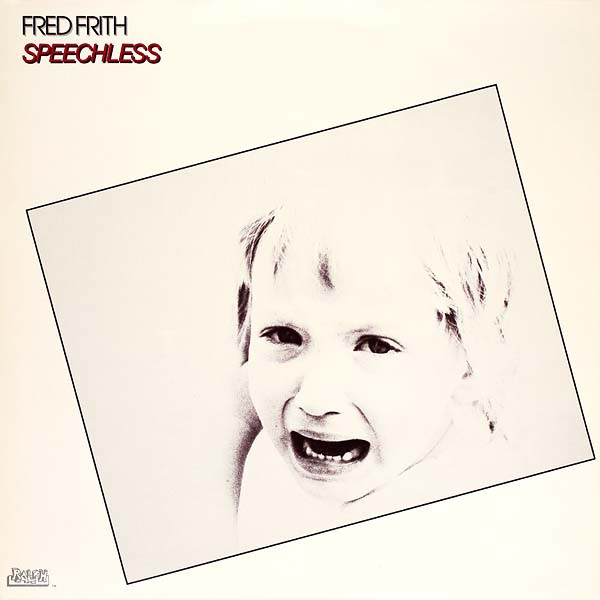
Actually, the very first image of Speechless is the album cover, Frith’s word to the wise for anybody expecting another Gravity. His first Ralph opus had Alfreda Benge’s painting of a merry, dancing crowd (complete with Frith looking out at us; Speechless has Tina Curran’s overexposed, close-up photo of the weeping face of her young daughter. As Frith says, this album “doesn’t have the same preoccupations as Gravity. There are references to ethnic music in it here and there, but it’s much less optimistic, I suppose.” The album has only one extended piece of what Frith calls “fake music” (cross-pollinated- or pseudo-folk music) as in Gravity, and it’s titled “Esperanza.” (Was that too corny, Ralph? Well, you know, that’s the way we are here.)
“Esperanza” careens through all sorts of intense, allusive material, slamming Middle Eastern violins into the impassioned sax playing of Etron Fou’s Margot Mathieu; there’s even the somehow absolutely appropriate Scottish bagpipes of Roger Kent Parsons, a street musician whom Frith recorded in Washington Square Park. Parsons’ pipes are momentarily skewered by a passing siren, which is also somehow absolutely appropriate. On one level, that noise is great, a felicitous example of Frith’s indispensable porousness.[1] But it’s also a footnote to the sense of emergency and alarm which haunts Speechless. Most of this album is as grim as its cover photo.
But that’s all: Speechless is never morbid or nasty, or half-blind from navel-staring. Frith just wants to describe something disturbing. His feelings were particularly extreme at this time – the darkest wrath of The Art Bears, their apocalyptic The World as It Is Today, was recorded just after Speechless, and he stoked that furnace here. Right from its opening whistle stab, “Carnival on Wall Street” is livid with rage. Frith’s sneering reinvention of circus-sideshow music snakes through some real-life audio of a vicious political demonstration. You can’t make out any of the voices clearly enough to follow what the protest is about, but judging from the context, he’s observing a few of America’s nastier chickens as they come home to roost.
Frith may be on the side of “Carnival”‘s protesters, but the point of Speechless is the inarticulacy of their protest: “If speechless has any concrete content at all, it has to do with being unable to say what you want to say.” Indecipherable speech characterizes the entire album, turning up an all but three (two?) of its 14 cuts. All the voice tracks have been altered in the studio, obscured in the mix, and/or edited into tiny chunks too brief to be identified. The few words you can catch are inevitably things you’d rather not hear: a cop barking at people to get back in “Carnival on Wall Street”; a child saying, “I don’t know where to go” in “Women Speak to Men Men Speak to Women.” Toward the end of that cut, there’s an even uglier intergender conversation when an angry beleaguered woman snarls, “I’m getting back, damn you!” to one of the cops trying to control the crowd at yet-another demonstration. “Women/Men,” which Frith co-produced with Tina Curran, is a scream against male power on the march, from the cops to John Philip Sousa.[2] While there are amazing things in its collage of mournful noises, statics, instrumental tracks, real-life speakers, and electronic howls, “Women/Men” goes completely over the top for its finale, with weird voices swarming over everything, and a brilliant vocal montage carved out of “The White Cliffs of Dover.”
Actually, Frith and Curran have pulverized “Dover” with this showstopper. Wisely, Frith saved it for the end of Side One. All that’s left is their frenzy of mad tracks, within which the song itself is almost wholly unrecognizable. (Ferdinand Richard is reciting the words right up front, but they’re obfuscated in the mix and by his halting, heavily accented delivery.) And once again, what you can’t hear is something Frith really wants to say, because “The White Cliffs of Dover” is a potent image for him. Beyond the sentiment of its lyrics,[3] there are also his memories of people in the nighttime pubs, singing their old faves, which always included “Dover,” the classic lighthouse-of-hope song from the dark days of World War Two.[4] By putting “Dover” through the Cuisinart, Frith is taking another stab at retaining contact with the Folk. But at the same time, he’s sadly reflecting on how alienated we are from our own power: a blinded world singing its vision of freedom, reassuring itself that everything good will happen not of course today but tomorrow. Today we’ll just go on wallowing in this muck…
Half the cuts on Side Two of Speechless are built around chunks of a live set by Massacre, a trio Frith formed with Bill Laswell and Fred Maher early in 1980. “I really fancied the idea of using a very raw rock music form. The whole idea was to strip away everything that wasn’t necessary.” And despite occasional flourishes from Fith’s violin, Casio, or throat mic (or Laswell’s pocket trumpet), the band restricted itself to Frith on guitar, Laswell on bass, and Maher on drums. But Massacre’s sound enjoyed a healthy variety thanks to Frith and Laswell’s chops-a-plenty. (They can make guitars sound all sorts of ways, you know.) Between them and Maher’s drumming, Massacre could rock as hot as anyone I’ve ever heard (especially live, but there are still “Legs,” “Killing Time,” and “Corridor” on their 1981 album Killing Time). Yet their drastic restrictions ultimately painted them into a corner. The CBGB set Frith uses on Speechless was recorded a few months after the band was formed; by Killing Time, says Frith, “the group seemed to me to be doing just about what it could do best, as best as it could be done. I couldn’t imagine what we what we would be doing six months from then, if we continued, other than the same thing, perhaps even better. Because the format was very limited, and the amount of time that the three members had was also limited.”[5]
How limited can you get? Well, I remember an improvised set of Frith’s in 1985, when his violin bow accidentally knocked into the excess wire projecting from a home-made’s peg. The wire flopped around, getting all sorts of reverberations from the home-made, an effect Frith discovered he liked, and so he made several swipes at it in the set. But during an intermission, as he and I were speaking, he snipped off the wire. “Fred,” I said, “you’re limiting your options.” “Well, that’s what it’s all about, isn’t it?” he riposted. Limitations define character, and Massacre is only one of the zillion ways in which Frith has deliberately limited himself in order to stimulate growth. There are all the self-imposed restrictions he’s built into his improvising; the genre challenges of folk music, fake music, the pop songs of Cheap at Half the Price; the decathlon challenge of Skeleton Crew’s ensemble of one-person bands; the collective composing of the Crew, Massacre, Henry Cow, The Art Bears…
But the stimulation Frith gets from limitations that he hasn’t chosen – people being reduced to commodities in a never-ending marketplace; the vulnerable self-exposure of love; communication hobbled by fear, anger, pride, confusion – he could live without. The catch is, before you can tell anyone else how to get their act together, you have to have something together yourself. And the most scattered, disintegrated voice on the album belongs to Fred Frith. The primary track of the title cut, “Speechless,” is a hopelessly garbled tape of him giving an interview (not one of mine, thank goodness). He shadows his voice with a dissonant keyboard, painting his talk to sound not just meaningless but silly. Over this, his bass and guitar play a sullen duo, barely listening to each other and oblivious to the mysteriously malfunctioning tape that turned his ideas into mud.
All the fears that haunt the album come to a head in this cut. Along with the introverted instruments and the chaotic tape (which occasionally oozes other recorded music and noises), there’s the constant sound of a dripping faucet, with all the overtones anyone can (not) want: poverty, the slipping way of time, the erosion of the body… It also lends a retroactive weight to the stream of water in the background of “Kick the Can (part 1)” – Frith doing yet-another interview is, after all, only another game, just like the one those kids play. His guitar playing in “Speechless” is also in the distant tentative style of “Kick the Can (part 1).” But his noise voice isn’t answering anything now; it’s asking the questions. Just one question, really, the same one you can also hear in the sucked-away, out-of-tape effect that ends “Women Speak to Men Men Speak to Women,” or in the mashed mellotron tone clusters that close “Esperanza” and “Kick the Can (part 2).” What’s-the-difference? is most explicit when Frith capriciously distorts Massacre’s playing in “Saving Grace” – no matter how you slice it, it’s still baloney. His blackest fear is a freezing doubt over music itself: What can it really do for anybody? How can it ever inspire any genuine change or growth?
An answer is proposed by the two extraordinary pieces that follow “Speechless.” The first, “Conversations with White Arc,” has Frith on electric guitar and Laswell on bass: “an improvised piece heard is played,”[6] and the only unobstructed glimpse of Massacre on Speechless. The two men were on a common wavelength at that moment, and their intense expressive lines interact magically; it’s a genuine dialogue, just as the title implies. Then Frith memorably communicates with bass player Tina Curran for “Domaine de Planousset.” against a repeated cycle of phrases from bass and acoustic guitar, he creates a static quiet soundscape where high, shimmering, electric-guitar tremolos fade up in a halo of still night air, glowing with the sounds of frogs and insects. It’s one of the most beautiful things he’s ever done – a simple, transparent serenity worthy of Erik Satie.
Significantly, both of these dialogues are without vocals (although I could swear I hear a child’s distant voice in “Domaine de Planousset”). Maybe we should try being speechless more often. How can we hope to talk if we haven’t yet learned to listen?
From the calm of “Domaine de Planousset,” Frith returns to the storms that have torn through the rest of the album. In “Kick the Can (part 2)” he accelerates material from the opener into a vicious kaleidoscope, chopping its sounds into jagged chunks and hurling them at you in a frenzy. The cut keeps swelling in volume, breaking out with alarmlike electric keyboards and screaming kid voices, but instead of bursting, everything suddenly deflates, and Speechless closes with the choked splutter of Frith’s hopeless flails at the mellotron. Ending with a bang is the privilege reserved for tragedies.
FOOTNOTES
1. I remember one listening to “Domaine de Planousset,” when the whistle of a braking truck added some perfect licks.
2. “The Washington Post March” takes some lumps in this cut – apparently, that number especially grates on Frith, seeing as how Skeleton Crew also goes after it on Learn To Talk’s “The Washington Post.” (Maybe he’s more pissed off at the newspaper than at Sousa, the march, or its marchers!)
3. “There’ll be bluebirds over / The white cliffs of Dover, / Tomorrow, just you wait and see. / There’ll be songs and laughter / And peace ever after, / Tomorrow, when the world is Free.”
4. It was made popular during the War by Vera Lynn (who was made popular with later generations by Stanley Kubrick’s film Dr. Strangelove, in which she provides the apocalyptic punchline, “We’ll Meet Again”).
5. They might well have gone on to something more like the Frith/Laswell/Maher “Square Dance” on the Material album Memory Serves (1981): a sort of Massacre in Technicolor. But that would have defeated the whole purpose of making a raw, black-&-white rock band.
6. Album notes, Speechless.
Links to:
SONIC TRANSPORTS: Fred Frith Essay, part 8
SONIC TRANSPORTS: Fred Frith Contents
SONIC TRANSPORTS: Contents
For more on Fred Frith, see:
Music Book: Historical Dictionary of Modern and Contemporary Classical Music, Second Edition
Music: KALW Radio Show #1, A Few of My Favorite Things…
Music: SFCR Radio Show #6, Postmodernism, part 3: Three Contemporary Masters
 NICOLE V. GAGNÉ