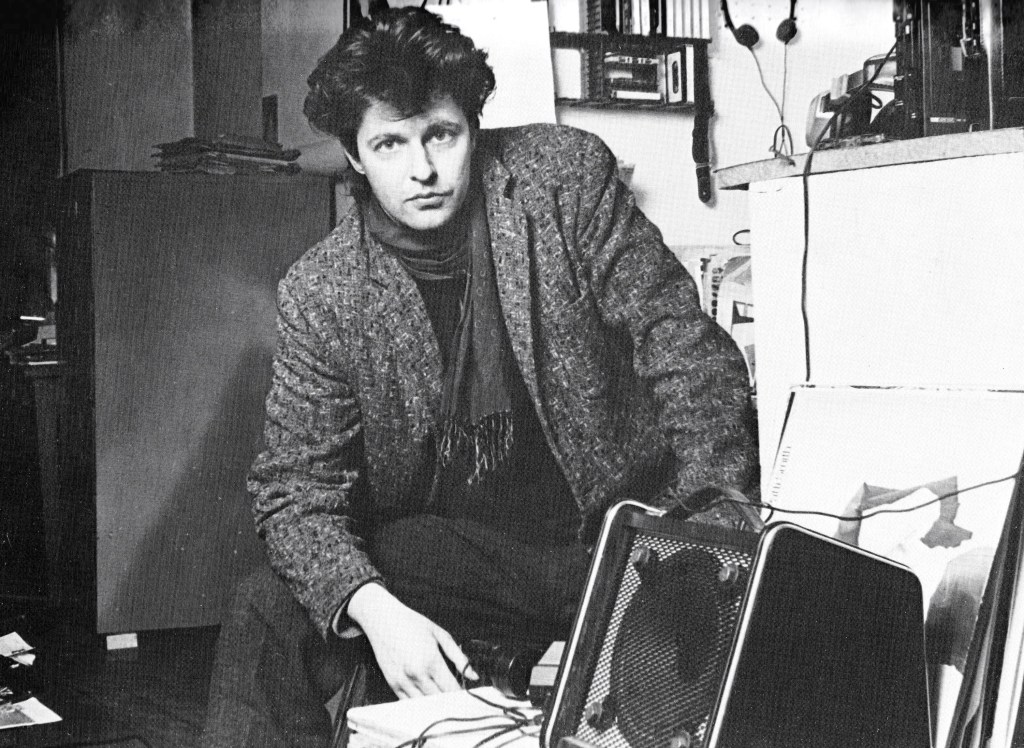
Q: What first brought you to New York?
Branca: I was working in experimental theater in Boston. I had a group called The Bastard Theater, and for a while I thought we could do something in Boston. But after a couple of years of beating my head against the wall, I realized it was absolutely out of the question. People in Boston were not interested at all in anything other than Beckett or Ionesco, as far as experimental theatre was concerned. I knew I was going to have to come to New York at some point to do that kind of work, so I worked two jobs at the same time, eighty hours a week. I saved like a thousand bucks and made enough money to come down here in 1976.
When I first got here, after a few weeks, I finally found an apartment-share with an NYU student. I was living in a hallway and I had almost no money. I lived on potatoes and eggs for a year. It was great, I wrote an incredible amount – I’d say the equivalent of somewhere between four and six full-length productions.
I finally came across someone else with whom I felt some kind of connection, as far as the work was concerned. As it turned out, he had a very large ground-floor loft space in SoHo. He was interested in theater pieces, even though, strangely enough, he had done a lot of work in experimental music, like I had. So we started setting up his place as a theater space. Basically we were going to build the space, and then he would do his productions and I’d work with him, and I would do mine and he’d work with me. One day I had an idea to start a band. It was something I’d wanted to do for a long time, even though I’d never really done it – other than when I was in college. Out of the blue, we got hold of a guitar; he played the piano; we found a drummer; we had a band; and the band was immediately successful. We realized that we could use the band as a vehicle for the work we wanted to do, because we had an audience.
I’d been playing the guitar since I was 15. I was always interested in rock, even though I was doing theater. I’d always felt that the rock stage was the most exciting theater, but I never really saw anyone use it. I had never been able to find a way of making it work. What happened with Theoretical Girls was a very slow process. When we first started, the songs were fairly conventional rock. But then it began to develop. We tried any ideas that came up. It was a wonderful situation: Playing one or two gigs every month, we were constantly performing and trying out new ideas. After about a year, I started to find some ideas that I really wanted to work with seriously.
Q: When I hear the name Theoretical Girls, the only sound I have in ear is the single, “You Got Me” and “U.S. Millie.” Is that an adequate representation of the band?
Branca: No, not even slightly. “U.S. Millie” was the only song in maybe three or four sets of material that sounded like that. Even “You Got Me” was not particularly indicative. We didn’t really have a sound of any sort. You could see that from the record: It’s two totally different kinds of things.
I like some of the old material, although I don’t work in the three-minute song format anymore. When I hear it now on tape, it still sounds relevant. I had a song called “I Want More,” which was a very simple kind of punk song when I played it by myself. There were simple chord changes, and the words were kind of vicious and antagonistic. But the arrangement! It started out with a really cliché lead break, going into two chords played so fast that it was impossible to keep the beat. The other guitar was playing a totally different rhythm – kind of a two-string Chuck Berry thing – at a little slower pace. The bass was playing a really slow, almost reggae line, a totally different rhythm. And the drums had the instruction, “Try to play something that’s not on beat with anything else.” It was almost like a tape piece with four different songs playing at the same time. Live, it had an incredible effect. I’ve never really done anything like that since.
Q: Did you have any formal musical training?
Branca: No. When I was 15, I studied guitar for four months. I started to learn how to read music and basically could follow a simple melody line. But I hated it. It was totally boring, and I put down the guitar for a year. Later I picked up a chord book.
Q: Do you think what you’re doing now is an outgrowth of your work with Theoretical Girls and other bands, or did you have to unlearn things in order to make your music?
Branca: It’s been an ongoing process all the way.
Q: Is it also an outgrowth of your theater?
Branca: Definitely. There’s been a progression, since theoretical girls, back to the start; some of the ideas that I had are filtering back. I remember that, even at the time when I was thinking about them and writing these things down, I was thinking that I’d never forget some of these ideas. And even at the time, I felt there was a kind of subconscious progression of ideas. If I wasn’t consciously thinking about something, I always felt that it was developing on its own. I would find that when it came back to an idea, it always seemed as if it had grown a little bit. And that happens musically too.
I remember working on theater pieces and thinking that my biggest problem was getting to a kind of pure simplicity. I found that there was too much information, too many images, too much complexity. I always felt that it was simplicity that I needed to get at. And strangely enough, since I’ve been working with only music, I think I’ve started to understand this simplicity, kind of intuitively. So now I can take the ideas that I was working on then – and these are ideas that I worked on very intensely at the time – and bring them back, but with a kind of simplicity that they needed in the first place. It’s funny, I’ve been thinking recently that, in the last couple of years, I’ve solved the major problem that I thought I had.
Another thing about the theater is that there was a lot of music involved. I just wasn’t using guitars. Actually, as far as The Bastard Theater was concerned, I considered the pieces to be music theater, and that’s what I find myself returning to. For the entire period of time that I was working on the theater pieces, I was also collecting instruments. I would find a saxophone and learn a little bit about it, or a trombone. There was a piano sounding board that I found on the street. Quite a variety of instruments.
Q: Did your theatre music have an interest in densities?
Branca: Well, I didn’t consciously have an interest in density in those days, no. But when I look back on it, I find that is where it’s coming from. Specifically, there’s one piece I made that I found myself listening to a lot and always thinking, this piece is a gold mine. It was very, very dense.
Q: What was it?
Branca: Well, it was some music that I used in a theater piece. I had a bolt that was about six feet long and maybe half an inch in diameter. It had a spiral groove, like a screw, running the full length. And I had a very thin metal rod that I would rub up and down the bolt. The bolt sat on a large garbage can lid that was elevated off the ground, so it would act as a sounding board. And underneath the garbage can lid I put a microphone.
At the time, I knew nothing about the harmonic series. I was just listening. I recorded the sound of the rod being rubbed up and down the bolt. Live, you could hear the density, the thickness and richness of the sound, but it was very soft. But on tape, played at a slower speed with the volume up, it was amazing. I could hear orchestras, I could hear choirs. At the same time, I felt that, as long as I have this tape, I’ve got a life’s work of music. Because every time I heard the tape, I could hear a different piece of music.
Q: Are you still interested in performing your older guitar pieces?
Branca: Well, I really don’t have that much interest in performing them. Most of the ideas in those pieces either have been already developed beyond what they were, or I intend to develop beyond what they were. What some of the earlier pieces had was tighter structure, more changes, more dynamic development. That may seem appetizing to some people, in relationship to what I’ve been doing recently. But it’s incredibly crude in relationship to what I know I can do with what I’ve developed in the last couple of years. I just can’t see getting up and performing that, when I know what I can do with these other instruments and with the way I’ve developed compositionally in the last couple of years. It’s a matter of having patience. The public doesn’t tend to be very patient, and no one helps them be patient either. But I think there will be a payoff. I feel that being patient will have its rewards.
Q: I’ve never heard a complete performance of your Symphony No. 4 can you tell me something about that piece?
Branca: Symphony No. 4 was written immediately after Symphony No. 3, and again, to tell the truth, it was written pretty quickly. So again, I didn’t really develop the ideas as far as I wanted to. But there is a growth involved in the peace. It’s really an extension of the ideas that I started working on with Symphony No. 3. (Symphony No. 3 was a kind of demonstration of those ideas which I discovered just a few months earlier.)
Q: Is Symphony No. 4 as big in scale as Symphony No. 3 is?
Branca: Yes. On the tour we did 18 concerts. It was a comparatively relaxed tour, we were more comfortable than we’ve ever been. The travelling situation was set up in such a way that the musicians were not totally burned out when we got on stage to play the concert. We had roadies. The equipment was taken around in trucks, and we rode on trains. So that meant that those four weeks were a working situation for me, and as we toured the piece, I changed it. The piece that was performed in Vienna was different from the piece that was performed in Amsterdam – only about half of it was the same. It was exactly the way I like to work, because I can’t really hear a piece until it’s in front of an audience. When it gets in front of an audience, it’s like the blood is pumped into the piece. Then I can see what the piece can do. So I was able to really shape it. The piece ran as long as two hours and fifteen minutes and as short as an hour and fifteen minutes. It was incredibly exciting. About halfway through the tour, I was teaching very long sections in the afternoon, we were rehearsing them in the sound check, and then playing them that night. It was incredible to work with that kind of immediacy – which is not something that a composer can usually do. By the end of the tour, the piece was hot. It was a really good piece. And I got to hear a lot of ideas that I wouldn’t have been able to hear normally.
Q: Why did you decide to do this piece instead of Symphony No. 3?
Branca: Because I wasn’t happy with No. 3. The piece was unfinished – I had a deadline and I wrote a piece and we went on stage. I wanted to develop those ideas. As I said, Symphony No. 3 was basically a demonstration.
Q: But still, you didn’t take advantage of that time to revise it. Instead, you wrote a new piece.
Branca: Well, the fact is that about 50% of Symphony No. 3 that was performed in Brooklyn – only 45 minutes of it is on the record – I did not like at all. It didn’t work. I was working with new instruments and at the same time trying new structural ideas. And some of them just fell flat and didn’t work. I wanted to go on to something new, and that’s what Symphony No. 4 was. There was some similarity, because the instrumentation was for the most part the same. And in one movement I was still working with a slow, continuous flow of chords, except I was breaking the chords down a little bit more and listening to them. I carried that idea one step further; I tried to develop a continuous quality. But it’s slow, and although I was very happy with the movement, it really wasn’t what the audiences wanted to hear, especially in the rock clubs! When we packed a place completely full of bodies, as many bodies as you can get in, and it was so hot that people were passing out, they really did not want to see me standing up there like I was moving in slow motion. They wanted to hear some action. So that was a little rough sometimes. But I’ve never heard such beautiful stuff as what we were able to get with this piece.
Q: You’ve said elsewhere that the clubs are the best place in which to perform your music. Do you still feel that way?
Branca: Well, no. I think a club, a club situation, could be the best, but the way the clubs are now, no.
Q: What’s the disadvantage now?
Branca: Well, the audience is treated like a herd of cattle. It’s the same thing that happens to any kind of business that starts becoming successful: The only thing on anyone’s mind is, how can we make as much money as we possibly can, how can we make the item as cheaply as possible and charge as much for it? That is exactly what’s going on in the clubs. They don’t care. Just get the people in and get ‘em out. They know it’s a short-term business.
Q: What made you think that the clubs were a good stage for you?
Branca: I used to love the idea of going onstage at 2 or 3 AM. The atmosphere at that time of night can be electric. I also like the idea of the underground, anything that was underground. When I came to New York, the first thing I did was look for it. And of course there wasn’t any.
Q: The subway.
Branca: That was underground all right.
There was a club, TR 3, which was about as close to underground as you can get. It was very hard to find. It had unknown bands playing there. It was a very tiny, actually very uncomfortable place to go. But the reason people went there was to hear good music.
Q: Restricting your music to the clubs would mean limiting the size and character of your audience.
Branca: At one point, it seemed to be either one extreme or the other, because the art world and the concert-hall situation seemed to me to be like a church, where people came and spoke in hushed tones and sat in awe of what was going on. The clubs really seemed more appealing, but the club scene had problems too. Now I’m more interested in working in concert situations. Not necessarily because of the atmosphere, but because I need time to set up, tune the instruments (which takes at least two hours). Then go through the sound-checking procedure.
Q: Do you have any regrets about the new keyboard instruments which were built for Symphony No. 3? Have you kind of painted yourself into a corner, in terms of the ease of having them played or just having them transported?
Branca: Oh yeah, definitely. The cost of transporting all of the equipment was incredible. It creates a lot of limitations. But eventually, what I’ll be able to get with these instruments… You have to realize, I haven’t even barely touched their potential. And the last piece, and even in Symphony No. 4, for some reason I stayed away from using the more unusual intervals. Within the system, I have been using the intervals that people are used to hearing. I don’t want to use these intervals just for effect. I want to incorporate them into the system as a completely viable technique. So really, these instruments are worthwhile for me. There’s always an albatross hanging around my neck; I just made it a little heavier.
The real question is, would a synthesizer be easier? At the moment, it’s not too much of a problem, because my instruments are a lot cheaper than the kind of synthesizer I would have to have. But that’s not always going to be the case. I’m interested in working with synthesizers, especially with computer-generated sounds. It really fits in, because in some cases I’m dealing with formulas, and they can easily be programmed. I’ve got some ideas that could never be done with any conventional instrument. I’m interested in working with variable pitch, pitch that’s in a constant state of movement. It’s not possible to do it in a way that you can really control. With the computer, it is. But you see, I’ve always been attracted to working with primitive devices. And when I get to a position where I am really developing the potential of working with the harmonic series, these instruments are going to make a lot more sense than synthesizers, just on a conceptual level, because the harmonic series is based on the vibrations of a string. It’s a system that exists in nature, and I still like the idea of using naturally produced sound and naturally resonating sound in a space as my compositional material. I still think that there is something in natural resonance that may be unique, something that you couldn’t get with synthesizers. I’ve heard very little electronically produced music that’s been even slightly interesting. But I know the potential is there.
Q: I was wondering if all the instruments that have been built for your music have begun to supersede guitars.
Branca: They were never intended to supersede the guitarist. I’m now developing guitars that’ll work with these instruments. The problem was, in this tuning system, I couldn’t use conventional guitars. In the Symphony No. 4 I did use a few guitars, but I was incredibly limited; I could only use a few notes on the fret board because of the placement of the frets. They’re not in tune with these instruments. So the next step is basically to make something like Harry Partch’s Adapted Guitar. I won’t be using his tuning system. It’s really just a matter of changing the fret positions. So the guitars are finally going to come back, and that was the initial idea. The idea was to create a guitar orchestra. It’s just taken longer to develop than I thought it was going to take.
Q: Even before you started working with the harmonic series, you were employing a variety of retunings of the guitars.
Branca: I had somewhere between seven and ten different tunings. It started out with one tuning that I called the octave tuning, which was the same note tuned in three different octaves. It was two strings tuned to a low tone, the next two strings one octave higher, and the next two strings an octave higher than that. And for about a year, I wrote all my pieces in that tuning. Then I started to get ideas for other tunings, and I started to think about having some guitars in one tuning and other guitars in different tunings. Then it became more complicated. I’d have an idea for one tuning, and that would determine what the piece was going to be. For instance, Indeterminate Activity was a unison tuning: All the strings were tuned to the same pitch. But each guitar was tuned to a different fundamental tone. I wrote it for all soprano guitars, completely within one octave. I’d written it specifically for an outdoor situation, and I knew that if I was going to use all sopranos, it was going to cut. And it did. But when the piece was performed indoors, it was a bit harsh! So I changed the piece, moving notes down to the baritone and tenor range. But it’s still weighted mainly toward the soprano.
Q: With the keyboards built for Symphony No. 3, the idea was that they would cover the range of intervals for part of the harmonic series?
Branca: Right, that was the idea – in the first seven octaves.
Q: Can they accommodate alternate tunings, or are they specifically designed to play only certain ones?
Branca: Oh no, there are any number of tunings. I’ve already experimented with tuning them differently. You see, there are tunings within a tuning. The harmonic series can be used as a tuning system. But within that, I can also have tuning systems that are similar to my older ones. I started to incorporate the unison tunings with great success: Instead of one string being sounded for one note, I have three strings all sounding the same note – I get a unison effect. Although the instrument is tuned within the harmonic series, I don’t have it sounding every single note progressively in a series, such as 15, 16, 17, 18, 19… What I did first was ear-tune the instrument to the intervals I liked. Then I figured out what intervals they were and put them in the context of the tuning. You might say that the tuning was the piece.
Now I’m thinking about creating instruments which are pieces in themselves, where virtually anyone could sit down and really play a piece. You would have to give some indication as to how the instrument should be played, but you wouldn’t necessarily have to specify what notes would be played. That’s interesting to me too.
Q: What was the value of the unison tuning in terms of the keyboards?
Branca: I just wanted to have one instrument that used the unison function you hear in harpsichords or pianos. There’s even more of a unison effect when you have two different keys playing two strings that are both tuned to the same note, because they’re attacking the two strings at totally different times. It gives you more of the impact that a unison has, which of course is what the impact of a string section is. In a violin section, 32 separate voices are being attacked by 32 separate instruments. That’s the beauty of it. And the unison is the most consonant chord. It reinforces itself at the lowest possible harmonic, which is the first!
The other thing that’s interesting about a unison – and this is so beautiful – is that, at the same time that it’s the most consonant chord, in a way it’s potentially the most dissonant chord: the chord that’s dealing with the smallest possible interval relationships. In a violin section, you actually have 32 different tones. It’s very common for many of the players to be as much as a quartertone off, especially in the violin section. When pianos are tuned, sometimes they’re purposely tuned slightly out of tune to create the so-called “warm” effect. Another reason a violin section sounds so great is because it’s pretty far out of tune.
If you really sat down and calculated the actual fundamentals, you’re dealing with 32 different fundamentals. We’re not hearing a lot of dissonance because the dissonance is occurring so high in the series: The closer an interval is, the higher its reinforcement occurs. All of that reinforcement is happening so high it’s out of our range of hearing, or at least it’s not having that much effect on what we are hearing. But in reality, we’re hearing what I think of as a unison cluster.
This is one of the main ideas I’m working on right now. I haven’t been able to do it because I haven’t had enough voices in my ensemble, to really work with it as a compositional tool. But with a string section!
I was listening to some Buddhist sacred music, instrumental music. It was some of the most incredible music I’ve ever heard in my life. Certainly some of the scariest music I’ve ever heard, strange and hallucinatory. And they’re clearly dealing with this concept of the unison cluster: a massive number of intervals all very close to the same tone.
The reason I know this is because I’ve started hearing it in my own music, and it’s an amazingly powerful sound. Whether the phenomenon I’m thinking about involves resultants or combinational tones, I don’t know. But there are sub-harmonic types of resultant effects and phenomena that begin to occur, which are absolutely amazing. You’re trying to reinforce an incredibly low range – you’re not only reinforcing something very high, you’re also reinforcing something very low. The harmonics themselves are creating resultant combinations. That’s another effect that was occurring in the last part of the fifth movement of Symphony No. 5. There would be times when I would start hearing a tone that was so diabolically low, no instrument could be making it. And as the piece progressed it would be getting louder, and sometimes it got so loud that I’d be scared to continue. I would actually stop the intensity of it because it would scare me, it sounded like the fucking floor was going to start shaking. It was a tone that was no longer a tone as much as a vibration – and no instrument was playing this vibration. And anyway, I’m pretty sure that the vibration I was hearing was somehow actually below the range of hearing, that’s what’s interesting about it.
Although we can’t hear the interaction of harmonics in the high range or in the very low range, does that mean that that is not still physically taking place, vibrationally? Of course not. It’s taking place, and it’s having an impact on what we actually hear.
Q: Would you be tempted by a commission for strictly traditional instruments? A string quartet, say, or an orchestral piece?
Branca: Yes. People have talked to me about it. I’m definitely interested in rearranging Lesson No. 1. I would love to hear this piece for orchestra. In many ways it would be better than the guitars, because the guitars have an intensity, but they also add a muddiness. A lot of the counterpoint is just totally missing when the guitars are playing that piece. Also, that piece was written as a structured improvisation, and it doesn’t have to be a structured improvisation. What I want to do is actually write the piece out with no improvisational aspects. I think I could bring the intensity back through the compositional process. But to write 15 minutes of that piece would take me at least two months, so I would have to have a commission to do it. I would like to do it for a large chamber orchestra, with a whole variety of instrumentation. That piece can go anywhere, the idea of that piece is one I haven’t really developed to its potential at all. Just a few days ago, I was thinking about a piece that was a further development of that idea. The problem with it is that it would definitely require trained musicians and plenty of rehearsal. So that’s something that just goes on the shelf.
The real danger for me is getting too involved in music theory and 19th-century compositional technique. It’s very interesting, and it’s been explored and developed to the point of a fine science by some composers. And it is an interesting area to work with some of these ideas in relationship to my tuning system. But that to me would be painting myself into a corner, losing the idea that there are no limitations. When I am working with music theory and mathematical ideas in relation to the harmonic series, it’s very time consuming, and you can get immersed in it and forget about everything else. It seems like the only thing in the world, and I think that’s a danger. I don’t want to get too far away from this kind of intuitive feeling I have about the music. I don’t want it to become too cerebral, and I don’t want to get too involved with craft.
Q: Earlier, you were talking about the advantages of being able to rework the Symphony No. 4 while you were touring with it. Are the other musicians useful in that they can offer compositional advice?
Branca: No. They don’t offer any compositional advice. Basically, I conceive the piece and then show it to them.
Q: What about Stephan Wischerth? Is much of the drumming his?
Branca: Yes, most of the drumming ideas are his. Stephan is an inspirational player, and I found that, when I restricted him too much, it sounded OK. But when I let him go at some rehearsals, he would practically raise the stage off the ground. So I figured it was worth it, say for that one out of three times when it’s like absolutely nothing I’ve ever heard. He does stuff that has nothing to do with listening to the drums; it has to do with an emotional thing that drives right through your body. So it’s worth it to leave him as much room as possible. There are some places where we have to say, “OK, we’re going to have to work this out, and you’re going to have to do it like this, and this transition comes here.” But even then, even when it’s an obvious transition, I try to keep away from him, because once he’s on a roll, you might say, he can make transitions sound more incredible than anything I could write.
We’ve been working together for over seven years now, developing a concept of drumming, and I think he’s about got it at this point. And I’ve about got it. There were things we knew we didn’t want to do, and things we knew we wanted to get but didn’t know how to get them. It’s definitely there at this point. A lot of it has to do with restraint. To me that’s what drumming is about. Composing too.
Q: You were saying that in earlier works, certain tuning methods were unique to the conception of the piece. Do you think that now, with the harmonic series, you have one system that you want to work with for an extended period of time, or can you see yourself getting involved with new tuning systems that are completely divorced from this one?
Branca: Yeah, I have to say that I’m in this one. I see it as something that I’m going to continue to work with. There are plenty of variations that can be done and have been done with a just system. I think the one that I’m doing is unique at the moment, and that the way I’m approaching it is unique. It can be mind boggling, and that’s one of the reasons why I’m trying to stick to this system for the moment, and not change it.
Q: In your notes to the Symphony No. 3, you say, “Ideally every aspect of the tuning, instrument design, compositional structure, and performance should reflect the logic of the harmonic series.” What essentially is the good news that you’re bringing people by acquainting them with the harmonic series?
Branca: There is no good news. There is only the harmonic series! That’s not the good news; that’s the news. It’s just ridiculous that it should be news at this point. But it most definitely is. It’s not really taught in schools, it’s not taught anywhere.
Q: Why should they care?
Branca: Why should they care? Ask the nautilus shell why they should care. Ask “the trees.” Ask yourself. It exists in every form. There’s no form in which it doesn’t exist. There’s no discipline in science, biology, chemistry, mathematics, philosophy, where it does not exist as a fundamental concept. Most likely, the discipline couldn’t have even come about without it. Why the harmonic series itself is not considered a discipline, I don’t know. It seems ridiculous that it isn’t. But it isn’t.
I feel that, within the harmonic series itself, there is contained a textbook on harmony, you see, and on modulation and on composition. And the compositions are also contained within the series. I still believe – it’s not a matter of belief. I can make it happen. I’m going to derive an entirely esoteric, eccentric compositional approach to the harmonic series!
The Symphony No. 3 may not have what Rockwell would consider to be structure and form, or quite enough of it for his tastes, but at least to me, when I conceived this idea and when I wrote this piece, I – seriously – I put it on my desk – I remember when I first did it – and I went to bed that night and I said to myself – I honestly said this – “If I die to night, I’ve done everything any human being can expect to do.” Now I no longer feel that way, because it’s grown so big since then. It’s like the seed, not the end. To me at least, in Symphony No. 3 the statement was made that this is something that is pre-existent. And it implies that even one composition, as simple and “primitive” as it may sound, can be derived, the possibly more “pleasing” compositions, with more “change and variety and modal modulation” can exist. And that’s basically what I’ve been working on. And I’ve already developed many approaches to that. But again, it’s such a lengthy process, that I have to, I suppose, come down to earth at some point.
With the Symphony No. 3, I tried to derive a series of chords from a pre-existent phenomenon. The harmonic series can be depicted in an incredible number of ways. What’s unalterable are the intervals themselves, the proportional relationships.
By limiting myself to every tone within the lower part of the series, I was trying to put across the idea that we are hearing harmonics. I’ve actually taken the physical proportions of these harmonics and tuned directly to them, which meant functionally, what I was actually playing were all of the harmonics in the first seven octaves of the series, which means all of the harmonics which are created when a string is vibrating, up to 128. I think it’s more possible to perceive or conceive of the fact that we’re listening to harmonics. Because I’ve been able to listen to a chord series and begin to lose a sense that I’m listening to chords, or that I’m listening to music. Which is something I want to do. I want to gain a perception not so much of a chord as a cluster of harmonics.
Q: Are you satisfied with the way your music sounds when it’s recorded?
Branca: As far as The Ascension is concerned, I like some of it, but most of it I don’t like. None of these pieces were written for the studio, and it’s clear that 99% of what you hear in commercial music is written specifically for the studio and recorded in a way that will adapt to studio techniques. And the engineers seemed to be really set in their ways. They’re so used to recording the same type of music. In most rock, the drums and voice dominate. If you take any track and eliminate the voice, you’ll see that everything else is really pushed way down. Engineers spent half of the session listening to the drums. They don’t want to listen to guitars because they know that guitars are impossible. So sometimes the guitar becomes a kind of effect track.
But my music has nothing to do with the way commercial rock is written and recorded. So I don’t know how to go about it. And if an engineer who’s been an engineer for five or six years, working at a top studio, doesn’t know what to do about it, then I’m really starting from scratch.
I’m not unhappy with The Ascension, but you should have heard that music in the room it was recorded in. The initial recording of The Ascension is not even what’s on the record. What’s on the record is overdubbed. But the first recording of it was the optimum performance of the piece. We had a lot of time to get the right sound out of each amplifier for each guitar. We really spent a lot of time listening, and of course we didn’t have lots of people bustling around, fixing lights and things. The room itself had a very good sound, much better than you would get in a club. And it sounded heavenly. And then we listened to the tape, and it sounded like shit. Simple as that. It just sounded like shit. And I don’t know what was wrong. We tried everything we could think of, as far as how to mic the room. What could you do?
Q: I understand that you did a recording of Indeterminate Activity. How did that come out?
Branca: We did a 24-track recording, which has been shelved. It just does not come across. Of any piece I’ve ever written, that piece would be the most difficult to record, because it was purposely written to be extreme in its intensity and volume. The piece just immediately saturates any room that it’s ever been recorded in. Nothing gets on tape.
Q: Would recording it digitally make things better?
Branca: No, that has nothing to do with it. I don’t think the problem is the medium in which it’s recorded. To tell the truth, I think the problem is with microphones. With what I do, I think the microphones just completely overload. The microphone is not an ear. Sometimes I’ll put my ear right where the microphone is, then I’ll go back in the room and listen, and it’s not there.
Q: At the performances of Symphony No. 3, I could hear a real difference in the quality of the sound depending on whether I was sitting in the balcony or the orchestra.
Branca: The room is just no good for my music. We actually had the best equipment you could get, it was not the fault of the equipment. We had professional people working, and they did what they call EQ the room: They tested the room, they ran white noise at an incredibly high volume. (It’s a very interesting test, it sounded great!) As it turns out, that room amplifies the mid-range – basically, the vocal range – so much that the high range and the low range are lost. This is in the orchestra section. For some reason, the exact reverse happens up in the balcony! So we had our hands tied: It was either lose the balcony or lose the orchestra. We didn’t rehearse the two days before the concert, because we were spending all of our time trying to get the space to sound like something.
Q: Before certain performances of the Symphony No. 3, you read to the audience excerpts from Dane Rudhyar’s book The Magic of Tone and the Art of Music.
Branca: I did that because I was in a state of mental collapse! I was really not totally with my feet on the ground. And I wanted them to realize that, in the same way that this was more than just a piece of music for me, that I wanted it to be more than just a piece of music for them. And there was no doubt that it did add some depth to the second two performances, when I read. It didn’t happen in the first two. I’m not interested in simply entertaining people. That’s not what I do and that’s not what I’m interested in doing. I want to have an experience. It doesn’t have to be an orgy. It doesn’t have to be a Dionysian rite. And it doesn’t have to be “spiritual.” But I want to have an experience. I wanted people to know that, and that text was one I had a feeling for.
Q: Why didn’t you read it at the first two performances?
Branca: It just didn’t feel right. I can’t explain it. It felt as though there was a wall of bad energy on that stage, and that it was the wrong thing to do, to go out and read this thing.
Q: And for the subsequent performances?
Branca: I felt more comfortable. The bad energy was definitely less. But when I got out there, the feeling that I got from the audience was almost the feeling of shock. I don’t mean shock in any extreme way. I think it was fear of what could happen. I felt as though I was projecting a kind of naked persona, the way I was approaching it. And I got the feeling that the audience was saying, “Don’t do it to me, don’t do it to me.” But my reading was horrible. The first time, I read it so fast, I don’t think people could even understand what I was reading.
I got a negative feeling from the audience, but I don’t think the audience was necessarily feeding me negativity. I think that the audience generally was not giving me anything at all. The reasons why people were there, and the troubles of getting to Brooklyn, the kind of hall it was, the whole way the series had been promoted – the whole situation just gave the wrong kind of context. It was a cold feeling from the audience, and it was my job to warm them up.
Q: You normally don’t face the audience when you perform. Does that make it more difficult to gauge their attitude or to work with them?
Branca: No. An audience can communicate a lot to a performer – to me, anyway. An audience can tell you what they think, immediately, without saying a word. It doesn’t matter whether I’m facing them or not. Even if I’m facing them, there still can be this incredibly thick wall between you and the audience. If you have really bright lights in your face, you can see only the people in the front; Sometimes you can’t see anybody. When I used to sing, sometimes it would just be a void out there. So it doesn’t make too much difference if my back is to them or not. I’ve walked onstage a few times and my back has been to them, but the energy was just all over me.
If I feel enough happening, I’ll turn around. If there’s really something to work with, it’s worth it. That happened in Berlin. My God, it was unbelievable. There were like 800 people in this horrible hellhole of a club, with no heat, in the middle of winter. They didn’t even bother to heat it because so many people would come. And so in the dressing room, our guitars were totally cold. We brought them onstage – it was really hot under the lights – and they were just dripping with moisture. The whole situation was ridiculous, but the second we walked on the stage, the energy was so incredible that I just felt completely relaxed. When the energy is not coming from the audience, it’s a kind of standoff situation; it’s either an “OK, prove it” situation, or it’s “We don’t know what to do about this, we don’t know who you are or what to think.” You feel all that the second you walk onstage. And you’re never sure how much you’re projecting and how much is really coming through. But in Berlin, when I walked onstage – and this is one of the only times this has ever happened – it was clear that the audience was saying, “OK, beat us, whip us, we wanna die! We’re just waiting for some action, we’ve been starving here in Berlin.” And I’d been on the road for two weeks, and we were bored and wanted to have some fun too, so I had it.
Links to:
SONIC TRANSPORTS: Glenn Branca Contents
SONIC TRANSPORTS: Contents
For more on Glenn Branca, see:
Music Book: Historical Dictionary of Modern and Contemporary Classical Music, Second Edition
Music Book: Soundpieces 2: Interviews with American Composers
Music Lecture: The Secret of 20th-Century American Music
Music: KALW Radio Show #1, A Few of My Favorite Things…
Music: SFCR Radio Show #7, Postmodernism, part 4: Three Contemporary Masters
 NICOLE V. GAGNÉ