INTRODUCTION
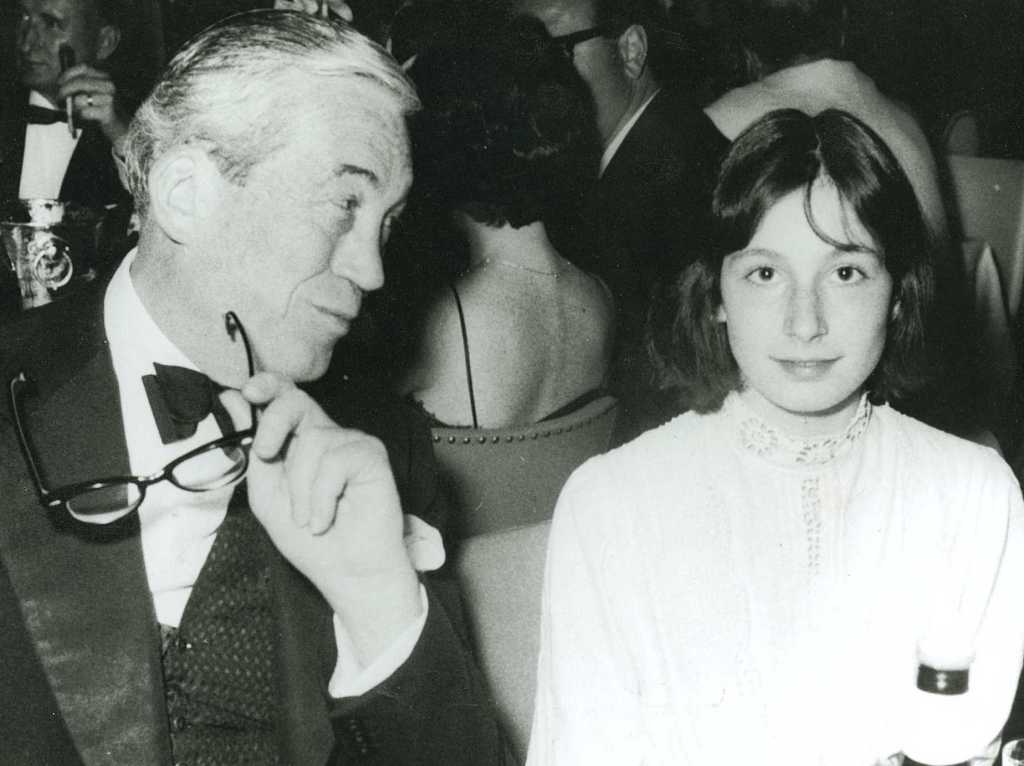
When Anjelica Huston spoke at the American Film Institute’s tribute to her father in March of 1983, she’d already earned some good notices for her performances in The Last Tycoon and The Postman Always Rings Twice, although both were small roles. To the public, however, she was still most familiar as Jack Nicholson’s girlfriend – and of course as John Huston’s daughter, although that subject could be sensitive, as she acknowledged from the AFI podium: “Dad, I know I gave you a lot more trouble than Walter ever did when we were working together. But I’m here tonight to tell you that I’m willing to try again.” So was he, and their mutual willingness led a year later to Prizzi’s Honor, which made her a star. But to most ears that night, she sounded like she was cruising for another bruising. Anjelica had made her film debut as a teenager in 1969, playing the lead in her father’s A Walk with Love and Death, and working together was a tense and unhappy experience for them both. The film also flopped badly and tarred her with some nasty, dismissive reviews. She wouldn’t act in front of a camera again for seven years.
That collision with his daughter altered John Huston’s career too. He of course continued to write and direct, and he acted more frequently than ever, both for himself and for other directors. Yet his experience with Anjelica seeped into his work and was reinterpreted by Huston in three of the four films that he made immediately after A Walk with Love and Death. In The Kremlin Letter (1970), The Life and Times of Judge Roy Bean (1972), and The Mackintosh Man (1973), the plots all hinge on daughters who are obliged to perform in the harsh arenas of their fathers. None of these women are lead roles, yet each is pivotal to the story. Within their specific trajectories – failure in Kremlin Letter, success in Roy Bean, and an unholy transfiguration, beyond failure or success, in Mackintosh Man – Huston locates the moral center of each film.
To approach John Huston’s career through the side door of these early ’70s efforts is to catch him at a disadvantage, artistically and commercially. None rank among his best work, yet each is a lot more interesting, sometimes even startling, than its current neglect would imply. They’re long overdue for reappraisal, and when considered in the context of A Walk with Love and Death, the daughter characters in these films take on a whole new dimension. As both writer and director, Huston was very much involved in creating these women; ironically, he took a co-screenplay credit only on The Kremlin Letter, which was a faithful adaptation and required the least new material from him. He put a lot of himself into these ambitious films, perhaps too much so, because they also lay bare an icy heart behind the action and the suspense – and the laughs too. This personal bleakness and hopelessness are communicated most palpably in his depiction of these daughters. The considerable difficulty Huston experienced in writing, casting, and directing their characters indicates the limits of this master filmmaker’s technique in the face of trauma and regret.
PART 1: A WALK WITH LOVE AND DEATH
Although born in California, Anjelica Huston grew up in Ireland with her brother Tony and their mother Ricki Soma. This was the 1950s, when their father was usually away filming on exotic locations – and paying for St. Clerans, the Irish castle he’d bought and proceeded to fill with the booty from his international shoots. Huston would see his children between films for varying lengths of time, but when he and his wife separated in 1961, she moved the family to London and he saw even less of them. Later in the ‘60s he tried to establish a better relationship with his daughter by bringing her into his career, and in 1967 he tested the 15-year-old Anjelica for the lead role of Annie in Sinful Davey but decided to go with Pamela Franklin (a pro who’d been acting in films since she was eleven). Anjelica was instead given a bit part, riding the inevitable horse – not unlike her older brother before her, although Tony had gotten a juicier role in the fox-hunt finale of their father’s The List of Adrian Messenger. After completing Sinful Davey Huston agreed to film Dale Wasserman’s script of the Hans Koningsberger novel A Walk with Love and Death. At the urging of his producer, Carter De Haven, he starred Anjelica as Claudia, a child of the nobility in mid-14th-century France, who is initiated into love, sex, and man’s inhumanity to man when she and her adored Heron of Foix are swept up in the lethal tide of the Hundred Years’ War.
“I really didn’t see myself in that part,” Anjelica admitted many years later to family biographer Lawrence Grobel. “I felt that I had to do the movie to please him […] I’m sure he felt somewhat thwarted and uncomfortable with me. I didn’t go to him for a lot of advice. I kept to myself, which has been my way in times of distress. It was not a pleasant experience for him either. He probably felt very rejected by me. […] The fact that I was ungrateful and petulant about it was hardly something he could have expected. […] I got through it, but it wasn’t an easy time for me.” Of Assaf Dayan, also attempting his first lead as Heron, Anjelica insisted, “He was getting through it the same way I was.” The sensation, she claimed, was “like I was to be carried along on this wave. There was no joy in it for me.”
Anjelica and Assaf’s situation – inexperienced, powerless, dislocated, swept away – is of course precisely the situation of Claudia and Heron in the film. Working with two young people who had little acting technique, Huston apparently decided to let them suffer for real. Not surprisingly, this approach didn’t endear him to his players – especially after the film’s demise at the box office. A Walk with Love and Death was blistered by bad reviews and has seldom been revived. But if you see the film, you’ll get to enjoy the discovery of just how good Anjelica is as Claudia. For all her newness and distress, she already shows the honesty and immediacy that define her best work as an adult.
In her first dialogue with Heron, Claudia is a shy, sheltered child, almost stammering as she speaks to this attractive young man; yet she always possesses an air of elegant security, defining her as a child of aristocracy – or as the director’s daughter, even if she is a tyro in front of the camera. She’s someone still assured that the world is running as it ought to, as God and the King and her Dad want it to run. Huston keeps offcamera the peasant uprising that claims Claudia’s father, home, and entire way of life. Heron finds her afterward, huddled in the corner of a church, shrouded in black. When she sees him, she comes back to life, her bare arm emerging from her robes to touch the scarf she’d given him a few days before. Just as eloquent are her black-hooded, medieval Madonna features as she describes the horrors she’s witnessed. Huston then provides the perfect cap with an unexpected slide into comedy after Claudia and Heron leave the sanctuary, and her robes open to reveal a pair of the church’s silver candlesticks, too heavy and bulky for her to keep hidden as she walks along with him. You can’t help but love that she’s been fast enough not only to finance their new life out in the world, but also to have fooled everyone, us included. Claudia is even more impressive when she summons up the verve to play The Lady and intimidate a smith into buying the hot sticks. But all her stealing and scamming are still just a girl’s game. Arriving at an inn, they walk straight into a nun and a noblewoman being pimped, and Claudia’s eyes burn with fear and disbelief from within their black wrappings.
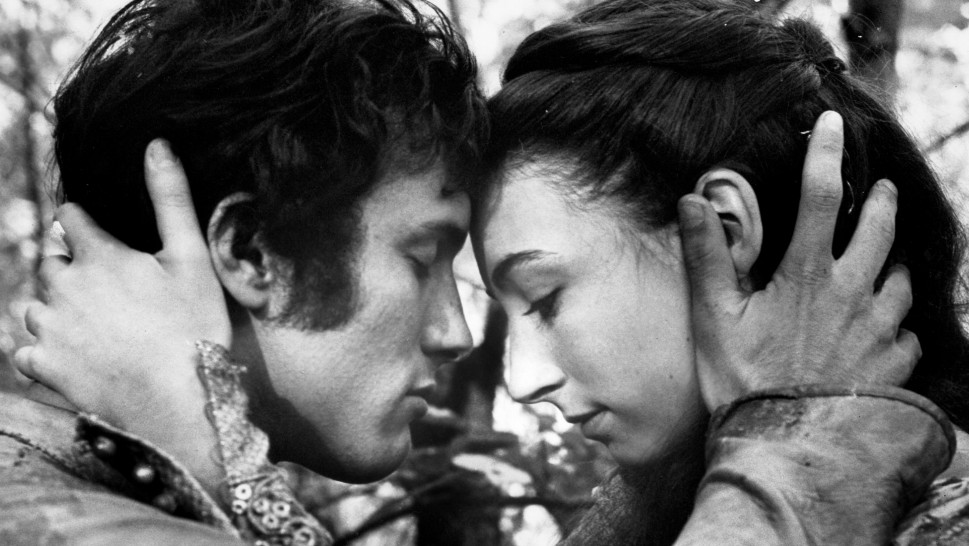
Anjelica has probably her best scene when Claudia and Heron are finally alone together at the inn. After explaining her idealized attitudes about the spirit and the flesh, she shows class in the good sense by letting him share the bed with her. Heron accepts graciously, keeping one chaste foot on the floor, and Claudia stretches out to sleep, resting her head on his thigh. The tenderness and innocence they both convey here makes the end of the scene all the more wrenching, when all of Claudia’s panic and grief emerge in a delayed-reaction hysteria, and she looks and sounds more 13 than 16, a shattered child who has lost everything.
Everyone thought he was just whistling in the dark when he said it, but Huston’s comment about his daughter after he made A Walk with Love and Death turned out to be accurate: “What really counts in film acting is that rare moment – just a flickering – when through the eyes you get a glimpse of the real meaning of the character. It is not technique or professionalism, just truth. Garbo had it. Monroe had it. I can see it in Anjelica.”
Look not for flickers from Assaf Dayan. Huston insisted that he chose the 22-year-old actor without knowing that his father was Moshe Dayan, then the Defense Minister of Israel; but if he was trying to pull an Otto Preminger by casting a newcomer of political celebrity, he chose someone more fated to failure than even John Lindsay, because Dayan’s pedigree brought with it the fear of anti-Israeli terrorism. It was rumored that Dayan was unable to obtain life insurance for A Walk with Love and Death – which would mean Huston had to shoot without the safety net of a completion bond. Few investors were equally willing to gamble such high stakes on the actor, especially after the pasting he took from reviewers. (Even Koningsberger later tried to blame him for the film’s failure and denounced his acting as “appalling.”) In fact, sometimes Dayan is quite good, as in the scene of Heron’s horror and guilt after having killed a peasant boy in battle. A handsome, easy-going type, with touches of both the poet and the rebel, he may have suggested to Huston a proto-Robert Mitchum, because the film does bring some of that out in him. Dayan’s real problem is that he lacks any deeper charisma or mystery. So whenever he’s on camera with Anjelica, she simply blows him offscreen.
That’s not the kind of rapport you want for a love story, and although A Walk with Love and Death has many handsome and impressive moments, it almost never communicates the special electricity generated by two young lovers. Huston was never really one for the mushy stuff, despite having already made two classic – and upbeat! – love stories, The African Queen and The Misfits. A Walk with Love and Death suffers not so much from his resistance to romance as from his reluctance to eroticize his daughter. He can depict her as a focus of idealistic adoration, as an emblem of suffering humanity, as a huffy and spoiled rich kid; but he cannot show us the teengirl who yearns for her boyfriend’s arms and lips and penis. She has to be all these females if A Walk with Love and Death is to be a success, and because she isn’t, it isn’t. Just a few years after the event, Anjelica confided about herself and Dayan to Berry Berenson and Interview magazine: “We never got into anything […] I don’t think he was that turned on by me, and I wasn’t that turned on. We liked each other a lot, but I guess in a love story the two characters should really be turned on.” Huston may have chosen to forgo passion between Claudia and Heron, lest it turn on between Anjelica and Assaf. But it sure would have helped his film. Instead, that intensity is implied in visual metaphors, most of which don’t make the grade. The film’s low point must be the moment when Anjelica and Assaf yes, literally frolic in the grass to show how happy and in love they are. That shockingly empty cliche follows an equally unevocative stab at eroticism: a brief far shot of the pair naked in a field, wriggling grublike on their bellies toward one another.
Far more persuasive is the bolt-from-the-blue emotion of Heron’s initial encounters with Claudia. He first sees her as he’s awakening, and the high-angle camera zooms in on his just-opened eyes; in the low-angle reverse shot, Claudia is silently gazing down into his eyes from an upper landing. The close shot of Heron is resumed, but in the cutaway back to Claudia, she’s gone. Their second meet cute is also spectral, and even better: After leaving the castle, Heron sits in a field and starts to write. A dog runs across the background from left to right and the camera pans right to follow it. As the dog wheels back, the camera starts to pan left but stops short on a two-shot of the motionless Claudia standing to Heron’s right. This sudden materialization supports his idealistic feelings for her, and it makes sense when he asks her to be his Lady as he journeys to the sea.
Unlike the intimate compositions of The African Queen and The Misfits, Huston’s camera in A Walk with Love and Death tends to stand back from his leads, in a visual sensibility closer to The Red Badge of Courage or The Treasure of the Sierra Madre – films that derive from The Battle of San Pietro and combat footage. He’s correct to emphasize the lovers’ besieged position in their perilous world, but this stance also leads him to gaze at them and frame them. The result is to evoke a sense of nostalgia and loss, underscoring the tragedy in this love story. But the lovers themselves are numbed in this cool distance – a problem Pauline Kael tried to describe when she called the film “too remote, and maybe because it’s so restrained – almost reserved – it never fully releases the lyricism of the conception.”
Far from being lyrical, A Walk with Love and Death is a depiction of the world gone insane. Claudia and Heron walk a lot more with death than with love, the war ripping at them no matter where they turn. Menaced by knights just as much as by the peasants, the lovers are repeatedly seen running toward what they hope will be a safe place only to arrive at one more fiery furnace. Their final trek takes them across one of Huston’s trademark long-shot windswept planes, as blasted and vast as those stretches of no-man’s land his heroes suffer through in The Man Who Would Be King and The Treasure of the Sierra Madre. This one, however, leads only to a prisonlike monastery, where the lovers are separated. They reunite hours later, after the sanctuary has been quickly abandoned to flee an advancing army – peasant or knight, who knows? “Running would be pitiful,” Claudia insists, and she and Heron stay behind and perform their own wedding ceremony in a sweet and simple single-take scene. “We heard the sound of death approaching. It rose in a great swell. But we were not afraid,” are Heron’s last words, heard in voice-over.
If killing off his daughter’s character – and her infant career with it – doesn’t seem sufficiently grim, then consider the blackness behind Heron’s death. Huston’s films would feature several more daughters, but Heron of Foix was his final take on the male innocent who receives his experience the hard way. In The Treasure of the Sierra Madre, The Red Badge of Courage, Moby Dick, and Heaven Knows, Mr. Allison, our lad survives with some of his innocence and most of his butt intact, even though death rains all around him. But as Huston got older, he came to a darker view of the world’s hardness toward Nature Boys. Among their incarnations in his 1960s films, only the original, Michael Parks as Adam himself in The Bible, is a survivor; neither Robert Forster’s Private Williams in Reflections in a Golden Eye nor Heron make it out of their stories alive. It’s no accident that this character doesn’t return in Huston’s cinema after A Walk with Love and Death. The triumphant natural man had ceased to exist for him.
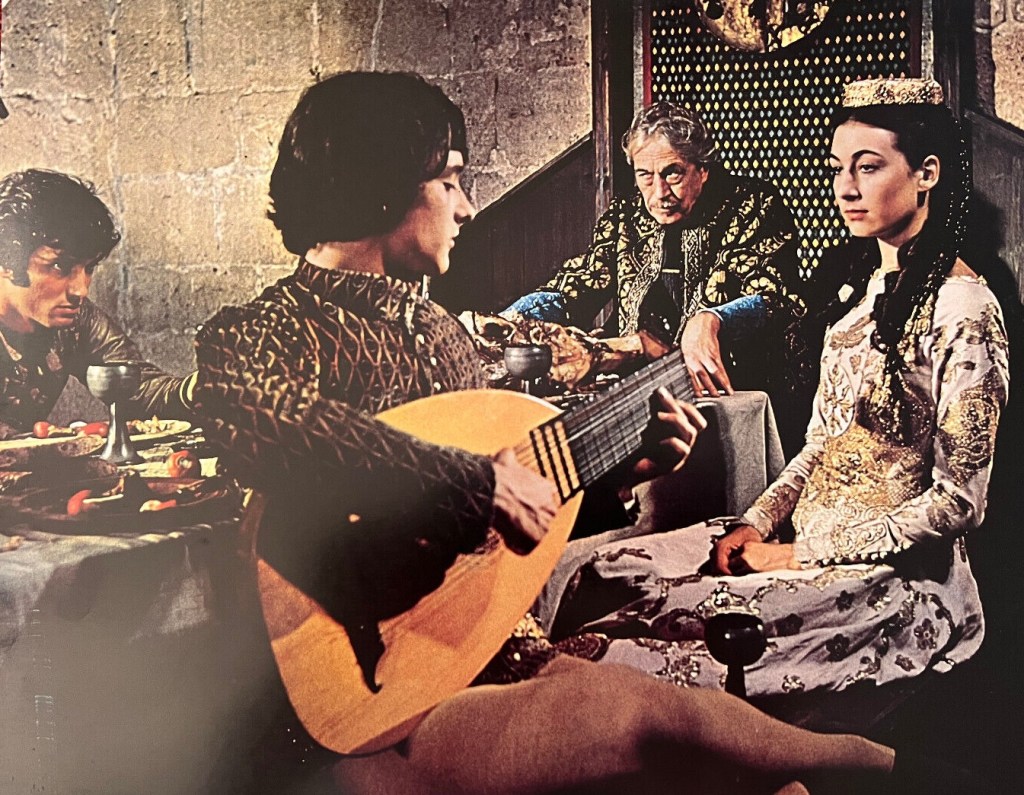
A lot else had also ceased to exist for Huston by the late 1960s. He plays the supporting role of Claudia’s uncle, Robert the Elder, and when he warns Heron, “Now God has turned His face from this world and its order has been destroyed,” he means it. Filming entirely on locations and using no studio set-ups, Huston got to see for himself how little 600 years meant in the death struggle between brutal landowners and rebellious populations throughout Europe. The crew of A Walk with Love and Death was kicked around just like Claudia and Heron: They lost their French locations because of the strikes and student riots of the spring of 1968; work resumed for a while in Austria, but Czechoslovakia was abandoned when Soviet tanks rolled in that summer, and the film had to be completed in Italy.
Robert the Elder is a noble who knows his time has come to an end, and he throws his support to the peasants, not the nobility, because he believes they are the ones most truly aggrieved. But he’s not too thrilled with where this position leaves him, and eventually the knights catch up with him and kill him. Huston, the real-life patriarch of his own castle in Galway, was right at home playing the lord of this manor. He even pays some of the tab for how tough this shoot had been on his daughter, by giving her a scene where Claudia can get angry at him and flounce off. Almost any moment of their onscreen time together is a special pleasure to watch today, but this business tops them all – letting her vent some bile was good for daughter and father, and it shows.
Having let Anjelica and Assaf live out their characters’ suffering, it was only fair that Huston wound up eating from Robert the Elder’s plate. Like his character, he found himself helping young people who weren’t particularly grateful or cooperative in return. And with the film’s release, the critics rose in a great swell while audiences stayed away. In his subsequent films The Kremlin Letter and The Life and Times of Judge Roy Bean, Huston again wore his heart of darkness on his sleeve and twice more appeared onscreen to repeat the black facts himself, stating them as plainly as Robert the Elder had. He would cast pros such as Patrick O’Neal and Paul Newman, and work in the familiar genres of espionage and the Western, trying harder than ever to make his films of the early ‘70s more audience-friendly, even as the spirit behind them steadily curdled. Huston’s personal and professional fiasco with Anjelica had been the rancid icing on the cake, which he would rework into three further investigations of the bondage within the father/daughter bond.
PART 2: THE KREMLIN LETTER
A Walk with Love and Death had been Huston’s third flop in a row, and he wanted to do something that would score at the box office. “I thought The Kremlin Letter had all the makings of a success,” he later admitted in his autobiography. “The book by Noel Behn had been a best-seller. It had, moreover, all those qualities that were just coming into fashion in 1970 – violence, lurid sex, drugs. […] Gladys Hill and I wrote the script, which I considered quite good, though in retrospect it was perhaps overcomplicated. In any event, audiences rejected the picture. This surprised and disappointed me, especially as it had been aimed so directly at the box office.”
Ironically, Huston may have failed to strike gold because he hadn’t been commercial minded enough. The Kremlin Letter’s view of sex is even icier, and its social condemnation more scathing and absolute, than the bouquets he’d tossed in A Walk with Love and Death. It’s hard for a film to be a hit if it doesn’t flatter its audience, yet Huston said he wanted to film Behn’s novel because none of its characters “has a single moral, ethical principle. The movie is just a reduction mirror. I think this is the way the world is. […] When I read the book, I thought that here was a reflection of the moral climate of our times.” To better portray some of his day’s deficiencies, he retained a sub-plot in which a young female spy known as B.A. is drafted to perform in place of her enfeebled father – and in accepting that yoke, is crucified on it.
Unlike Claudia in A Walk with Love and Death, B.A.’s initiator into love, sex, and man’s etc. is a veteran, Lieutenant Commander Charles Rone. The film starts with Rone’s abrupt discharge from the Navy, which he subsequently learns has been arranged by the government so he can participate in a risky espionage mission in Russia. The baffled Rone is treated with contempt by the nameless Admiral who relieves him of his rank, sneering, “I’m sure your new friends in Washington can explain.” Playing that Admiral, Huston clearly relishes the task of calling his star on the carpet. Yet both Admiral and Lieutenant Commander are also shown as subordinates to the officially displayed big smiling mug of then-President Richard M. Nixon, whom Huston deplored. Echoing Robert the Elder, Huston’s Admiral is also an elder statesman who loathes the current state of the world he once fought to defend. Oozing the disaffection Huston held for all the characters in The Kremlin Letter, he regards Rone as a defector allied with so-called Intelligence. When the Admiral dismisses Rone, he orders him to change into civilian clothes: “Only officers in the United States Navy are entitled to wear that uniform. Once upon a time, legend has it, some men even died for it.”
Now Rone must trade with men who risk their lives only for money. His compatriots are a team of veteran spies who have lost one of their reliables and therefore require Rone’s computerlike photographic memory for an assignment in Russia. This rogues gallery of aging operatives is dominated by their dying, ill-tempered boss, known as the Highwayman, who’s played by Dean Jagger in a way that reminds you just how unlikable old men can become. George Sanders is another stand-out, bringing some class to his turn as a gay spy who also performs as a drag chanteuse in a San Francisco queer bar. But the film’s bravura performance comes from Richard Boone as Ward, one of the funniest and most frightening monsters in Huston’s cinema. Disfigured by skin grafts, the drawling and grinning Ward is folksy, smart, completely untrustworthy, and utterly lethal – part Andy Griffith/A Face in the Crowd, part Tura Satana/Faster, Pussycat, Kill! Kill!.
Rone becomes the audience surrogate: We see everyone else through his eyes and learn information as he learns it, and so automatically we’re on his side and have a stake in his safety. But as Huston’s Admiral indicates, the film takes a dim view of Rone too. He is part of his generation, one more robot to displace the older, more colorful characters in the international spy game. Patrick O’Neal was a fine actor – he’d have to be, just to remain visible opposite the gargoyles Huston cast against him. His realism as Rone keeps the film tense and believable, grounding the story as its characters and situations fly to ever wilder extremes. But Rone is never sympathetic or even particularly likable, and he’s onscreen almost all the time. (In his finite wisdom, then-production chief Richard Zanuck vetoed Robert Redford as Rone because the studio was about to release a Redford film that he thought wouldn’t do much box office: Butch Cassidy and the Sundance Kid!)
With the relentlessly grim and pokerfaced O’Neal at its center, the only character whom the audience can worry for without ambivalence is B.A. She is discovered by Rone when he tries to re-enlist her father, the team’s safecracker and technician, who’s too disabled with rheumatism to rejoin his cohorts. The elderly spy urges Rone to take his daughter, and she demonstrates that she has chops to spare by cracking a safe with her toes! But when Rone returns with B.A., her presence provokes a meltdown among the other agents. Any new face would be bad enough, but this one is attached to “A girl!” as Jagger’s Highwayman snarls with contempt. Rone in effect forces B.A. on them by bringing her into their Top Secret, No Girls Allowed treehouse, and Huston enjoys harpooning the spies’ machoid fears about women spoiling the fun. He also enjoys showing how effortlessly and thoroughly Ward beats the piss out of Rone, just to teach him a lesson.
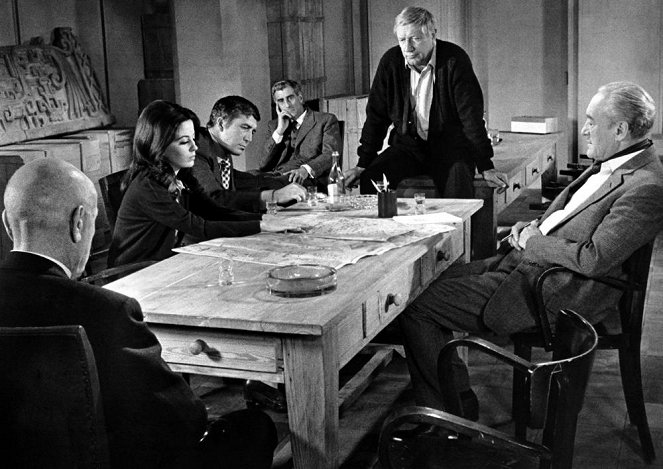
Employing B.A. is, for a ‘70s guy like Rone, a question not of feminism but of expediency. He dismisses what he calls the “mad tea party” the spies operate, and insists, “All I’ve seen around here so far looks like a rummage sale of outmoded espionage artifacts – with one exception, this girl,” a crack for which Ward really makes him kiss the carpet. Then again, perhaps Rone quickens to B.A. because, as played by Barbara Parkins, she’s even more of a robot than he is. Just coming off her success on the hit television series “Peyton Place,” Parkins’ tubular celebrity never translated into film, and by the end of the 1970s her career was pretty much over. B.A. may tell Rone, “I’ve never been away from home” or lament, “I wish I was home with my father,” but Parkins is too bland and limited an actress to bring her character’s misery to life – at least not with the shorthand treatment she’s given by Huston and Hill’s script. B.A.’s decision to sleep with Rone on the night before they go to Russia could have been her most touching scene; instead it’s one of the coldest moments in the film. A virgin, she’s been warned by her father that sexual experience is an important prerequisite in the biz, so for her initiatory piercing she turns to Rone (whose first-timer code name is The Virgin). Their encounter is inspired more by the dread of tomorrow’s unknown than by any attraction or passion or tenderness. B.A.’s reliance on this physical alteration to make her a better-equipped spy is a creepy reminder of an earlier clinical scene in which Rone received, as everyone must on this mission, a “whoopie thumb”: an artificial, poison-laced thumbnail which is surgically implanted in place of the real nail, to be chomped on in the event of arrest.
Which is a real possibility, because they’re supposed to retrieve a top-secret letter, written by Anglo-American intelligence, in which the West commits itself to help the Russians destroy a Chinese nuclear-weapons project. They target the chief of Soviet intelligence, a sadist named Colonel Kosnov, who’s played to icy, demonic perfection by Max von Sydow. As Alexei Bresnavitch, Kosnov’s treacherous Kremlin overlord, Orson Welles delivers one of his best performances of the ‘70s: a lethal monster inflected with humor and mischief. The American agents rendezvous at the Moscow apartment of a bureaucrat named Potkin, whose cooperation they’ve secured by holding his wife and daughters hostage back in the States. They infiltrate the city’s underground networks of homosexuals, male and female prostitutes, and drug dealers, and eventually maneuver Rone into bed with Kosnov’s wife Erika. She’s a classic Huston loser moll, right up there with Key Largo’s Claire Trevor, and the great Bibi Andersson plays her with real sympathy and honesty. But despite their deep penetration into Soviet security, the spies’ mission, like so many missions in Huston’s films, ultimately comes to naught, because Kosnov doesn’t have the explosive letter. It turns up in China, and when Bresnavitch gets that piece of news, he responds with apocalyptic laughter worthy of Walter himself in The Treasure of the Sierra Madre.
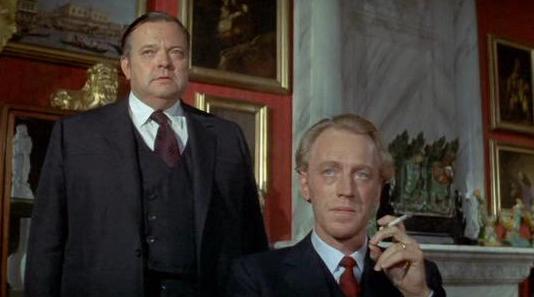
Ward is also on Bresnavitch’s wavelength at the end of The Kremlin Letter, and in more ways than one. “You can’t win ‘em all,” he philosophizes to Rone, even though Ward has won everything: He organized this mission so he could exact his own grisly vengeance on Kosnov – including an unexpectedly brutal, bare-handed murder of Erika – and then accept Bresnavitch’s offer to become the new head of Soviet intelligence. Putting Rone on a plane back to the States, Ward acknowledges how much they’re alike: “I’m kinda proud of you, sorta like a father that brung up his kid right.” The two men are the only Americans left standing. The KGB has eliminated all their associates except B.A., who wasn’t quick enough to swallow all her whoopie-thumb poison when she was arrested. Ward displays her to Rone, a mute prisoner strapped to a stretcher in an ambulance, and explains that she will be his leverage to insure that Rone maintains his uprightness and carries out Ward’s final instructions. That new assignment is the only letter Rone brings back from the Kremlin: “Kill Potkin’s daughters and wife or I kill the girl.” The film’s final image is those last five words, with the cranked-up roar of the jet engines providing the scream Rone can never utter.
When he saw the ruined B.A., Rone swore to Ward that he’d get her out of Russia somehow – suggesting that he can hold a Ward-like grudge himself. But has he learned enough from Ward to double-cross him and rescue B.A.? Has he become enough like Ward to kill those hostages? The funereal drumbeat that ends the film doesn’t argue much in the way of optimism.
It didn’t summon much of a crowd to the film, either. For all its mercenary intent, The Kremlin Letter was far too downbeat and labyrinthine to be embraced by audiences. For a 1970 crowd, the film was too Old Guard in its frosty sentiments and too Old School in its casting – only Barbara Parkins was under the age of 30. Had her character not hewn so closely to Behn’s underdeveloped original, more of Huston’s relationship with his own daughter might very well have crept in – because that’s exactly what happened when he retooled the script of The Life and Times of Judge Roy Bean.
PART 3: THE LIFE AND TIMES OF JUDGE ROY BEAN
With The Kremlin Letter his fourth consecutive flop – and the masterful but, for these purposes, insufficiently daughter-logged Fat City taking the fifth – Huston really wanted to deliver a hit with The Life and Times of Judge Roy Bean. He praised John Milius’ original script, seeing in it “the fine old American tradition of the Tall Tale, the Whopper, the yarn filled with outrageous characters capable of prodigious and highly improbable deeds.” Milius had written a full-blown fantasy on the real-life Roy Bean, who in 1890s Texas actually did dispense frontier justice and feed beer to his pet bear in a combination courthouse and saloon which he called The Jersey Lily, in honor of actress and singer Lillie Langtry. The screenplay was filled with humor, but Milius – who would write and direct such ‘80s chest-thumpers as Conan the Barbarian and Red Dawn – was already thinking of Lawrence of Arabia and regarded his Bean very seriously: “He sits out there in the desert and he’s got this great vision of law and order and civilization and he kills people and does anything in the name of progress. I love those kinds of people. That’s the American spirit!” To Milius’ dismay, Huston drastically revised his script, deleting the Judge’s most heinous deeds (whipping his bear, shooting one of his marshals). Of course, Bean still kills plenty of people in the movie, but the only reprehensible act Huston retained from Milius is Bean’s 20-year-long abandonment of his daughter after her mother dies in childbirth. Who that daughter grows up to be, how she comes to know her father and struggle alongside him – all that was rewritten after the vision of the director.
“They changed it,” Milius howled, “from a Western that was about royalty and greed and power to a Western where Andy Williams sings a song in the middle of the movie and the judge and the girl and his pet bear go off on a picnic. It’s incredible! He goes on a picnic and sits on a teeter-totter. It’s a movie about Beverly Hills people, about John Foreman and John Huston and Paul Newman.” Strictly speaking, a movie about Beverly Hills people can also be a movie about royalty and greed and power – but Milius was right, this one isn’t. And if you’ve endured the treacle of Andy Williams crooning “Marmalade, Molasses, and Honey,” you know how justified Milius’ bitterness is. That sticky intermission certainly rates as the nadir of the film, with Bean sacrificing before the Butch Cassidy altar as if its $uccess would rub off. (Huston was still kissing up to the Golden Calf a few years later, when he offered The Man Who Would Be King to Newman and Redford! Even Newman knew better and told him, “For Christ’s sake, John, get Connery and Caine.”)
While Huston may have lapsed into Butch-isms with this film, Paul Newman to his everlasting credit did not. His portrayal of Roy Bean stands apart from the rest of his screen work before or since, and he knew it too: “If not my best work, it’s certainly close to it. John Huston let me crawl out of my skin and do the kind of work that surprised me.” With his grizzled voice, full beard, and face-shading sombrero, the actor disappears into his role. You forget it’s Newman and instead see the Judge for himself: a whiskered, cigar-chomping patriarch, alternately sadistic and gentle; a con man who’s also a visionary.
Although he never does an out-and-out impression of Huston, Newman was plainly inspired by his director’s persona. If his Huston-isms are easy to miss, that’s probably because Huston also acts in the film and throws everyone off the scent by playing not himself but his father! He gives a funny, manic twist to the mountain man Grizzly Adams, “di-rect dee-scendant of John Quincy Adams, sixth President of the Yew-nited States,” who went wild and “co-habitated with the barrs” – all delivered in a spray of crazed patter clearly inspired by Walter’s cadences from The Treasure of the Sierra Madre. Adams has come to die where it’s warm, but Bean shoos him away: “There’ll be no illegal dying. The only people that die in my town are those I shoot or hang.” Adams departs, growling, “Can’t die here, can’t die there! A man can’t even die where he sees fit no more. I want no part of what this world’s come to, and I’m glad my days are at an end.” But before he goes, he bequeaths some of his wildness to Bean, leaving him the bear he calls Zachary Taylor: “My eldest boy, named after the twelfth President of the Yew-nited States. I prefer his company to that of men.”
Robert the Elder in A Walk with Love and Death was said by his son to have “the manners of a bear”; Grizzly Adams, in one of Judge Roy Bean’s many bestiality jokes, is ursine in other regards as well. In both films, as in The Kremlin Letter, Huston climbed in front of the camera to a) put the hero in his place, and b) pronounce his disaffection for so-called civilization. Once again, he tipped his hand and verbalized the disappointment and disdain he felt for his situation, only this time he also betrayed a mindset that made it impossible for him to realize his own project successfully. While he was shooting these early scenes from the script, he and Milius were also trying to write a new ending for the film. Making “a turd smell sweet” was how Huston described their efforts to one of his players, and he was still sweetening to taste right up to when the cameras had to roll. Under that kind of pressure, it helps to have a more positive foundation than Huston’s thinking then enjoyed; otherwise, you can wind up with a hilly, uneven product like The Life and Times of Judge Roy Bean. The director seems unsure just how seriously to treat this undertaking, and the film is uncertain as to whether it’s fish or fowl, shark or lark. In the end, it never quite makes either – too unfocused and cutesyfied to champion, but too provocative and original to ignore.
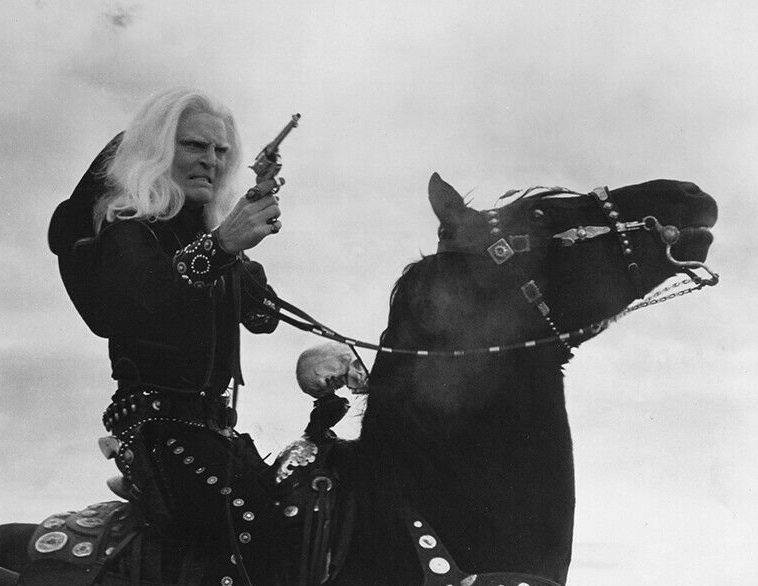
At first glance, one of the strengths of The Life and Times of Judge Roy Bean – as is ordinarily the case with Huston’s films – is its casting; and unlike The Kremlin Letter, this time there’s a charismatic star opposite the eccentric supporting roles. Besides Huston’s Grizzly Adams, the mob ranges from Anthony Perkins’ droll, understated turn as an itinerant preacher to a totally over-the-top Stacy Keach as the prodigiously vicious Bad Bob. Huston indulged Keach’s inspiration to play the role as an albino with long white hair, and introduced the film’s most cartoonlike humor for this scene, culminating with Bean shooting Bob in the back and blowing a hole in him the size of a bowling ball – thus providing an unobstructed glimpse of the scenery behind Bob, in a sight gag worthy of that real-life descendant of Roy Bean, the great cartoon director Frederick Bean Avery, best known by his native-state nickname “Tex.”
Roddy MacDowall, suggesting an even-snootier older brother of Richard Haydn circa Sitting Pretty, practically slithers as the malevolent lawyer Gass, who takes over the town Bean has built up in the wilderness. Victoria Principal, making her film debut, plays the Mexican girl Marie Elena, who becomes the mother of Bean’s daughter; she tenderly evokes the initial awe – and later, the affection and amusement – with which Marie Elena regards the Judge. For Lillie Langtry, Huston managed a coup by casting a luminous Ava Gardner. Her appearance carries a hush into the film’s wistful epilogue, when the ageless beauty enters The Jersey Lily some ten years after the Judge’s death.
Although Huston shrewdly cast his major characters, the rest of the subsidiary casting is considerably weaker, which hurts the film. The Kremlin Letter bristled with effective faces and sinister presences in practically every shot, but too much of The Life and Times of Judge Roy Bean was filled in on automatic, from Bean’s marshals on down. Ned Beatty’s cozy narrator, Tector Crites, is separated out from the others right at the beginning. (His request that Bean let him be bartender instead of marshal is a delicious moment: the heavy kid asking for a less strenuous role in a game of Cowboys & Indians.) The other four marshals remain interchangeable throughout, which undercuts all their scenes – particularly the ending, where the film reaches for some pathos by having the Judge reunite with his former comrades for one last job.
That job, the climax of the film, was mostly rewritten during production. Although Huston retained Milius’ conception of the town descending into corruption with the discovery of oil after the Judge’s departure, he also showed Langtry as an ecological nightmare, an oily swamp shrouded in a forest of metal derricks. But he abandoned Milius’ shift of genres, in which the town became a Roaring Twenties gangster haven under the heel of a mafioso named Fat Willy Garga. Rather than introduce a new heavy whom the audience must learn to hate, Huston retained Gass as the villain. More importantly, by keeping the story a Western, he also gave the film more coherence and immediacy, and brought a deeper melancholy and beauty to the closing – which he recast into a quasi-supernatural apocalypse more violent than anything even Milius had imagined.
For the character of Bean’s 20-year-old daughter Rose, all Huston kept from Milius was her idealization of her father; otherwise, there’s no connection between the film’s Rose and the young woman in the original script. Milius’ Rose was an IWW activist and Bolshevik. When Bean first sees her at a protest march, he tells Tector, “I thought she’d be more like her mother,” to which Tector replies, “No, Judge – I’d say – she’s more like you.” From there, however, Milius put the lie to that assessment, making Rose simply a damsel in distress, dumb enough to rattle the bad guy’s cage and feeble enough to get trapped by him.
Huston wanted something more interesting from a daughter of the Judge, and when Gass tells Rose he’s going to evict her from The Jersey Lily, she pulls out a shotgun and evicts him instead. Unlike Milius, Huston saw the American spirit in the people who refuse to roll over for someone else’s idea of civilization. When Tector tells Rose, “Civilization has set in here,” she responds with a snort, “Civilization?! Well, we’re not gonna let it swallow us up. I won’t stand by and see my father’s house, the birthplace of law and order, turned into a gasoline station!” Rose rallies him to a fight, declaring, “I am a Bean, and we Beans just don’t know when we’re licked! Uncle Tector, let’s give them hell.” Rose’s dialogue here is sheer Huston – with a closer very near to what would be his own real-life last words.
Alas, Jacqueline Bisset, who plays Rose, can’t sell any of it. The impossibility of this semi-accented princess being the feisty fruit of the Judge’s union with a Mexican peasant makes all her scenes a little comic – except for when she sez, “I am a Bean,” which truly is a howler. Not at all helping Bisset is the uncanny way her wardrobe anticipates the Annie Hall look. Huston apparently wanted something hoydenish, and she wears a collar and tie. But with her dark knit bowler – raffishly cocked to one side – and matching vest, white blouse, long skirt, and boots, all she lacks are the specs and a few la-dee-dahs. Bisset, like Anjelica, would justify Huston’s faith in her by the 1980s, when she delivered a nuanced and moving performance in Under the Volcano. But circa 1972, her flat line readings and clueless expressions in Judge Roy Bean offer a grim spectacle.
Huston had abandoned this daughter too, according to Bisset: “I don’t know where John was on that, but my scenes were mostly directed by Paul Newman.” The actress also lamented, “I didn’t have particularly close contact with [Huston] … I didn’t have the benefit of scene preparation or anything like that; I did my bit and it was fine… They were rewriting the script before every scene, and actors were left with quite large speeches to learn, fifteen minutes before. And I thought that’s something I would not like to be in, because I’m a slow study.” As it turned out, her bit wasn’t fine at all; and if Huston suddenly handed her any sizable amounts of dialogue, he must have taken them away just as quickly, because her character has pointedly little to say in the film – when she’s reunited with the Judge after two decades of separation, her voice is stilled altogether.
Huston wanted to see these two characters reconciled, so he dispensed with Milius’ wink at dime-novel sentimentality, where Rose never recognizes the strange old lawman who got gunned down rescuing her from Garga. In the film, the Judge gathers together his scattered and tattered marshals and they enter the Jersey Lily for the first time in 20 years, just as Rose and Tector are loading an arsenal of weapons in preparation for Gass’ threatened eviction at midnight. Gazing at Rose, Bean tells her, “You take after your mother.” “Sometimes she takes after you,” Tector elaborates, and in a few minutes Rose will prove him right. But at this moment she speaks not a word, and her silence provokes from the Judge an admission that had to have cut close to home for Huston: “Maybe you got nothing to say. I wouldn’t blame you if you never spoke to me at all. I ain’t been no kind of a father.” Maybe because this father admits his failure to his daughter, or maybe simply because this film is a fantasy, Rose feels no bitterness or abandonment. “You’re always here, Pa,” she tells him. “You and Ma and the watch bear and Miss Lillie.” This daughter is grateful to have been raised in her Texas St. Clerans, another private museum where her father was present only in the collected tokens of his obsessions and the stories of her caregivers. “Maybe this isn’t the way it was … it’s the way it should have been,” to quote from the film’s opening titles.
Then again, Huston may have believed that no father alive could earn his daughter’s love after such neglect, and Rose may feel such warmth toward her father only because she knows he’s already dead. The director was deliberate about imbuing the Judge’s reappearance with a dreamlike ambiguity: “You don’t know if it’s the Judge or his ghost that has returned.” This supernatural feel is introduced in the first glimpse of the Judge after two decades: lovely but eerie low-angle shots of a man on horseback, with the sun flaring into the camera. In his last scenes, Newman brings an ectoplasmic edge to the now white-haired, quietly growling Judge, and uses mostly slow, stiff movements and a slit-eyed demeanor. No one ever actually touches Bean in any of these scenes either. Still, he’s tangible enough to fight alongside his marshals – and Rose and Tector – when Gass and his goons arrive. But before the shooting starts, Rose gets to enjoy a Hustonian bonding with her father in a hand of poker. Which she wins, just as her mother did so many years before.
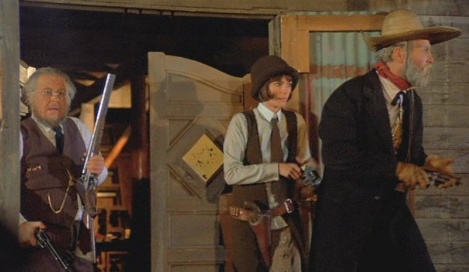
The confrontation between the Judge and Gass erupts into a full-scale Armageddon that claims Gass, goons, marshals, and Judge along with most of the town, leveling it in an inferno of bullets, flames, and explosions. For Huston, “It’s as if the 19th century rose from its grave to destroy its progeny, the 20th century.” Rose and Tector get to kill only one bad guy apiece, but their participation in the mayhem is an essential sign of their bond to the Judge. After that, he’s earned the apotheosis Huston gives him. Riding his horse onto the balcony of a burning whorehouse, the Judge rears back and cheers, “For Texas and Miss Lillie!” and then disappears into flames, while fiery oil derricks collapse to the ground.
In the epilogue, the town has pretty much blown away, like the gold in The Treasure of the Sierra Madre; all that’s left is a few buildings in the middle of nowhere, as it was when Bean first arrived. The boom ended once the oil gave out, but an elderly Tector still maintains the Jersey Lily as a museum; Rose, we’re told, married an Army aviator whom she met when his plane ran out of fuel and landed in the street. (He’s played, albeit seen only posing in a photograph with Rose, by Bisset’s then-boyfriend Michael Sarrazin.) The film ends looking not ahead with Rose but back, toward another essential female in the Judge’s life. Lillie Langtry’s train pulls up to this depopulated whistle-stop and she finally enters The Jersey Lily. Tector presents her with a letter that the Judge left behind on that final night, in which he reiterated his devotion to her – a last gesture of his fidelity to the Eternal Feminine, and to the idealism that humanized his quest for glory.
In this quiet ending, Huston achieves the poignancy he’d fumbled in the scenes with Rose and her father. So much of his judgment in revising Milius’ script was so perceptive, that to see him stumble in filming it is all the more troubling. He’d rewritten Bean’s story so he could have his cake and eat it too, with ice cream yet: a dutiful daughter who can also do the job right, plus a big scoop of the 20th century getting flushed down the crapper. Yet for the second time – and with a very similar physical type – Huston couldn’t deliver a daughter who comes across. In their respective scenarios, Rose is as big a success as B.A. is a failure. But Huston’s repeated inability to get something real in these and related casting matters suggests more than just a miscalculation on his part; a deeper detachment or non-involvement is at play, as Bisset bemoaned. Just as if Huston believed all those negative things said by Grizzly Adams and the Admiral and Robert the Elder.
PART 4: THE MACKINTOSH MAN
The Life and Times of Judge Roy Bean failed to make much of an impression, critically or at the box office, but Huston, Paul Newman, and producer John Foreman had enjoyed working together and were loath to part company. Casting about for something to do, they committed to a script by Walter Hill. Hill would go on make his reputation as a writer and director of such actioners as The Warriors and 48 Hours, but back then he was only another Warner Bros. scribe, finishing off his contractual obligations with a quickie adaptation of Desmond Bagley’s novel The Freedom Trap. Newman was also seeking freedom from Warners and made straight for the script, even though Hill said he felt “vaguely ashamed of the whole thing […] the story didn’t make sense.” He was amazed that Newman wanted to star in it and had gotten Huston to direct. Eventually, reality caught up with them as well, according to Huston: “There was one moment when we all said, ‘Whatever possessed us to entertain the idea of doing this?’ and then somebody said, ‘Why not?’”
Of course, there were a legion of reasons why not; the only compelling reason why was the dough, as Huston later acknowledged: “We were each offered good round sums to participate.” Ironically, he and Foreman would run into trouble raising money for The Man Who Would Be King in part because The Mackintosh Man bombed so badly, even worse than Bean, making it Huston’s seventh flop in a row. “From the beginning we were plagued by the screenplay’s weaknesses. All the time we were filming we were casting about frantically for an effective way to bring the picture to a close,” Huston commented a few years after the fact. Again he was directing a film while rewriting it, and again it shows – and what he had to sweeten this time was something a lot more fecal than Milius’ script for Bean. It’s easy to believe the story told by James Mason, who steals the film as an ultra-patriotic British politico who’s really a Soviet agent. According to Mason, a reporter asked Huston which was the best of his films, and the director replied, “I can’t exactly tell you which is the best of my films, but I sure as hell can tell you which is the worst: That’s the one we’re shooting right now!”
With that grim an outlook, Huston didn’t bother playing the embittered patriarch in this film. Perhaps he took a lesson from Judge Roy Bean and decided against spreading his energies too thin: to direct while rewriting – this time in collaboration with Gladys Hill – would be demanding enough. His concentration eventually paid off: “During the very last week of shooting, an idea for an ending came to us. It was far and away the best thing in the movie, and I suspect that if we had been able to start shooting with it in mind, The Mackintosh Man would have been a really good film. But we weren’t.” That final scene is indeed as strong as he claimed. It’s about a daughter being a professional in her father’s field and living up to his image, even at the cost of her humanity.
To get to that provocative finale, alas, you have to sit through a lot of slick but slight genre hijinks – car chases, beatings, escapes, shootings, etc. – all very familiar and very impersonally done, with none of the dark perspective on espionage which defined The Kremlin Letter. Of what’s onscreen, Walter Hill said that he wrote “about 60 percent of the first half; after that there was nothing there that was mine.” What he’s alluding to would be the rather pointless busywork of the opening reels, in which Newman’s secret agent Joseph Rearden undertakes a mission that involves his stealing some diamonds just so he can be arrested and sent to the same prison as the Soviet agent Slade – and then escape with him in a break-out arranged by the Scarperers, a criminal organization that springs convicts for a hefty fee.
This tangled web is woven by British intelligence, here represented only as two people in a quiet little business office. The chief, Angus Mackintosh, is played by Harry Andrews, who’d given such a great performance as the First Mate Stubb in Huston’s Moby Dick. Here, alas, Andrews is pretty much on autopilot – but he still outdistances an uninvolved Dominique Sanda, who plays Mackintosh’s secretary, Mrs. Smith, in near-phonetic cadences. There may be few pleasures in the scene they share with Newman, but they’re still more interesting than most of what follows, because the diamond theft is mechanical, Rearden’s capture and interrogation by the police are perfunctory, and his trial is protracted and redundant, reiterating information heard in his initial briefing. After taking more than 15 minutes just to get Rearden into jail, the film then spends another quarter-hour on prison scenes that are even flatter, as though Rearden is staying in a very drab hotel where people have to tell him all sorts of things until the plot can get rolling again. A three-man scuffle ignites a yard-wide melee as the diversion for Rearden and Slade to escape, but even the film’s prison riot is a snooze.
Rearden and Slade are liberated to a less drab hotel, namely Mr. Brown’s remote Irish estate for the temporary lodging of the self-paroled. The film then proceeds to do almost nothing between the two men, even though it’s spent the last half-hour getting them together. Ian Bannen is an expert actor, but he brings no special warmth or quality to Slade because no character has been written for him. Other than playing a little chess together, there’s virtually no interaction between the two men while they’re at Brown’s. Later, when Slade seems to have gotten away, Rearden tells Mrs. Smith, “I’m glad in a way. I kinda liked Slade,” but you don’t really know why.
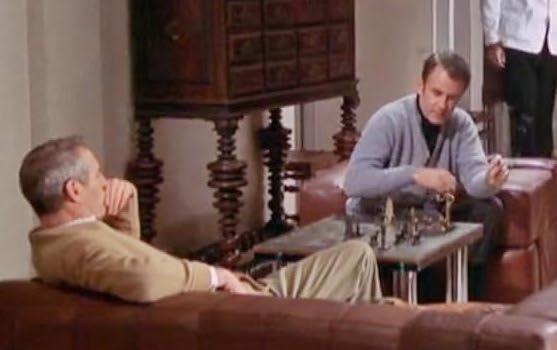
The best these scenes offer comes from Michael Hordern, who’s in his element as the malevolent Brown, siccing his rottweiler on Rearden and then feeling squirely outrage when his victim defends himself: “How dare you kick my dog, you reprobate!” Unfortunately, the drop-off in interesting faces and characters in The Mackintosh Man is even more precipitous than that of The Life and Times of Judge Roy Bean, with all of the Mackintosh cons, toughs, and locals strictly from central casting. The porridge of faces does include such welcome raisins as former Pequod crewmen Leo Genn and Noel Purcell and future Dead man Donal McCann, but they have nothing to do and fail to make any impression. Even James Mason as the sinister Wheeler doesn’t get rolling until that reprobate Rearden is kicking Brown’s dog – sicced because the spy’s cover has been blown. Earlier that day, Mackintosh mentioned to Wheeler that one of his men had infiltrated Slade’s escape; immediately after that conversation, Slade is relocated, Rearden is clobbered, and Mackintosh is killed by a hit-and-run driver.
When Mrs. Smith brings Rearden up to date after he escapes from Brown, she also tells him that she’s Mackintosh’s daughter – a relationship nowhere implied in the preceding scenes, not even when she saw him get hit by that car, or watched him linger in the hospital, where the doctors resuscitate his heart. Maybe she’s too pro to display her feelings. But she doesn’t show any of that pro on the job. It’s Rearden who puts two and two together and figures out that Mackintosh’s real purpose was to use him as bait so Wheeler would reveal himself to be a Soviet agent. Mrs. Smith isn’t even hip enough to spot when their car is being followed – and they’re driving in the back roads of a remote, auto-less Irish village! But even if she were a regular Jane Bond, no one would ever suspect a blood relation between Mlle. Sanda and Harry Andrews’ proud Scot, unless line-garbling is supposed to be a family trait.
Mrs. Smith may be slick enough to find Slade on Wheeler’s boat, but she’s slow enough to let Wheeler slip her a mickey and capture her. Like B.A. and Rose Bean, her character doesn’t have much to do beyond getting into trouble. As a result, although she’s second-billed in The Mackintosh Man, Sanda doesn’t get much footage – which isn’t bad news because she’s even blander than Barbara Parkins was as B.A. Relying throughout on a sullen monotone that matches her flat, unresponsive features, Sanda appears to be playing Mrs. Smith under duress, as though someone offcamera was threatening her with a sock full of manure. Granted, she doesn’t stink up the place the way Jacqueline Bisset did in The Life and Times of Judge Roy Bean, but her performance is in almost every regard lousy.
The actress shows an edge only in the film’s powerhouse ending, when Rearden corners Wheeler, Slade, and their hostage Mrs. Smith in a secluded church which is the rendezvous point for the two agents to be spirited off to Russia. Rearden’s appearance forces a stand-off, and Wheeler and Slade try to reason their way out, saying they were only doing what they truly believed in, and besides, once they leave England, their spying days are over. Their suggestion is, rather than kill each other, everyone should just put down their guns and go their separate ways. “Let’s break the rules tonight, eh? Just this once,” Slade urges Rearden. Mrs. Smith yells, “Kill him, Rearden!” even with Wheeler holding a gun on her. As the men try to negotiate, she screams that they’re traitors. Slade calls her number, telling Rearden she’s “the voice of fear and anger. The fanatic in our midst.”
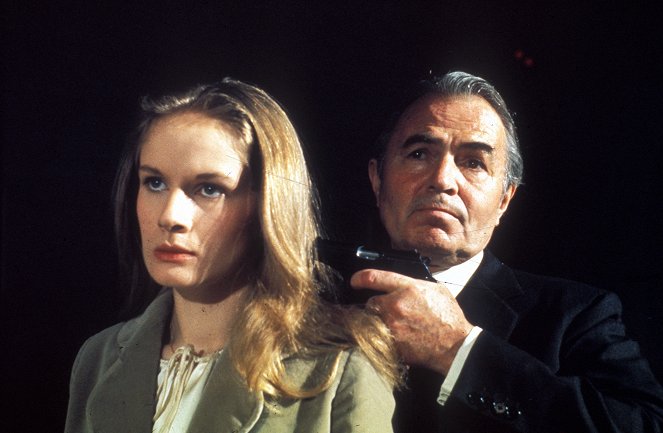
He’s more right than anyone realizes. Rearden agrees to their proposal and all three men relinquish their weapons, but just as Wheeler and Slade start strolling for the exit, Mrs. Smith grabs the guns and blasts them both straight to hell. It’s a shocking moment, not just from the surprise or even the ferocity of the violence – she pumps shot after shot into the two men, their blood filling the cracks in the old church’s stone floor – but because it’s so unnecessary. You’re left feeling cheated by her.
Wheeler did drop the dime on Mackintosh, but is Mrs. Smith’s volley professionalism or passion? Providing a tidy cover-up, she plants the guns in her victims’ hands and announces, “Wheeler died trying to get Slade. That’s how Mackintosh would have wanted it.” Her explanation may point to something deeper regarding her feelings toward her father – especially as she then turns on the stunned Rearden and hisses, “You were going to let them get away! I should kill you too!” In a gesture that really does say it all, Rearden tosses her his gun. Luckily for him, she turns away and walks off. The film’s final shot is Mrs. Smith disappearing into the blackness of the nighttime street.
The ending of The Mackintosh Man is one of Huston’s strongest set pieces from the ‘70s, a perfect distillation of his take on human endeavors, the mixed motive, and our genius for snatching failure from the jaws of success. He was right to regret not having begun the film after it was written – who knew that Mrs. Smith had it in her to be the most startling of the many women who kill in Huston’s cinema? She’s a vengeful daughter who craps up an all-male undertaking, as well as the ultimate professional who fulfills her father’s work, even at the price of her own soul. Is she at her most human or her most inhuman when she kills Wheeler and Slade?
Either way, they’re both dead. So too is part of Mrs. Smith. She may be killing for Dad as Rose Bean did, but this double homicide isn’t the communion Rose shared with the Judge; it’s Mrs. Smith’s consecration to Death Itself. Like B.A. in The Kremlin Letter, she’s a victim of her father’s legacy. As sisters in the Dirty Game, B.A. and Mrs. Smith also touch base in their sexual behavior, with Mrs. Smith spreading her legs for Rearden on the night before his assignment. But unlike the chill of passionless sex in The Kremlin Letter, the only shudder The Mackintosh Man extracts is one of embarrassment at seeing a business-like Sanda stand in a hotel-room doorway and ask Paul Newman, “Would you like me to stay?” After he immediately accepts, she adds, “That’s the least I can do,” explaining away that crack with, “I said that to seem less… wanton?” Of course, she doesn’t have to worry about seeming promiscuous – this woman is plainly not a slave of desire. If anything, her remark suggests that, like B.A., her father has taught her some ideas about pre-Mission libidonizing – Steadies the nerves, lass! – and so has put herself in service to their man. (As late as 1981, Huston was still using this cliche, letting Sylvester Stallone score some duty booty off Carol Lauré in Victory.)
Despite the thinness of The Mackintosh Man, an odd, retroactive melancholy attaches itself to Sanda’s first and only scene with Andrews and Newman. When Mackintosh and Mrs. Smith get down to business with Rearden, Huston is depicting the situation for which he has longed: father and daughter side by side, doing a professional, high-quality job at the difficult, dangerous work they both know and love. Only these two spies are so good at what they do that no one knows they’re related – not even the audience.
CONCLUSION
For all the drubbing she received from the critics, Anjelica Huston in A Walk with Love and Death plainly outclassed her successors. Had her father waited only a little longer and debuted her playing B.A. or Rose Bean or Mrs. Smith, how much more successful those years of her career would have been – for that matter, how much more successful those films would have been! But then again, who would Rose Bean or Mrs. Smith have been had he never suffered through A Walk with Love and Death with Anjelica? Huston’s talent for casting had aspects of genius, yet his ‘70s films consistently founder on the playing of the daughters. The abnormally blind eye he brought to the flesh for these fantasies suggests those characters may have been too personal for Huston. His professionalism and objectivity appear to have deserted him when it came to women who so directly impinged on his own experience with his daughter.
Based on The Kremlin Letter, The Life and Times of Judge Roy Bean, and The Mackintosh Man, one could argue that Huston didn’t really believe that a daughter could cross the generational and gender gaps and stand shoulder to shoulder with her father in his world. Rose Bean and Mrs. Smith may not be victims the way B.A. is. But although Rose is fine in spirit, she doesn’t do all that much, and cannot be expected to, because that world, in which her father genuinely was larger than life, is gone. There’s no stage left for them to share after she hands the Judge freshly loaded pistols and he rides off to a fiery end. Of the three, Mrs. Smith is the most attuned to her father’s way of life, yet here again the two are separated and she too doesn’t do a lot – and she has none of Rose’s excuses. From somebody so intimate with Mackintosh and his scene, Mrs. Smith’s deficiencies are unrealistic and hurt the film.
If Huston didn’t believe in capable daughters, he really couldn’t be expected to write them into his scripts. The mediocre casting of all these women likewise implies some fundamental disengagement from the characters. Perhaps his real failure in making A Walk with Love and Death came with that part of him which already believed that a daughter and father couldn’t excel together. It took Huston more than a decade, when Anjelica starred in Prizzi’s Honor and The Dead, for him to make classics that demonstrated just how wrong he’d been.
(This essay, written in 2002, appears here for the first time.)
SOURCES
Introduction
“Dad, I know”
AFI Life Achievement Award to John Huston, March 1983
Part 1
“I really didn’t see myself”
Lawrence Grobel, The Hustons. New York: Charles Scribner’s Sons, 1989, pp. 597-603
“He was getting through it”
“like I was to be carried along”
Grobel, The Hustons, p. 606
“What really counts in film acting”
Axel Madsen, John Huston. Garden City, New York: Doubleday & Co., 1978, p. 228
“appalling”
Cineaste, vol. XV, no. 3, 1987
“We never got into anything”
Interview, July 1972
“too remote”
Pauline Kael, The New Yorker, October 18, 1969
Part 2
“I thought The Kremlin Letter”
John Huston, An Open Book. New York: Alfred A. Knopf, 1980, p. 337
“has a single moral, ethical principle”
Stuart Kaminsky, John Huston: Maker of Magic. Boston: Houghton Mifflin Co., 1978, p. 183
Part 3
“the fine old American tradition”
John Huston, An Open Book. New York: Alfred A. Knopf, 1980, p. 339
“He sits out there”
“They changed it”
Madsen, John Huston, p238
“For Christ’s sake, John”
Huston, An Open Book, p352
“If not my best work”
notes on Warner Home Video box, 1989
“a turd smell sweet”
Grobel, The Hustons, p. 640
“I thought she’d be”
“No, Judge”
John Milius, The Life and Times of Judge Roy Bean. New York: Bantam Books, 1973, p. 159
“I don’t know where John was”
The Movie Magazine, June 1984
“I didn’t have particularly close contact”
American Film, July-August 1984
“You don’t know if it’s the Judge”
“It’s as if the 19th century”
Kaminsky, John Huston: Maker of Magic, p. 194
Part 4
“vaguely ashamed of the whole thing”
Grobel, The Hustons, pp. 662-63
“There was one moment when we all said”
After Dark, August 1973
“We were each offered good round sums”
“From the beginning we were plagued”
Huston, An Open Book, p. 340
“I can’t exactly tell you”
AFI Life Achievement Award to John Huston, March 1983
“During the very last week”
Huston, An Open Book, p. 340
“I wrote about 60 percent”
Grobel, The Hustons, p. 663
Link to:
Film: Essays: Contents
For more on John Huston, see:
Film Dreams: John Huston
Film Interview: Danny Huston
Film Review: The Dead
Film Review: Under the Volcano
For more on John Huston and Orson Welles, see:
Film Essay: Orson Welles and the Other Side of Nicholas Ray
Film Essay: Where Is The Other Side of the Wind?
Film Lecture: Charles Chaplin
For more on Orson Welles, see:
Film Dreams: Orson Welles

