Super Tramp: The Art of Charles Chaplin
I’m here to speak with you today about the art of Charles Chaplin. And there’s a lot to say. But let’s start with a film clip. This is the first part of a one-reel comedy from the Keystone studio, called Mabel’s Strange Predicament. It was released over 112 years ago, on February 9th of 1914. Chaplin was 24 years old. This is the second time he’s ever acted in a film, and the very first time he played what can be recognized as his Tramp character.
All the elements of Chaplin’s iconic costume are there: oversized shoes, baggy pants, tight jacket, small derby, the cane, the mustache. But he’s not quite a tramp, is he? He could be just a somewhat shabby occupant of a somewhat fancy hotel. He certainly has none of the elegance of any of the other hotel guests we see, least of all the incomparable Mabel Normand, whom he’s trying to pick up when the film starts, and whom he pursues throughout this short. She was already a very popular film star when this comedy was made, as you can tell from its title, which alerts the public to Mabel’s starring role. I hope someday soon to give a talk on her, because she was an extraordinary talent. But today we’ll stick to the subject at hand, Chaplin.
Setting him apart from everyone else we see in this film is his drunkenness. When Chaplin came to the States, he was a member of Fred Karno’s comedy troupe, which had been very successful performing sketches in the music halls of their native England. They were a hit on tour here as well, not least because of Chaplin’s eye-catching turn as a drunk who causes havoc. And throughout his film career, he would return to playing someone who’s inebriated. One of his last feature films was Limelight, completed in 1952 when he was 63 years old, and in his first scene, he’s returning to his room in a boarding house, and he’s drunk.
Now, in the footage we just saw, the character Chaplin plays is someone who’s interfering and aggressive. He’s a pest, and pestiness tended to define his character in his films at Keystone. In the next comedy he made there, the Tramp’s intrusiveness is the whole joke: He keeps wandering in front of a newsreel camera, checking it out as they’re trying to film a race held for kids in go carts.
It was only after he had lived with his character for a while – and had moved along to other studios where he could control his work more and develop the personality of the Tramp – that Chaplin understood he was more successful playing defense rather than offense: As an underdog, the audience’s sympathy was totally with him.
But to my mind, what really distinguishes Chaplin in this short comedy is his method of operation, which is to take his time. You’ve seen him when he’s wandered into Chester Conklin’s hotel room in pursuit of Mabel Normand: He does almost nothing in there. What’s funny is that he’s there at all. And the less he does, the more he’s just there? The funnier the situation becomes. And Chaplin knew that.
Such an approach, however, went against the grain at Keystone, where activity tended toward the frenetic. The studio’s directors – Henry Lehrman, George Nichols, Mabel Normand, Mack Sennett – would typically urge Chaplin to run around more and act and react more quickly, which he resisted, and so confrontations ensued until Sennett, the head of Keystone, who had signed Chaplin to a one-year contract, finally agreed to let Chaplin direct himself. That began about three months after Chaplin started performing in movies.
At Keystone, the situation was the comedy: the strange predicament in which Mabel finds herself. For Chaplin, the character was the comedy, and he needed time in which the audience could come to appreciate who the Tramp is.
That appreciation snowballed quickly; the reason Chaplin got the nod to direct himself was because he had made an immediate hit with the public. He became so popular, in fact, that by 1915 – just one year after he had started making films at Keystone, where he was paid $175 per week – the Essanay studio offered Chaplin a salary of $1,250 per week, plus a bonus of $10,000 just for signing a contract with them.
He had appeared in some three dozen short films during his year at Keystone, as well as one feature. At Essanay, Chaplin would make 14 shorts over the next 18 months. And by mid 1916, at the end of his Essanay contract, he was what we would now call a superstar. Here’s how Peter Haining described it in his book The Legend of Charlie Chaplin:
Chaplin had become world famous[, …] the centre of a remarkable “craze” on both sides of the Atlantic. The Little Tramp figure was to be found in all manner of books and magazines, in cartoons and comic strips, on postcards and in advertising. Toys and statuettes were produced in his likeness, as were cups, mugs, vases and even candles. People began to imitate his clothes, his walk and his moustache. Popular songs were written about him such as “The Chaplin Strut,” “The Chaplin Waddle” and “Those Charlie Chaplin Feet,” and he was widely impersonated on the stage and screen.
After Chaplin finished his contract at Essanay, he travelled to New York City by train, and everywhere it stopped – Amarillo, Texas; Kansas City; Chicago – huge crowds of people swarmed the train, hoping to catch a glimpse of him. Before arriving in New York, the Chief of Police telegrammed him and asked him not to get out at Grand Central Station, because the crowds there already were too enormous. Chaplin had to disembark at 125th Street in Manhattan and take a limo to his hotel.
What had happened? Well, a lot. This film clip will give you some idea:
You can see a constellation of themes in that opening scene from Chaplin’s 1916 two-reeler, his last for Essanay, called Police: There’s homelessness; hunger; a hostile, predatory environment. Of course, many a rump still gets kicked, just as they had at Keystone. But now Chaplin has the space he needs to react with some personality, to be perplexed or shed tears or become enraged; he has time in which he can cogitate and process the strange predicaments that unfold around him. The audience is on his side now as he struggles against deprivation, injustice, assault – “the cruel, cruel world.”
After Essanay, Chaplin moved on to the Mutual studio in 1916, and the gold just inundated him. He became the highest paid motion-picture star in the world, getting $670,000 to make twelve two-reel comedies, which took him about a year and a half.
At Mutual he created some of his greatest work, a dozen short masterpieces, in which he defined not just who the Tramp was but how the Tramp was funny. The how of it was pretty straightforward: Chaplin would have a set built and then improvise gags and situations on it. None of these films ever had a script, which is why, over the years, he would need more and more time to make a film, because he had to figure out something funny – in other words, something that was odd, but logical. And if he filmed something but it just wasn’t funny enough, he would discard it and start over.
As for who the Tramp was, the answer became: a person of boundless possibilities. Despite whatever slip-ups or confusions or messes he may generate, the Tramp ultimately proves himself to be more capable than anyone around him. As a fireman, he rescues the heroine. As a policeman, he conquers the most terrifying brute on the street. Give him a pair of roller skates, and he’s Nijinsky on wheels. Put him to work in a pawn shop, a movie set, a department store, and he resolves every dilemma that’s thrown at him. The French film critic André Bazin summed it up, writing in the late 1940s: “He is never at a loss in any situation. There is a solution for everything, even though the world (and especially things in it rather than the people) is not made for him.”
What the world does offer him is an endless plasticity. There’s a wonderful throwaway gag in Behind the Screen, when the pies start to fly. The Tramp overturns a table and ducks behind it for protection. Then he grabs two empty bottles by their necks and looks through them like they’re binoculars, surveying the pastry battlefield. If Edna Purviance is making biscuits and her dough is like lead, the Tramp will use them as weights to exercise with. In The Gold Rush, the Tramp is trapped in a snowbound cabin and starving, so he boils and eats his own shoe – but the laces become spaghetti to be twirled on a fork, and the nails in the sole of the shoe, bones to be sucked at and savored. The virtuoso example of this technique, which has been called the transposition of objects, takes place in a two-reeler he made while at Mutual, called The Pawn Shop.
Just as the object can become anything, depending on how it’s handled, so too the Tramp can become anyone. In that short scene, we see him go from a pawnbroker to a doctor examining a patient; a carpenter working a hand drill; a cook with a can of tuna; a jeweler examining a ring, with the mouthpiece of a telephone substituting for a loupe; a mechanic with oil can, pliers, hammer; a tailor measuring cloth and snipping it to size; an exterminator confronting crawling clock innards; and finally, a bouncer dispatching a rowdy patron.
Yes, the plasticity of the material world extends to the Tramp as well. In a couple of his films, he actually plays dual roles: A Night in the Show, The Idle Class, The Great Dictator. More frequently, however, the Tramp is impersonating someone, mostly with great success. At Keystone, he passes himself off as the Premier of Greenland, the Count De Beans, a dentist, a woman. At Essanay, he’s mistaken for a propman, pretends to be Count Chloride de Lime, and does another female impersonation. At Mutual, confusion arises because a robber looks just like him; the Tramp also presents himself as Count Broko, as Sir Cecil Seltzer; or he’s an escaped convict pretending to be a gentleman guest at a swanky party. After leaving Mutual, Chaplin began working in his own studio, one built for him by First National. There he made Shoulder Arms, in which he plays a World War One doughboy who impersonates a German officer; he also made The Pilgrim, where he’s another escaped convict, this time pretending to be a clergyman.
This theme would be raised to a high style in Chaplin’s later features. In City Lights, the Tramp pretends to be a millionaire, because he’s been befriended by a real millionaire, but only when that millionaire is drunk does he recognize the Tramp; when he’s sober, he doesn’t recall who Chaplin is. And of course, in Chaplin’s later talkie Monsieur Verdoux, he assumes an array of aliases – Varnay, Bonheur, Floray – depending on which wife he’s planning to murder.
Oh yes, there is a dark side to this plasticity of identity. In his book The Silent Clowns, the critic Walter Kerr located it:
The secret of Chaplin, as a character, is that he can be anyone. That is his problem. The secret is a devastating one. For the man who can, with the flick of a finger or the blink of an eyelash, instantly transform himself into absolutely anyone is a man who must, in his heart, remain no one. To be able to play a role, to know the role as a role, is to see through it. To be able to play them all is to see through them all. But that leaves nothing, no way of life, no permanent commitment in which such a man can possibly believe. Just as Don Juan, loving everyone, can love no one, so Chaplin, impersonating everyone, can have no person. […] Sometimes the dark pain filling Chaplin’s eyes is in excess of the situation at hand. It comes from the hopeless limitation of having no limitations.
There’s also a dark side to the plasticity of objects. Yes, they can transpose into anything in his hands. But they can also become something else when he doesn’t want them to. This is why the Tramp has to be a chameleon, because he has to function in a basically unstable environment. In The Gold Rush, he’s prospecting in the frozen North, and when he leans on his cane and surveys his surroundings, the cane goes right through the snow and he topples over. But this instability characterizes the everyday world as well. If the Tramp rests against a picket fence, that’s the plank which gives way; if he places his elbow on a table, it goes into a cup of coffee.
Here’s a quintessential example, from his classic feature City Lights. The Tramp wanders over to the window of an antiques gallery and there pretends to examine the objets d’art, although his real interest is to gaze at the statue of a nude woman.
From the fingers of his glove to the little guy on the elevator who suddenly becomes a big guy, nothing is stable – not even the pavement.
City Lights was released in 1931, when everyone else in Hollywood had stopped making silent films. Chaplin took an enormous gamble then, making a film without talk. But the film was so brilliantly funny as well as deeply moving that it became one of his greatest financial successes – and arguably his masterpiece.
He had to make silent films in the 1930s, because Chaplin was absolutely convinced that the Tramp could not speak, the role had to be played in pantomime. Years later, he wrote in his autobiography:
Although City Lights was a great triumph and had made more money than any talking picture at that time, I felt that to make another silent film would be giving myself a handicap – also I was obsessed by a depressing fear of being old-fashioned. Although a good silent film was more artistic, I had to admit that sound made characters more present.
Occasionally I mused over the possibility of making a sound film, but the thought sickened me, for I realized I could never achieve the excellence of my silent pictures. It would mean giving up my tramp character entirely. Some people suggested that the tramp might talk. This was unthinkable, for the first word he ever uttered would transform him into another person. Besides, the matrix out of which he was born was as mute as the rags he wore.
And in 1936 Chaplin released his final Tramp comedy, again without dialogue: the exquisite Modern Times. Which was also a big hit at the box office.
The previous year, when he was immersed in the filming of Modern Times, Chaplin paid a visit to a great American writer who had long been residing in France, and who had returned to her homeland for a lecture tour. Her name was Gertrude Stein, and in her account of her American visit, an amazing book she called Everybody’s Autobiography (perhaps hoping to re-create the best-selling status of her 1933 book The Autobiography of Alice B. Toklas), she told us – in three sentences – what Chaplin told her about the problems of working with dialogue:
Of course I liked Charlie Chaplin he is a gentle person like any Spanish gypsy bull-fighter he is very like my favorite one Gallo who could not kill a bull but he could make him move better than any one ever could and he himself not having any grace in person could move one as no one else ever did, and Charlie Chaplin was like Gallo. Gypsies are intelligent I do not think Charlie Chaplin is one perhaps not but he might have been, anyway we naturally talked about the cinema, and he explained something. He said naturally it was disappointing, he had known the silent films and in that they could do something that the theater had not done they could change the rhythm but if you had a voice accompanying naturally after that you could never change the rhythm you were always held by the rhythm that the voice gave them.
By the way, Stein clocked him: Recent scholarship has discovered Romani blood on the mother’s side of Chaplin’s family.
Chaplin had shared with Gertrude Stein his real dilemma in making films after the advent of talking pictures: the rigidity of rhythm, of tempo, imposed by the human voice. And to this very day, whenever a film needs to alter its rhythm, speed up its tempo, people have to stop talking. Look at the greatest high-velocity, rapid-fire editing sequences in sound films: the battle of Shrewsbury in Orson Welles’ Chimes at Midnight or the climax of Sam Peckinpah’s The Wild Bunch. The dialogue has to cease in order for these films to make that great rhythmic leap. Whereas a silent film can kick into high gear on a dime, whether it’s a one-reeler from Keystone or a monumental drama such as D.W. Griffith’s Intolerance or Sergey Eisenstein’s Battleship Potemkin or Abel Gance’s Napoleon.
Chaplin’s problem was talking, not sound. Both City Lights and Modern Times have some of their funniest moments thanks to the soundtrack. The Tramp is boxing in a prizefight in City Lights, and his neck gets entangled in the string used to ring the gong and signal the end of a round. So he gets hit and goes down, which causes the gong to ring and obliges his opponent to retreat to his own corner rather than go in for the kill. But as the Tramp staggers to his corner, his neck pulls the string, the gong rings again, and the round resumes. He gets hit again, goes down, the gong rings… You get the idea. Or in Modern Times, a minister and his frosty wife are visiting a prison where the Tramp is incarcerated, and Charlie is left alone with the wife in the warden’s office, where the two of them endure the embarrassment of their rumbling stomachs punctuating the icy silence.
In his two feature films of the 1930s, Chaplin also had the advantage of turning off the sound when he needed to. Consider the most mind-blowing moment in Modern Times:
That exceptional gag could never work in a talkie: What person would not hear an angry workers march coming up right behind them? In a silent film, it works perfectly.
Earlier, I referenced Chaplin’s talkie Monsieur Verdoux, released in 1947, and I have to say at least a few words about it now, because it is quite simply one of the greatest of all American films. He subtitled the film “a comedy of murders” and it is precisely that, the blackest of black comedies – perhaps the funniest too – in which an amiable Frenchman goes around assuming different identities and marrying women whom he murders for their money. It is also the bitterest and most despairing of black comedies, a film that could only have been made in the immediate aftermath of World War Two: Only someone who had seen the newsreel footage of Auschwitz and Hiroshima could have made this film. Just look at how we first meet the character of Monsieur Henri Verdoux, here under the assumed name of Monsieur Varnay.
It’s all there, isn’t it? Ooo là là, don’t step on a caterpillar, while his latest victim is turning into ash and black smoke just over his shoulder. There’s The Zone of Interest in a nutshell, more than 75 years earlier.
In fact, what Chaplin did was so incisive, arriving at the root of the problem, because we come to like Henri Verdoux. I was trying to think of any other American film, prior to Monsieur Verdoux, in which a serial killer is heinous and yet sympathetic and funny. There have been comedies where comedians dealt with murderers, but it’s the comedians who are sympathetic and funny, not the killer; the murderer is played for menace. The only earlier example I’ve yet found is, of course, Arsenic and Old Lace – which was originally a play, written by Joseph Kesselring. And when it premiered on Broadway in 1941, Chaplin was in the audience. The film of it was made that same year, but not released until 1944; the director was Frank Capra. How remarkable that the two American filmmakers who are arguably the ones most beloved for their humanity both saw the humor in serial murder. Two men who were not simply aware of their Shadow, but who were capable of laughing at it. Two men who were also immigrants: Chaplin coming from England and Capra from Sicily.
Don’t forget, Chaplin and Capra were also the only two non-Jewish filmmakers who, prior to the start of World War Two, were denouncing fascism: Chaplin tackling its European form in The Great Dictator, and Capra depicting its American manifestation in Meet John Doe.
It was another anti-fascist filmmaker, Orson Welles, who gave Chaplin the idea to make Monsieur Verdoux.

Welles had proposed to write and direct a film in which Chaplin would star, about the French serial killer Henri Landru, who murdered upwards of ten women in the years after World War One. But Chaplin, resisting the idea of having anyone else direct him, bought the property from Welles and wrote his own script.
Now, the Tramp never kills anybody. But the reason Chaplin was able to play a serial killer so well was because he was not the Tramp. He contained the Tramp, but he was not the Tramp. The British writer Thomas Burke put his finger on the difference after getting to know Chaplin in the early 1920s:
Your ordinary actor is always an actor “on” and “off”; but as I walked and talked with Chaplin I found myself trying vainly to connect him by some gesture or attitude with the world-famous “Charlie.” There was no trace of it. When a little later, I saw one of his films, I again tried to see through the make-up the Chaplin I had met, and again I failed. The pathetic, fragile clown of the films is purely a studio creation, having little in common with its creator, for Chaplin is not a funny man. He is a great actor of comic parts. Every second of his pictures is acted, and when he is not acting he casts off “Charlie,” drops the mask of the world’s fool, and his queer, glamorous personality is released again.
In the early 1960s, looking back over his work in film when he wrote his autobiography, Chaplin insisted that his time at Mutual, from 1916 to 1917, “was the happiest period of my career. I was light and unencumbered, 27 years old, with fabulous prospects and a friendly, glamorous world before me. Within a short time I would be a millionaire – it all seemed slightly mad. […] I could never take it for granted.”
The reason he couldn’t take it for granted was because his childhood had been appalling. Sigmund Freud made a very interesting comment about Chaplin in 1931:
He is undoubtedly a great artist; certainly he always portrays one and the same figure: only the weakly, poor, helpless, clumsy youngster for whom, however, things turn out well in the end. Now do you think that for this role he has forgotten about his own ego? On the contrary he always plays only himself as he was in his early dismal youth. He cannot get away from those impressions and to this day he obtains for himself the compensation for the frustrations and humiliations of that past period of his life.
Chaplin’s parents were music-hall performers who split up in 1892, when Charlie was about three years old. His father drank himself to death; his mother suffered with mental instability and was repeatedly institutionalized. At age 7, young Charlie was taken away to a workhouse, and from there to a home for children without families. By the age of nine he was performing in theaters and music halls, and he kept at it despite awful periods of deprivation, hunger, and poverty, until at age 16 he signed on with Fred Karno’s celebrated comedy troupe.
And like a lot of people who endured awful childhoods, Chaplin as an adult, making films in the years of World War One, had little patience for sentimentality about children. Look at this image from one of his last shorts at Keystone, His Trysting Place:
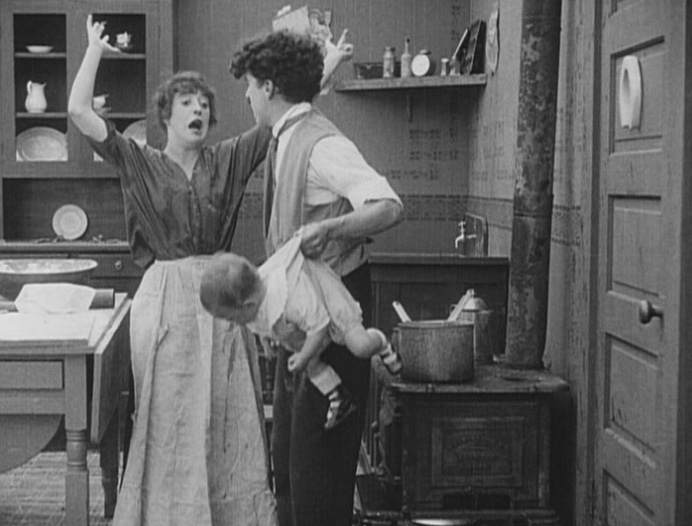
Mabel Normand, playing Chaplin’s wife, is horrified by the way he handles their infant son. When I saw that moment in Chaplin’s film, I realized that there was an image of another comedian doing something comparable. At first I couldn’t place who it was. Then it finally came to me.
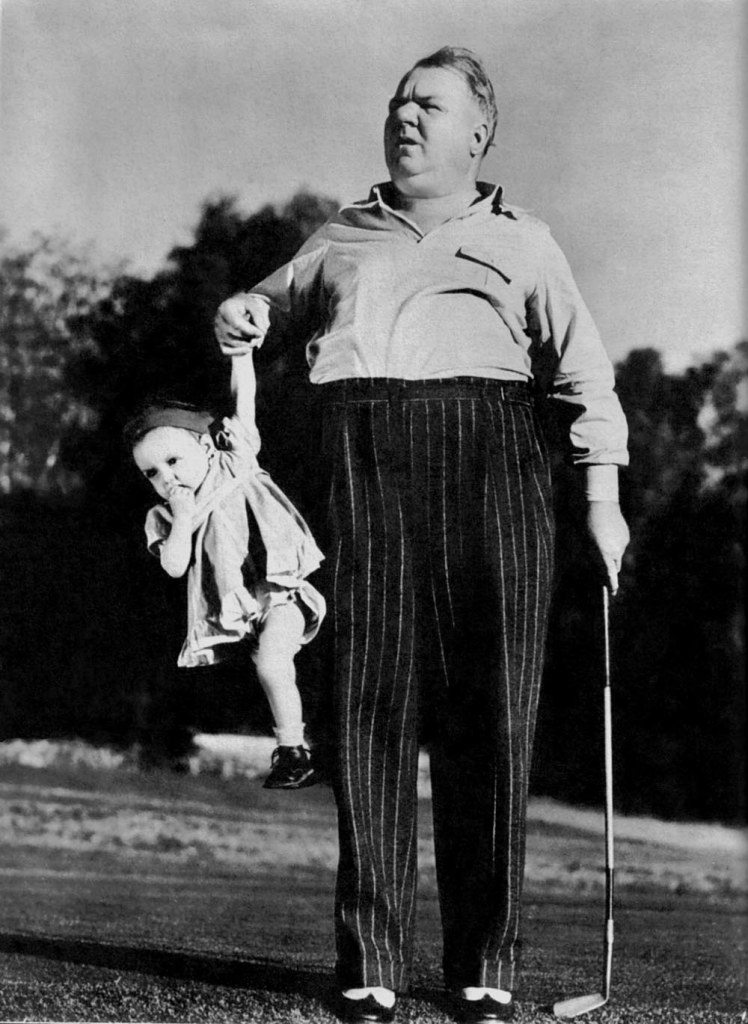
Handling a young child like they’re baggage instead of a human being came naturally to W.C. Fields – who, like Chaplin, had also suffered a hard and painful childhood.
In fact, the character Chaplin played at Keystone had distinct similarities to Fields’ personality: a disdain for the others around him and their niceties; a fondness for alcohol; a disinterest in observing the constraints of the law. Their styles of comedy were very different, of course; but their characters had a lot in common – including an aversion to children. Both comedians were perfectly willing to appear onscreen with bratty, ill-behaved kids, thereby justifying – or at least removing some of the sting – in their antipathy toward youngsters. In Chaplin’s The Pilgrim and Fields’ early talkie The Old-Fashioned Way, both comedians avenge the abuses heaped upon them by an obnoxious little boy by giving him a kick – once nobody else is around.
In Chaplin’s classic Mutual two-reeler Easy Street, there’s a scene where the Tramp, now a police officer, is taken by heroine Edna Purviance to visit a needy slum family. They bring groceries for them, because that family has about a dozen small toddlers, ensconced in washtubs and laundry baskets around the living room. Chaplin takes a box of cereal and gives the food to the children by scattering handfuls of it at them, like he was feeding chickens. As he later explained, “I did that because I despise them. I don’t like children.”
He made that comment in 1930, speaking to the great Soviet filmmaker Sergey Eisenstein, who was then visiting the States.
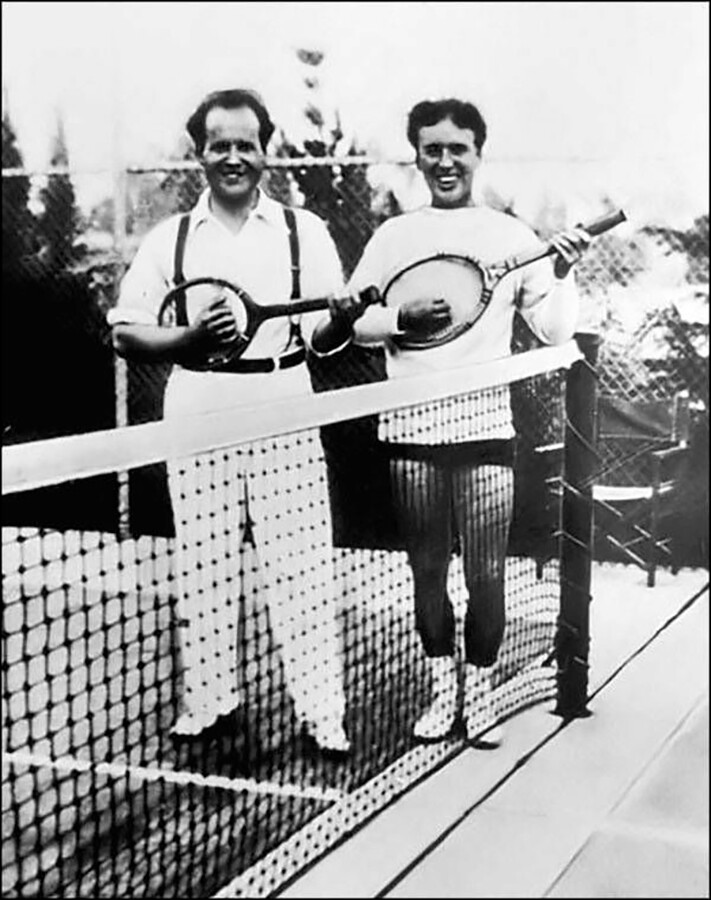
That’s the two of them on the tennis court together. Notice the transposition of objects, with the pair strumming their tennis rackets like guitars or balalaikas.
Eisenstein was convinced that the essence of Chaplin’s genius lay in his ability to retain the perspective of a child, and he was not flummoxed at all when Chaplin admitted his hostility toward children. Reflecting on it in the 1940s, Eisenstein wrote, “But who normally does not like children? Only children themselves.”
Eisenstein also pointed out:
In that is the secret of Chaplin. […] In that is his greatness. To see things most terrible, most pitiful, most tragic through the eyes of a laughing child. To see the images of these things spontaneously and suddenly – outside their moral-ethical significance, outside valuation, and outside judgment and condemnation – to see them as a child sees them through a burst of laughter. In that Chaplin is outstanding, inimitable, and unique. The sudden immediacy of his look gives birth to a comic perception. […] The ability to see as a child – is […] inherent in Chaplin personally. […] To see the world thus and have the courage to show it thus on the screen is the attribute of Genius alone. Though, incidentally, he doesn’t even need courage. He can only see it that way, and no other.
How do we know this is true? Well, how would a child, ignorant of politics, incapable of conceptualizing fascism and bigotry and imperialism, how would that child react if shown newsreel footage of a little man with a funny mustache, wearing a military-style uniform and ranting and screaming hysterically in an incomprehensible language? That child would see and hear this:
In his private life, Chaplin raised ten children, which was almost as many as he tried to feed in Easy Street: two boys with his second wife Lita Grey and eight kids – five girls and three boys – with his fourth and final wife, Oona O’Neill, daughter of the great American playwright Eugene O’Neill. And Chaplin made sure to include several of his children in his later films.
I’d like you also to consider a story that sheds more light on Chaplin’s personal attitude toward children. This story is 100% true and not well known. It appears in the autobiography of someone who, as a child, had an encounter with Chaplin outside of the realm of filmmaking. That person was maybe ten or eleven years old at the time – this would be about 1916, 1917. He suffered then from poor health, in fact was bed-ridden, and he and his mother had just arrived in California, to spare him any exposure to a brutal winter. Here’s how he recalled it many years later:
[W]e stayed at the Alexandria Hotel in downtown Los Angeles. There were no good hotels out in Hollywood then, and the Alexandria was where people from the motion-picture colony congregated.
[…] One day the telephone rang. My mother talked for a few minutes, put down the phone and said excitedly, “John, I have a wonderful surprise for you!”
“What?”
“That was Charlie Chaplin! He heard there was a sick boy in the hotel, and he’s coming up to see you!”
A few minutes later there was a knock at the door. Mother opened it, and Chaplin came in. My heart was pounding. I couldn’t contain my excitement. No one today holds a position in a child’s world even remotely comparable to the one Charlie Chaplin held then. He was more than a picture star; he was a myth incarnate; nobody thought of him as a real being. Yet here he was, flesh and blood, standing before me. After shaking hands with me, Charlie turned to Mother and said, “My dear, you must have something to do,… some shopping perhaps? You go on out. Take as long as you like. I’ll stay with John.”
She was gone for more than an hour, and it was an enchanted hour for me. To see Charlie Chaplin on the screen was a joy, but to see him in person, to be an audience of one for my idol, was beyond words wonderful. He was a trainer in a sideshow performing with invisible fleas. He folded a handkerchief and did a little puppet show. Then we talked. I asked how they made everything go slow in movies, and he explained the principle of slow motion to me. I asked how somebody could jump off a diving board and, before hitting the water, reverse and come back up. He told me how that was done. His explanation was simple and clear, and I understood perfectly. It seemed as though only a few minutes had passed before I heard the sound of Mother’s key in the lock.
I didn’t see Chaplin again until I came to California years later to work in pictures. We were reintroduced in David Selznick’s house, but some reticence kept me from reminding him of our previous meeting.
[…] One night there was a party at the French Consulate. Charlie, Oona and I were by ourselves for a moment in a corner of a room. It was probably the good champagne that prompted me to speak about our first meeting.
“Charlie, do you recall […] coming to see a little sick boy in the Alexandria Hotel?”
He stiffened, gave me a strange look, then abruptly turned and hailed someone across the room. It was a mystifying reaction. It was as though he was ashamed of my mentioning a good deed. I saw Charlie often after that, but there was no reference to this subject again, ever.
[…] In 1965 I happened to be at the Shepperton studios in London where Charlie was making A Countess from Hong Kong. The cast and crew were having a party to celebrate his seventy-sixth birthday, and I joined them on the set. Charlie rushed over and embraced me with tears in his eyes. It was the only time I ever saw him emotionally demonstrative.
Here they are at Shepperton in 1965.

Yes, that’s the great American director – and actor and scriptwriter – John Huston, talking to Charlie Chaplin at Chaplin’s birthday party. By the way, Huston was filming The Bible when that picture was taken, and he had been very keen to have Chaplin play Noah. According to Huston, “He was tempted and toyed with the idea for some weeks. I thought we had him, but he finally said no; he couldn’t conceive of being in someone else’s picture.” So Huston played the role himself!
All right, now let’s face facts: There’s no way that encounter in the Alexandria Hotel in the mid-teens, between John Huston and Charlie Chaplin, was the only time Chaplin had spontaneously given himself over to a scared and vulnerable child who was a stranger to him. And Chaplin’s reaction some thirty years later, when reminded of his openness and kindness, reveals why we don’t know more about similar events in Chaplin’s life throughout the years.
So there’s a contradiction at work in the man. A personal reluctance to deal with children – largely due, I would suggest, to his unwillingness to be reminded of his own desperate and sorrow-filled childhood – and at the same time, an impulse to bring healing to that tragedy.
I mentioned earlier how Chaplin first made a hit by playing a troublesome drunk for Fred Karno’s troupe – a role he would reiterate many times in his film career. Well, this was also his way of working out his relationship with his abandoning alcoholic father: his way both to ridicule the foolish old drunkard, and to forgive his father too, by embodying those failings himself. Which is the way most of us wind up forgiving the failures of our parents, only Chaplin had the luxury of doing so in pretense, on the stage and on the screen, rather than suffering with those failings in his own personal life.
Chaplin was also able to realize his love for his mother and compensate her for how she had struggled, despite poverty and her own severe limitations, to care for her children as best she could. Upon achieving success in the States, he brought her here to live the rest of her life in comfort and security.
To work through his own issues of abandonment and loss, Chaplin made his first feature film in 1921 while at First National. It was called The Kid, and the story revolves around a baby boy, abandoned by an unwed mother and discovered by the Tramp, who raises the child as his own. Adding to the poignancy and wish fulfillment of The Kid is the fact that Chaplin had just become a father for the first time – this was with his first wife Mildred Harris – but the infant died on July 10, 1919 – three days after he was born. Three weeks later, Chaplin started filming The Kid, and it took him over a year to complete it, finalizing it at the end of 1920. The five-year-old Jackie Coogan played the boy and gave a brilliant performance, becoming a big star in silent films.
The Kid begins with an opening title that tells us it is “a picture with a smile – and perhaps, a tear.” Well, there’s no perhaps about it! I want you to see the film’s most heart-rending moment, when orphan-asylum officials take the child away from the Tramp. Jumping into the film like this severely undercuts this scene’s emotional impact, which is visceral in the full film, because you’ve had time to know and love these characters – and to laugh your head off too. But for our purposes here, isolating this moment makes it easier to consider the technique at work.
What does Gloria Swanson say about silent-film acting in Billy Wilder’s classic Sunset Blvd.? “We didn’t need dialogue, we had faces!” And what face can compare to Chaplin’s at that moment when he hears the Kid, from the back of a pickup truck on the street, screaming and begging for him, while the Tramp is being physically restrained by a policeman and the asylum official. I’ve mentioned Walter Kerr’s reference to what he called “the dark pain” that sometimes fills the Tramp’s eyes in Chaplin’s films. Well, it’s devastating at this moment, and we’re shown it twice. Then the Tramp explodes and dashes to the rooftops. He’s been chased by cops since his days at Keystone, but never does he dispatch a cop as ruthlessly as here. And when the Tramp is reunited with the boy, the love they feel for each other cascades off the screen as they embrace and kiss.
The profound depth of that image is rooted not simply in the film’s narrative of guardian and child. What we’re witnessing, right before our eyes, is nothing less than the reintegration of Chaplin’s own psyche, he is rescuing himself from the nightmare of workhouses and orphanages, into which he had been abandoned as a child in the 1890s.
Keep in mind that, throughout his career, from the teens to the 1960s, Chaplin’s method of directing actors was to act out for them exactly how he wanted them to behave onscreen. So when that child becomes hysterical, Chaplin was performing those same emotions with him, just offcamera.
I want to add here that Chaplin the professed child-hater was unfailingly kind to Coogan and protective of him throughout the lengthy filming of The Kid. Look at this photo of the two of them together on the set.
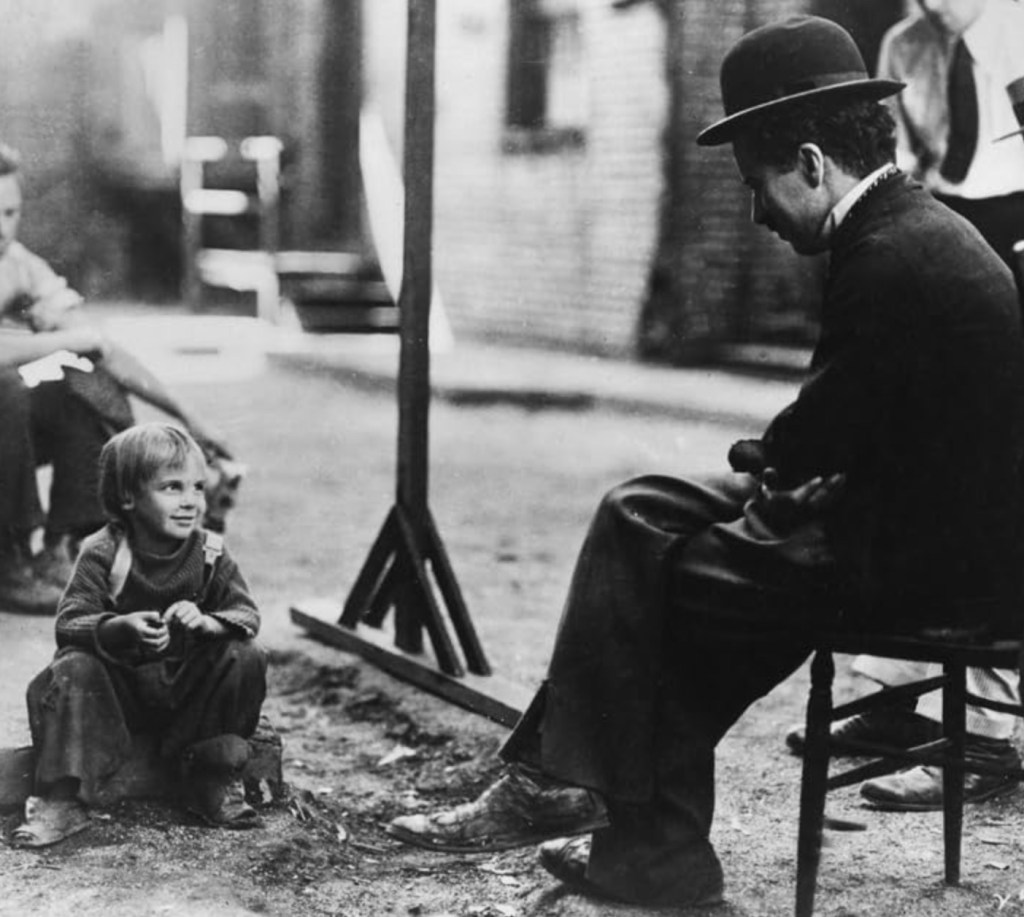
There’s only one word to describe that child’s face: adoration. And that has to be the same way the ten-year-old John Huston gazed at Chaplin on their afternoon together in the Alexandria Hotel, just a few years before the making of The Kid.
And that’s the way we still look at Charlie Chaplin today, more than a century later.
I’d like to close by reading to you a short poem that is attributed to Chaplin. We’re told it was read by him on the occasion of his 70th birthday. It’s called “As I Began To Love Myself.”
As I began to love myself I found that anguish and emotional suffering
are only warning signs that I was living against my own truth.
Today, I know, this is “AUTHENTICITY”.
As I began to love myself I understood how much it can offend somebody
As I try to force my desires on this person, even though I knew the time
was not right and the person was not ready for it, and even though this
person was me. Today I call it “RESPECT”.
As I began to love myself I stopped craving for a different life,
and I could see that everything that surrounded me was inviting me to grow.
Today I call it “MATURITY”.
As I began to love myself I understood that at any circumstance,
I am in the right place at the right time, and everything happens
at the exactly right moment. So I could be calm.
Today I call it “SELF-CONFIDENCE”.
As I began to love myself I quit stealing my own time,
and I stopped designing huge projects for the future.
Today, I only do what brings me joy and happiness, things I love to do
and that make my heart cheer, and I do them in my own way and in
my own rhythm. Today I call it “SIMPLICITY”.
As I began to love myself I freed myself of anything that is no good for
my health – food, people, things, situations, and everything that drew
me down and away from myself. At first I called this attitude
a healthy egoism. Today I know it is “LOVE OF ONESELF”.
As I began to love myself I quit trying to always be right, and ever since
I was wrong less of the time. Today I discovered that is “MODESTY”.
As I began to love myself I refused to go on living in the past and worry
about the future. Now, I only live for the moment, where EVERYTHING
is happening. Today I live each day, day by day, and I call it “FULFILLMENT”.
As I began to love myself I recognized that my mind can disturb me
and it can make me sick. But as I connected it to my heart, my
mind became a valuable ally. Today I call this
connection “WISDOM OF THE HEART”.
We no longer need to fear arguments, confrontations or any kind of problems
with ourselves or others. Even stars collide, and out of their crashing
new worlds are born. Today I know THAT IS “LIFE”!
(This lecture was first given at the main branch of the San Francisco Public Library in July of 2026. Special thanks to Sam Genovese, Mike, Kenny, and all the wonderful people at SFPL! Extra special thanks to Debbie Vigneri for her assistance!)
SOURCES
“Chaplin had become world famous”
Peter Haining, The Legend of Charlie Chaplin. Secaucus, N.J.: Castle, 1982, p. 57.
“He is never at a loss in any situation”
André Bazin, “Charlie Chaplin” (1948) in What is Cinema?, Vol. 1, 2004 edition. Edited and translated by Hugh Gray. Berkeley: University of California Press, 2005, p. 145.
“The secret of Chaplin, as a character”
Walter Kerr, The Silent Clowns. New York: Knopf, 1975, p. 85.
“Although City Lights was a great triumph”
Charles Chaplin, My Autobiography (1964). New York: Plume, 1992, p. 360.
“Of course I liked Charlie Chaplin”
Gertrude Stein, Everybody’s Autobiography (1937). New York: Cooper Square, 1971, pp. 282–284.
“Your ordinary actor is always an actor ‘on’ and ‘off’”
Thomas Burke, “The Tragic Comedian” (1922) in The Legend of Charlie Chaplin, pp. 98–99.
“was the happiest period of my career”
Charles Chaplin, My Autobiography, p. 188
“He is undoubtedly a great artist”
Sigmund Freud, 1931, quoted in David Robinson, Chaplin. Köln: Taschen, 2006, p. 97.
“But who normally does not like children?”
Sergey Eisenstein, “Chaplin’s Vision” (1946) in The Legend of Charlie Chaplin, p. 156.
“In that is the secret of Chaplin”
Sergey Eisenstein, “Charlie The Kid” (1945–1946) in Film Essays. Jay Leyda, ed. New York: Praeger, 1970, pp. 124–125.
“[W]e stayed at the Alexandria Hotel”
John Huston, An Open Book. New York: Knopf, 1980, pp. 18–19.
“He was tempted and toyed with the idea”
John Huston, An Open Book, p. 318.
Link to:
Film: Lectures: Contents
For more on Frank Capra, see:
Film Dreams: Frank Capra
For more on Charles Chaplin, see:
Film Essay: Super Tramp: The Enduring Legacy of Charlie Chaplin
More Cool Sites To Visit! – Film
For more on W.C. Fields, see:
Film Essay: Clyde Bruckman
For more on John Huston, see:
Film Dreams: John Huston
Film Interview: Danny Huston
Film Review: The Dead
Film Review: Under the Volcano
For more on John Huston and Orson Welles, see:
Film Essay: John Huston and His Daughters
Film Essay: Orson Welles and the Other Side of Nicholas Ray
Film Essay: Where Is The Other Side of the Wind?
For more on Orson Welles, see:
Film Dreams: Orson Welles
And here’s a video of the July 2026 lecture (film clips have been deleted due to rights issues):

