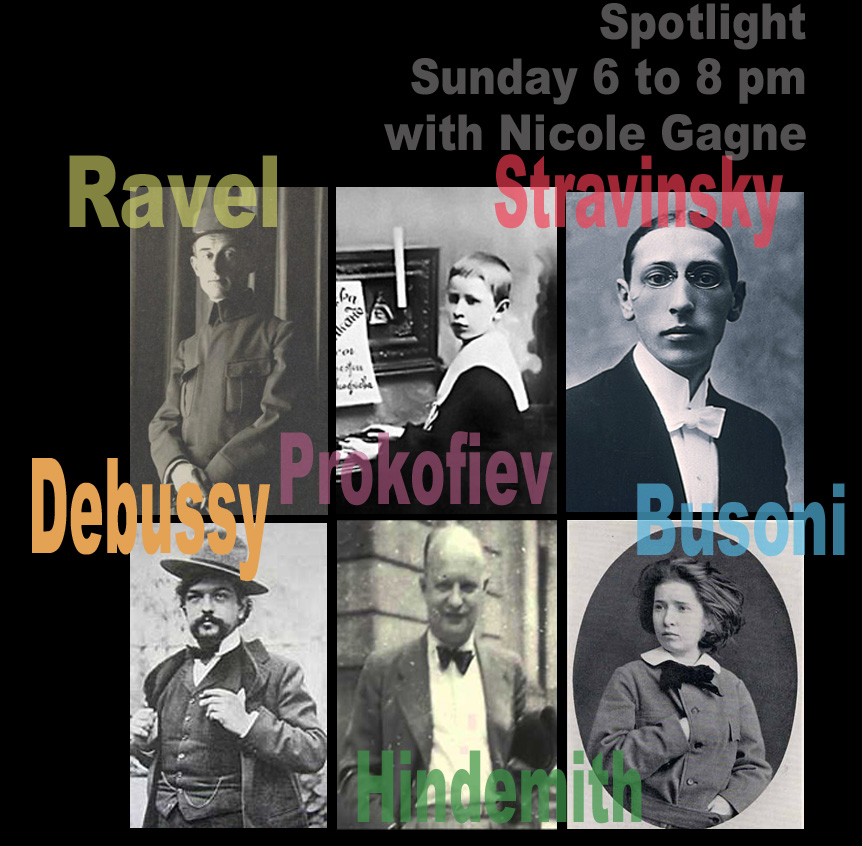
This show, first broadcast on August 16, 2015, examines the origins of neo-classical composition: the use of classical principles and techniques, employing classical and Baroque forms along with modernist harmonies and rhythms. The notable Italian composer Ferruccio Busoni was a pioneer in this field during the 1900s. The years of World War One saw significant contributions from French masters Claude Debussy and Maurice Ravel, as well as Russia’s Sergey Prokofiev. A full-fledged movement by the 1920s, neo-classicism was championed by Germany’s Paul Hindemith and Russian master Igor Stravinsky. Compositions heard are:
FERRUCCIO BUSONI
Turandot Suite, Movement IV (1905)
CLAUDE DEBUSSY
Sonata for Cello and Piano (1915)
MAURICE RAVEL
Le tombeau de Couperin (1917)
SERGEY PROKOFIEV
Symphony No. 1 (1917)
PAUL HINDEMITH
Kammermusik No. 1 (1922)
IGOR STRAVINSKY
Octet (1923, rev. 1952)
Link to:
Music: SFCR Radio Shows 2012–2018
For more on these composers, see:
Music Book: Historical Dictionary of Modern and Contemporary Classical Music, Second Edition
More Cool Sites To Visit! – Music
For more on Ferruccio Busoni and Igor Stravinsky, see:
Music: SFCR Radio Show #27, 20th-Century Music on the March
For more on Claude Debussy, see:
Music: SFCR Radio Show #18, Gunther Schuller and Pierre Boulez at 90
For more on Paul Hindemith, see:
Music: SFCR Radio Show #29, Electro-Acoustic Music, part 1: New Instruments
For more on Sergey Prokofiev, see:
Music: SFCR Radio Show #15, Prokofiev, Shostakovich, and Formalism in Soviet Music
For more on Maurice Ravel, see:
Music: KALW Radio Show #2, Anticipations of Minimalism
For more on Igor Stravinsky, see:
Music Lecture: “Intense Purity of Feeling”: Béla Bartók and American Music
Music: KALW Radio Show #7, In Tribute
Music: SFCR Radio Show #21, Neo-Classicism, part 2
Music: SFCR Radio Show #22, Neo-Classicism, part 3
Music: SFCR Radio Show #27, 20th-Century Music on the March
 NICOLE V. GAGNÉ