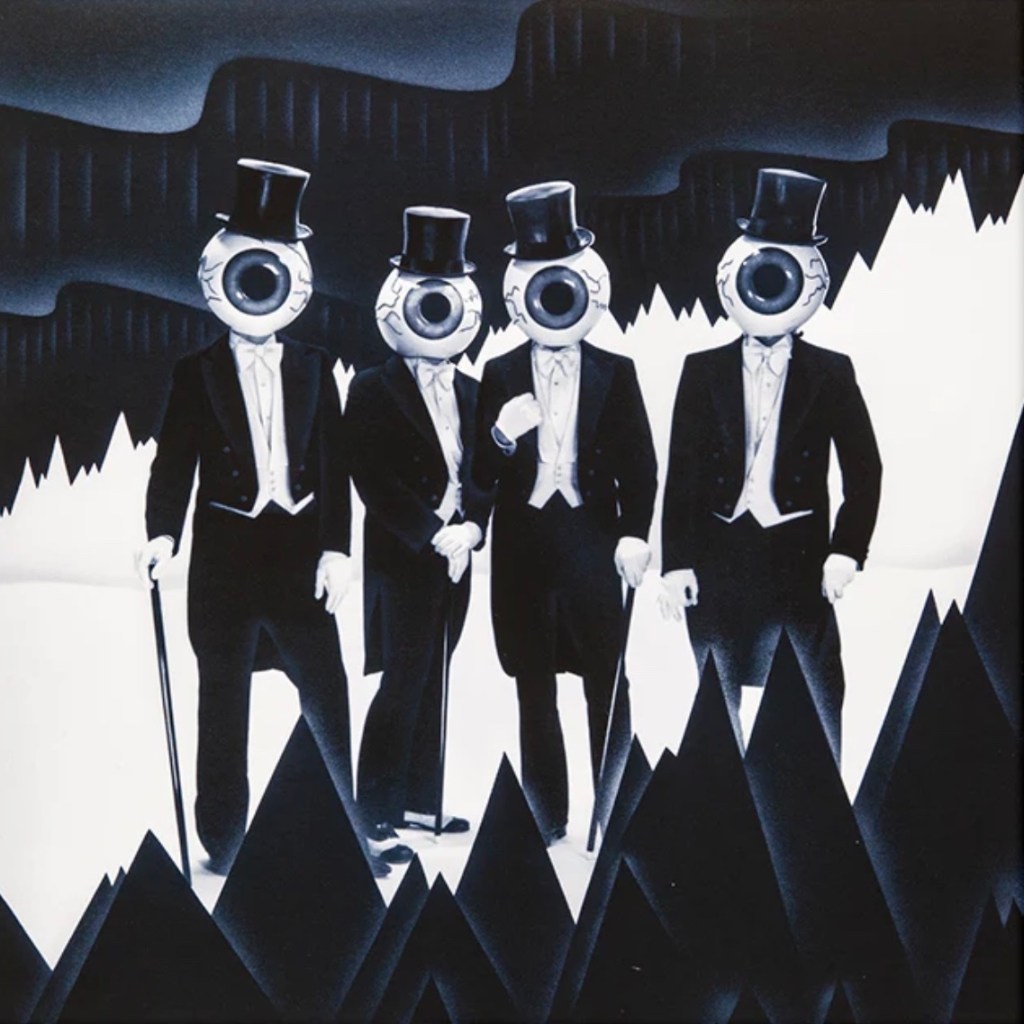
Eskimo
Report from the Aleutians
Despite the helping hands of Snakefinger, Chris Cutler, and Don Preston, The Residents took over three years (1976–79) to create Eskimo. Apparently, they felt they were working on their magnum opus and weren’t about to hurry up for anybody. And when it was finally released, Eskimo made a real splash, getting them the most and best press of their career. If I can drag in The Beatles one more time, Eskimo is The Residents’ Sgt. Pepper: the record that made people sit up and take notice, the official masterpiece. Their biggest seller too.[1] The Beatles used the Lonely Hearts Club Band to break with their moptop image; Eskimo introduced The Residents as the eyeball gents, a bit of Surrealist iconography that they still employ. And just as Sgt. Pepper is less original and accomplished than Revolver or Abbey Road, The Residents made better albums before and after Eskimo.
Let me immediately add that some of The Residents’ finest music is on Eskimo (and that some of The Beatles’ finest music is on Sgt. Pepper). But the triumphs of Eskimo – “Arctic Hysteria” and “The Festival of Death” – are also its least representative cuts. Most of the album consists of programmatic depictions of Eskimo adventures (described in the liner notes), with the music too often taking a back seat to the stories. The opening piece, “The Walrus Hunt,” is just that: paddling the kayak, harpooning a walrus, clubbing it to death… Lux Radio Theater presents Nanook of the North. I don’t want to get churlish here – an astonishing technique has gone into evoking all this (and the horns and chorus that open the piece are gorgeous). But The Residents have done all the work with this music; they have left almost no room for listeners to bring anything to it.
The good news is that “The Walrus Hunt” is the only cut that never really takes off. “A Spirit Steals a Child” does pull over periodically to pass kidney stones of plot, such as the discovery of the child’s disappearance or the dog sled ride – and you can go nuts sweating out the interminable bladder-popping game that opens the piece. But what’s good about this cut is great: the kidnapping spirit itself, a nightmarish kaleidoscopic rush of winds and malefic voices and insect wings.
In general, the more literal-minded Eskimo is, the less interesting the music becomes. “Birth” is a strong cut because it’s not so much a narrative as a glimpse at the tribe’s ritualization of childbirth. With less of an ax to grind, The Residents bring more imagination to the sounds that symbolize external reality – ravishing synthesizer tones swell and fade to represent what the liner notes call “the sweet music of slowly moving ice.” Another plus for “Birth” is that a lot of the action involves making music: There’s a ceremonial band, female and male choruses, and the incantations of the Angakok, the Eskimo shaman who presides over the delivery. Characters play or sing in all of Eskimo’s cuts, but only “The Festival of Death” has more actual musicmaking. (That doesn’t automatically make “Festival” better – which it is – but it helps!)
The real knockout of “Birth” is the deep, loud voice of the Angakok, which seems to sound only as he inhales. He’s both fearsome and comforting as he chants over the pregnant woman, intoning like a croaking stone, something more elemental than human. But he can also be very funny, particularly in his Doggy Serenade for the sacrificial husky in “A Spirit Steals a Child.” The Residents even wring a gentle beauty out of him with his farewell solo in “The Festival of Death.” He obviously tapped something very special for them. His music may be especially Resinant as a reflection of that most cryptic figure in their corporation, the Mysterious N. Senada.
Emperor of the North Pole
“Eskimo is respectfully dedicated to N. Senada who started the whole thing,” according to its liner notes. The official Ralph line is that N.[2] was (still is, I reckon) a German ethnomusicologist with unorthodox musical ideas about phonetic organization. In 1971 he came across a weird tape recorded by some anonymous musicians in San Mateo.[3] Here the plot thickens to include a British musician, Phil Lithman, who also heard a copy of this tape in London. Not long after he met N. while vacationing in Austria. Discovering that they had independently developed a taste for the San Mateo Sound, the pair decided to hit the States and investigate the source of this phenomenon.
If you’ve swallowed all that, you should be able to choke this down too: N. Senada allegedly spoke very little English, but had an improviser’s feel for its sound, and was able to get around by faking the language. If(!) his name is pseudonym – which seems especially likely, in light of The Residents’ anonymity and Lithman’s embracing the name “Snakefinger”[4] – you can understand why he’d select a pun on a California city. And you can also understand why The Residents would dig a lunatic like this, enough to let him and Lithman crash with them for months.
So N., Snakefinger, and The Residents were making music together all the time, and dropping enough acid to keep the population of Red China tripping well into the next century. (N. and Snakefinger also performed as a duo in various San Francisco outlets and even played two live sets with The Residents in October 1971.) They recorded an album’s worth of stuff, Baby Sex, which has never been released – and probably never will, at least not with its original cover photo of a woman going down on a male infant. However, the 1983 compilation album Residue includes the Sex cut “Kamikazi Lady,” with vocals reputedly by N. hisself.[5] The singing seems to be clearly in English but not always intelligible. After many listenings, I’ve come to believe that it’s always intelligible but not clearly in English. It sounds like someone slithering his way through English on just a few legitimate phrases and a feel for the way this talk sounds. But it doesn’t sound at all German to me, in the pronunciations or cadences. Of course, I’m willing to believe that N. was who they say he was – if you don’t show your face or sign your name, you can get away with being honest almost all the time.[6] I’m also willing to believe, going only on the roaring, soulful voice of “Kamikazi Lady,” that N. was a Black Californian wino who lost the habit of traditional syntax, only to realize that he didn’t need it to get by. You can be obscure and still make your point, you know.
Having brought a new twist to The Residents’ work, N. moved on, pursuing “some musical link[…] hidden among the Eskimos of the frozen north.”[7] He sent them tapes of some Northern songs (with his own cross-fertilizing, I should think), which fertilized his friends to create Eskimo. But The Residents took N. Senada’s techniques a step further with this album and faked a foreign language almost entirely from English homonyms. Slur the speech, and you get a passable gloss on spoken Eskimo out of “cupcake” or “Coca-Cola” or “toupee” or “uppercut.” (If N. turns out to be Sid Caesar, it will explain a lot.)
The Angakok is The Residents’ official homage to N. Senada. But he must still mean a great deal to them because they keep reworking that image. You can draw a straight line from the Angakok to the Moles’ shaman and George & James’s synthetic James Brown and Ramsey Whiten’s Mohelmot singing on The Big Bubble: characters who articulate the strangled feelings of oppressed people and attempt to further their spiritual and social freedom.
The Angakok definitely helps free The Residents: The one cut in which he stars, “The Angry Angakok,” is also the only piece that relates a lot of incident without floundering musically. An ice floe is blocking the men from pursuing a shoal of whales, and the frustrated hunters begin to doubt the Angakok. Why hasn’t he intervened with his magic – could he be a fake? A voice pipes up out of the praying crowd, baiting the shaman. Others back up his taunts, and soon everyone is rhythmically chanting the insult “necki!” But the Angakok silences the crowd and magically summons up a waterspout, which not only breaks the ice but also carries off the hunter who first challenged him.
“The Angry Angakok” opens and closes with the crazy whistlings and spoutings of the whales, who seem to diet more on beans than plankton. At first, they are razzing the powerless hunters, who in turn will mock the not-so-powerless Angakok. But when the whales close the piece, the irony has turned full circle: The joke’s on the unfaithful, especially the loser who’s been swept away by the water spout. (A further irony can be heard in the sound of the waterspout itself, its winds re-creating the rhythm of the crowd’s derisory chanting.)
Glenn Branca once told me that Eskimo was for him “a fart in the face of music.” He was one of those people who were waiting to hear The Residents’ long-delayed biggie. It finally arrives, and what’s on the album? Thhrrrrrp! Brrrrrft! Fahrrrrrump! Besides finding that sort of stuff irresistibly funny (so do I – Mel Brooks’ beans scene in Blazing Saddles is one of the great moments in American film), Branca admires the Residential attitude behind it, their desire to keep Art out of the way of music. You know, no matter how long and hard these noble souls labor to produce their work, it’s still just a fart in the windstorm of everyday life. So when The Residents saw a lot of people – including themselves[8] – acting as though Eskimo was the greatest thing since sliced bread, they released a disco version of it, “Diskomo”: dance music to help keep one’s feet on the ground.[9]
Sensation Hunters
And speaking of Branca… One of the highlights of “The Angry Angakok” is the back-breakingly visceral tearing of the ice floe. Like Branca, The Residents value visceral effects as an essential part of their arsenal, and have deployed it over the years with tremendous imagination. Part of their purpose is of course to shock, but it doesn’t end there for them. It’s another way in which The Residents can demonstrate – again, like Branca – that there are no limits to what they can include in music; no limits to what we can enjoy in music. In this regard, Eskimo is the culmination of such earlier Residential eruptions as “Satisfaction” and “Flight of the Bumble Roach.” Their enthusiasm for visceral music remains undiminished, although subsequent applications have been somewhat parsimonious and one-dimensional: It’s been limited pretty much to a coloristic way of alluding to the Moles’ suffering in Mark of the Mole (“The Sky Falls”), The Tunes of Two Cities (Praise for the Curse”), and Intermission (“Lights Out”). Their pre-Mole music has more chutzpah, more sheer excitement and joy in their uncovering of verboten beauty.
Eskimo’s visceral high point, “Arctic Hysteria” (an excellent subtitle for the album itself), starts out quiet and simple. A woman is “beating the snow from her husband’s seal fur clothing” and singing to herself as she listens to “the nearby solitary kooa player.” Her nasal, three-note phrase, combined with the slow, pounded beat and the plucked kooa, is a funny, typically Residential superimposition: Japanese singing with jazz toy guitar.[10] But she’s soon gripped by an attack of the eponymous “Arctic hysteria […] a phenomenon that occurs in the dead of winter, primarily to women. The weeks of darkness and general sensory deprivation lead to the eventual temporary loss of a firm touch with reality.” The music sickeningly deteriorates as the madness sets in. Her singing becomes more harsh and choked; the kooa player, knottier and more percussive; the ever-present winds, more insistent and shrill. Eventually they fuse and rocket into a tearing upward glissando of LOUD steam-whistle/siren winds, bearing her insane screaming voice – and us along with it – right through the ceiling.
The music cuts from this uproar to a distant chanting chorus, but the madwoman’s howling voice continues blindly, propelling us on until she finally, mercifully drops out and the terrain shifts into charming electronic twinklings. These give way to a dense, trainlike sound that swells to thunderous proportions, only to burst into another chorus, this one far more present and dramatic. They chant the dazed woman back into reality, returning her to her song, her work, and the music of the kooa.
According to the notes, the twinklings and the train represent, respectively, her mad visions of “the ‘Land of the Crestfallen,’ where only the spirits of poor hunters and badly tattooed women spent eternity snapping at butterflies,” and a swarm of “the dreaded Arctic locust.” Sure. Throughout most of Eskimo, the music is clearly shaped by the plot. Here, the story seems to be running after the music. “Arctic Hysteria” is one of the less-rhetorical pieces on the album – the liner notes seem to be reaching to describe non-narrative sounds. I can’t shake the suspicion that this cut was an initial step in the making of Eskimo.[11] (Of course, The Residents may well have recast it for Eskimo’s instrumentation and tunings once the project finally defined itself for them.)
Death Takes a Holiday
The least rhetorical piece on the album is “The Festival of Death,” and it’s a classic, pure and simple. Its dreamlike beginning, with an ominous tolling bell, echoey percussion, disembodied voices, and the ever-present wind, is strongly reminiscent of Meet The Residents, both in specific events (such as the percussion noises or the brass snorting like tenor elephants), and in the segueing of one musical patch into the next. The ceremonial band returns for its finest hour, starting with a lovely duet for pooeye and drum. There’s also a chorus that goes into some of the wittiest anti-Art music on the album, with The Residents celebrating the best of all possible worlds by observing over and over and over again that “Coca-Cola adds life.” (It climaxes with a tip of their top hats to their dealer, in a heartfelt “We want coke, oh yeah!”)
But drubbing art is only one way to make it. The finale takes another route, and it’s exquisite. Essentially, The Residents use the musical equivalent of a multi-car crack-up, introducing event after event – either ostinati or continuously developing lines – and layering them one atop another. Some run throughout, most notably the percussion tracks that hold everything together. Others enter and spin and vanish, such as the high, birdlike, crystalline tones heard early on, or the last solo of the Angakok. But the music never seems busy or crowded. Each event arrives in its own good time and stays as long as it ought to. The timbres and harmonies vividly separate each line and lend to them all a typically Residential cartoon quality, combined with an atypical joy and sweetness.
In this music, The Residents are freed from Eskimo’s programs as well as from their own Residential characterizations – but not from their Residential character, which is now expressed as never before, because they’ve unlocked music that’s about only itself. According to the notes, we’re witnessing the arrival of the sun, “signaling the end of six months of winter darkness.” And although this is perhaps the least programmatic music of Eskimo, it’s still completely visual: The piling up of lines forces The Residents’ camera to crane up and track back, just to keep everything within the frame.
And what a last shot it is. Sure, we’re still in the studio. That sun is clearly a tinfoil disk, wobbly sliding along a wire and stopping not quite center stage. The lapping waves are only three rows of sawlike cardboard cutouts, moved by offcamera grips. And even a child can see that the waterfall is a large vertical ribbon of wrinkled plastic, turning slowly on two wheels. All this radiance – and this music is radiant – is as artificial as Eskimo’s dogs and walruses and whales; as phony as the anthropology and the liner notes. But it’s this very artifice that makes it so beautiful. A couple of guys have gone far out of their way to take the limited materials on hand and fake a landscape. They’ve faked this music because they have to – they wouldn’t dare presume to know the Inuit or lay a claim to the stuff of their lives. And because The Residents have built their work within that limitation, Eskimo, above all in “The Festival of Death,” has a coherence and integrity that can make it sound miraculously… natural. I feel as grateful and calm hearing this music as I feel when I look at a river or the sun.
FOOTNOTES
1. About 65,000 copies in its first six years.
2. “Nigel,” according to Take It!, January 1981.
3. The liner notes to The Third Reich ‘N Roll muddies the waters somewhat by alluding to “the Bavarian avant-guardist [sic], N. Senada, with whom The Residents worked with [sic] in the late 1960’s.” (Two sics in one phrase – I smell a rat.) Interviews with Snakefinger in Take It! (January 1981) and East Village Eye (November–December 1980) give the dates used in this essay.
4. “It’s a term of endearment basically for my guitar playing, but what it stems from in the first place is a gig when I first met The Residents and we were playing in Northern California. It was a Halloween night […] I was playing the violin and wearing a gas mask and trench coat, with The Residents in their various guises doing all the things that they do. And they came up to me afterwards and they said, ‘Wow, your finger looked like a snake over that violin.’ There was a photographer there, and the photos were developed the next day and sure enough, whether it was a blur or whatever but it was literally a snake snaking the whole way around the neck of the violin, and it stuck, says The Snake to Frank Jude Boccio in Phoenix’s “Greener Postures, A Conversation with Snakefinger,” 1 December 1980, p. 9.
5. So says Jay Clem in a 1977 radio interview (now available from Ralph as the cassette The Residents Radio Special).
6. The Residents’ fake-German in The Third Reich ‘N Roll is one more exhibit for the defense of Ensign Nada v. The State Of Imagination. One byproduct of The Residents’ exposure to the Bavarian Bombshell’s English would have to have been their taking a stab at German.
7. Meet The Residents, liner notes.
8. “I think it’s their pinnacle record, and I know they do too,” is what former Ralph Records employee Doug Kroll said to me about Eskimo. (Of course, that was back in June of 1981.)
9. Unfortunately, the windy and repetitious EP (1980, 8′) was too lead-footed; the cut version on Residue (1983, 4’22”) is more inventive, but by that time and for that length it could have been done by plenty of studio hacks, so why bother? “Diskomo” acknowledges New Wave disco’s slickest cultivations of timbral surrealism and noise, territory cleared in pop’s consciousness by the pick-and-shovel work of among others The Residents. Either way, “Diskomo” is a thread on the finger for observing distinctions between being smart and being clever (the latter being The Residents’ meanest black beast). “Diskomo” is also useful as a demonstration of the strength of what it calls the “Sunrise” music of Eskimo’s finale: That’s where both versions are at their hottest – Residue’s not quite as hot as the EP’s, alas. (Besides, the EP is a must simply for The Residents’ virtuoso, all-toy-instrument “Goosebumps” on the flip side!)
10. Unlike the kooa player in “Birth,” this soloist displays some real chops – sounds like Snakefinger to me, especially in the loving pirouettes.
11. Which would date it back to 1976, the year they recorded “Satisfaction” and “Flight of the Bumble Roach.” (The latter particularly resembles “Arctic Hysteria.”)
Links to:
SONIC TRANSPORTS: The Residents Essay, part 4
SONIC TRANSPORTS: The Residents Contents
SONIC TRANSPORTS: Contents
For more on The Residents, see:
Film Review: The Eyes Scream
Film Review: Triple Trouble
Music Book: Historical Dictionary of Modern and Contemporary Classical Music, Second Edition
Music Lecture: My Experiences of Surrealism in 20th-Century American Music
Music: SFCR Radio Show #7, Postmodernism, part 4: Three Contemporary Masters
Music: SFCR Radio Show #26, Surrealism in 20th-Century American Music
Music: SFCR Radio Show #27, 20th-Century Music on the March
 NICOLE V. GAGNÉ