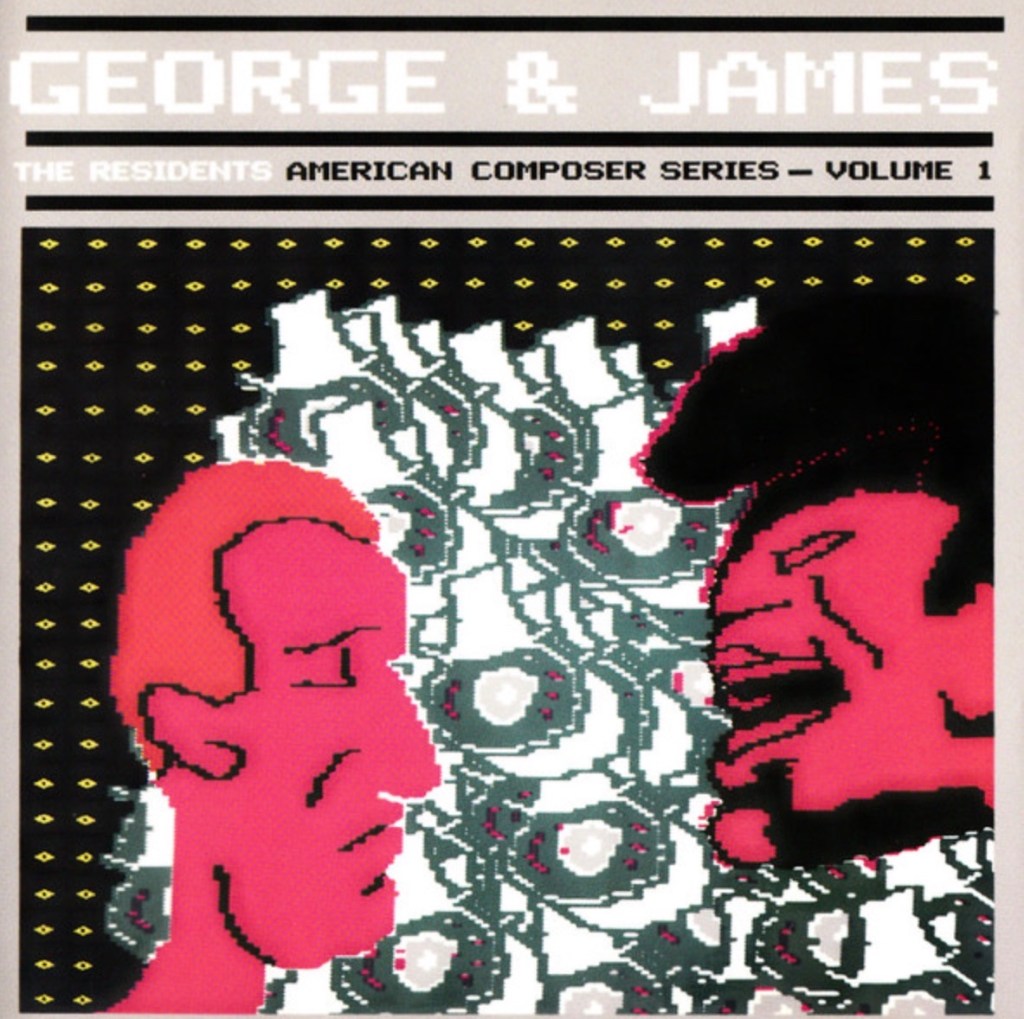
George & James
American Madness
With Part Three of the Mole Trilogy still only a distant rumble, The Residents unleashed a new project: “The American Composer Series […] to be recorded during the final sixteen years of the 20th century (1984–2000). While each record will be released upon completion, the work, as a whole, will not be available until 2001 and will contain the works of not less than twenty composers.”[1] Volume I on this series is George & James – Gershwin and brown, respectively. The George side has an elaborate version of Rhapsody in Blue, along with covers of “I Got Rhythm” and “Summertime”; James, a reinvention of the 1962 Live at the Apollo album.
It isn’t like The Residents to publicly sign themselves up for a massive commitment like this. (It’ll be wild if they actually pull it off.) Ironically, though, my biggest problem with George & James is how much it is like The Residents; to me, the album sounds more like a retrenchment than an advance. It made a lot of sense for them to go all out creating an albumful of covers with The Third Reich ‘N Roll – but that was ten years ago. Their work has become richer, more complex and ramified: Five of the twelve cuts on The Tunes of Two Cities are covers, but the album isn’t about covering. Coming after Tunes, George & James – for all the virtuosity of its execution – seems surprisingly unambitious, a reworking of superficial aspects from their Chub (Rhapsody) and Mole (Apollo) musics.
Rustlers’ Rhapsody
But taken strictly on its own, George & James is pretty amazing. The Residents’ sense of humor is wilder than ever, and for George perhaps even more than James. They’ve never pulled a better practical joke than the siren that begins Rhapsody in Blue. (The klassic klarinet gesture just has to wriggle out of that wail as best it can.) Whenever I’ve introduced this album to friends, I’ve witnessed an inevitable chain of responses: They abruptly look to the window, startled over what emergency is going on out there are they dropping the big one?; then they shake their heads over the realization that North Louisiana’s phenomenal pop combo still can’t be taken for granted, not even after all these years. (I got hoaxed out the first time I heard it too.)
The Residents’ sensitivity to timbre and harmony has never been more limpidity beautiful, more spatially evocative, than in the rippling cords that highlight Rhapsody’s andantino theme. But they never wallow in the sound’s lushness, this album isn’t Gershwin in Technicolor. In fact, their Rhapsody in Blue strikes me as being only superficially about Gershwin. It’s really a commentary on the whole genre of electronic transcriptions, which means they’re alluding to artists as different as Tomita, Wendy Carlos, and Emerson, Lake, & Palmer. Rhapsody in Blue is their contribution to this tradition, but beware of geeks bearing gifts. By beating the Tomitas at their own game, The Residents demonstrate how vapid and timorous, how literally servile (to both composer and audience) the genre has become.[2] To quote Emerson, Ralph, & Waldo, “Wordsworth dismisses a whole regiment of poets from their vocation.”[3]
Of course, you can’t play this side and not hear Rhapsody in Blue in Technicolor; the piece is an emulator orgy. Which may be part of its problem – I don’t know whether it’s a quality peculiar to that machine, or something The Residents deliberately chose to characterize Rhapsody, but the sound is consistently thin and washed out. This texture can have an appeal of its own, but I tend to find the lack of presence vaguely frustrating, because it lowers the stakes somewhat, admitting precious little in the visceral department to match the surprise of that siren. The Residents toss out only one other bone, but at least it’s a good gnaw: the foghorn blast and wooden slam that close the penultimate section. The music has sparked into some real excitement by that point, reaching an alarmlike climax of spinning gears and tolling bells, and that eruption is the perfect capper.
Shrewdly, The Residents rhythmically enliven the emulator thinness, energizing Rhapsody by constantly insinuating into it different machine-like hummings and revvings. Part of the pay-off is in laffs, because the piece is at its funniest when it’s the most literally mechanical – Gershwin’s agitato e misterioso locomotive becomes The Residents’ Calliope Express. But there’s also the music’s weird talent for making you feel like you’re inside the bowels of a huge machine. It presses you against idling dynamos with a claustrophobic subterranean intimacy equal to that of Mark of the Mole. These industrializations suggest the image of an imperturbable monolithic source of imminent power, and that’s pretty much what Rhapsody in Blue is these days, having become an Official American Classic. A situation The Residents would like to free up, hence their cover.
As for the other Gershwin cuts, “Summertime” is basically old business; Wrong-note Porgy and Bess meets the Fenris Wolf noises of Mark of the Mole. You get a good chance to study its qualities for a while and enjoy the low rumblings, the shimmering suggestion of voices – but it never touches the surrealistic intensity of “The Short War”‘s finale. “I Got Rhythm,” however, is a gem, full of surprises – most of them, not surprisingly, rhythmic: ominous cross-rhythms like distant war drums; mysterious sustained tones; a sensational percussive finale, lively and hot, with synthetic snare and maracas taking it all home. Well, almost home – they tack on a nifty ending that beeps the musical question, “Who could ask for anything more?” Not me, for sure: “I Got Rhythm” is the high point of George & James; The only piece on the album which effortlessly sustains its running time.
Yes, the album does become long-winded. Surrealism frequently embodies a special literalness: If you want to stop traffic by showing us a man with an apple floating in front of his face, both the man and the apple have to be represented accurately; otherwise the contrast between them disappears, taking your point along with it. In reinventing Rhapsody in Blue and Live at the Apollo, The Residents have been brutally literal-minded, all the way down to preserving Gershwin’s pyrotechnics and Brown’s verbosity. These are very weird pyrotechnics and verbosity, but the weirdness never travels further than the boundaries of the characters, and so George & James has its lulls. And when either side starts to drag, all The Residents can fall back on is the rhetoric of their adopted personae, which isn’t always enough.
Black Like Me
But if you’re going to adopt a persona, you could corset yourself into something a whole lot worse than a synthetic James Brown. The James side also has an opening surprise, and it’s a jaw dropper equal to George’s siren. But it doesn’t kick things off; after the attenuated emulatorisms of George, all The Residents need to grab you is the lively present drumming that opens their Live at the Apollo. The knockout is the first aria of their Golem of Soul: a hilarious unbelievable torrent from N. Senada’s (and James’?) sharpest observer. This tongue-twisting invocation locates James Brown’s branch on the tree of shamans, and it’s right where he belongs: James has been trying to whoop up some common sense and common dignity in people for quite a few years. Here he may be talking in The Residents’ tongues, but he’s still saying, “You gotta live for yourself and nobody else.”
Live at the Apollo bears a mark of The Mole Show, in that The Residents get this cover to sound like a single hot live set – a needed change after George’s glacial machineries. That’s partially the literalness discussed above: When this James teasingly prolongs the statement of intro chords until he finally begins “Lost Someone,” it’s an almost exact copy of the real James’ original Q&A session. But Live sounds even more live, more played, when James puts the audience through its paces. The Residents’ faked the Apollo crowd with a souped up recording of a Mole Show audience in Utretcht, Holland, and the strainings and hesitations of that altered tape, as it tries to twist itself into a birdlike gale to deliver an “Owww” that can match the Owwws James keeps demanding, is no mere Xerox of Brown. And how neat it is the way that gale swells into an ovation of recognition and welcome as James commences “Please, Please, Please.” In fact, I can’t disenthrall myself from the sneaking suspicion – which I’m utterly unable to prove – that The Residents made their Live at the Apollo in one take (except for the double-tracking of Raoul N. Di Seimbote into the Famous Flames). Keyboards, drums, bass, audience tape, and voice – they could have done it, you know. They’d have required a little help from their friends, but then that’s how they’ve done most of their music so far, including The Mole Show.
James is, in a sense, a monochromatic but lively doppelganger of the colorful but anemic George. And here again The Residents include some true pearls within their restrictive sound: the hot lonely sax that highlights the propulsive “Think’; the sled-dog support of the Flames’ backing vocals on the otherwise minor “I Don’t Mind”; the distant (sounds like all the way from Utrecht) clapping in “Lost Someone,” which almost subliminally fills in the triplets of the keyboard’s pulse and works with the airy arrangement to cool down the lugubriousness of the slow 4/4 beat. Above all there’s the finale, a phenomenal cover of “Night Train.” The Residents terrace the density of events, rather than lay out card after card as they do on their other albums. The second part of the number takes a subtle heightening, however, and it’s easy to miss its rhythmic and timbral variety. But even on a casual listening, “Night Train” is irresistible, with those sounds spinning in a glistening, almost stately, Philip Glass staticism, and James soaring above everything. It aint like the finale of Eskimo, but it’ll do. And the farewell is beautiful: The Residents cranking up the surreal audience cheers into a cyclone swarm of mechanical budgies.
FOOTNOTES
1. Liner notes to George & James.
2. By the same token, their Live at the Apollo simply decapitates clone bands, Elvis impersonators, etc.
3. Ralph Waldo Emerson, Selected Writings. (Journal entry dated November 1842.) William H. Gilman, ed. New York: Signet Classics, 1965, p. 112.
4. Whether it’s George or James that has the least lulls depends on whether Gershwin or Brown is more to your taste – which means both sides are successful as covers of someone else’s music, doesn’t it?
Links to:
SONIC TRANSPORTS: The Residents Essay, part 7
SONIC TRANSPORTS: The Residents Contents
SONIC TRANSPORTS: Contents
For more on The Residents, see:
Film Review: The Eyes Scream
Film Review: Triple Trouble
Music Book: Historical Dictionary of Modern and Contemporary Classical Music, Second Edition
Music Lecture: My Experiences of Surrealism in 20th-Century American Music
Music: SFCR Radio Show #7, Postmodernism, part 4: Three Contemporary Masters
Music: SFCR Radio Show #26, Surrealism in 20th-Century American Music
Music: SFCR Radio Show #27, 20th-Century Music on the March
 NICOLE V. GAGNÉ