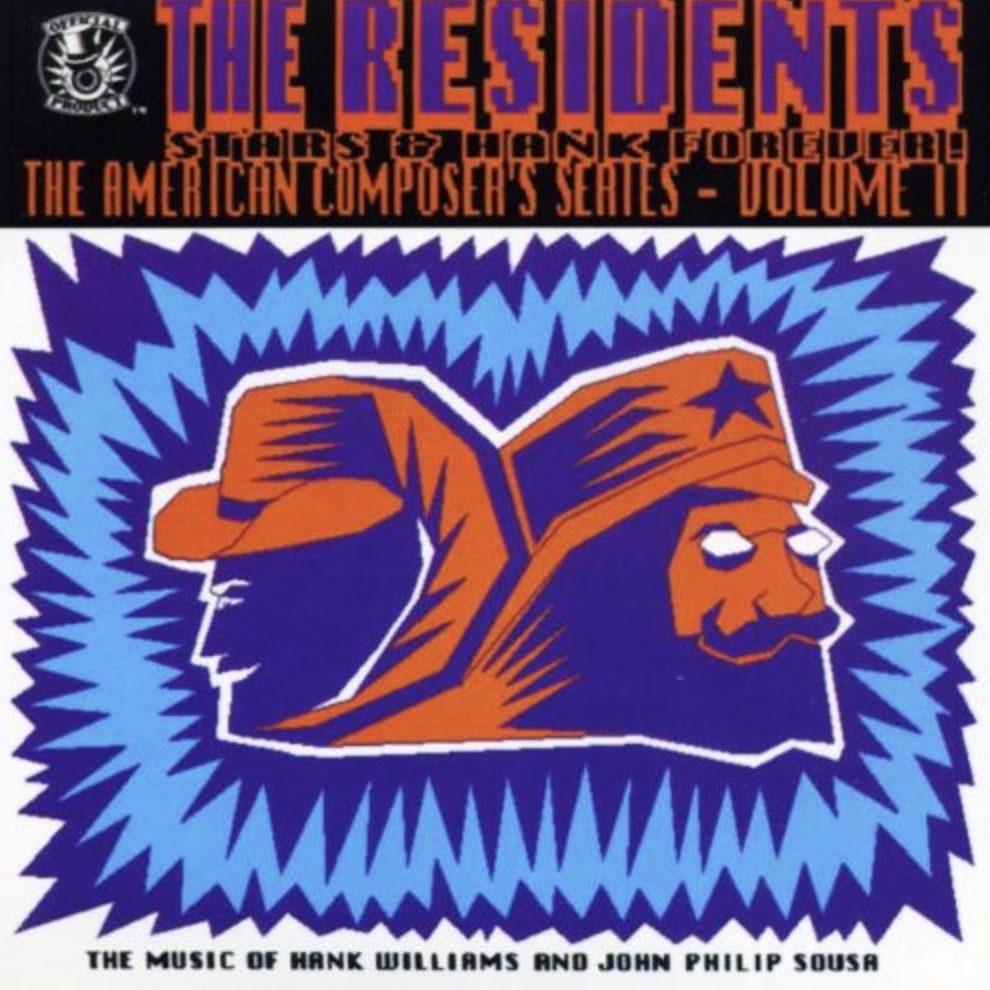
Stars & Hank Forever!
Advance To The Rear
Chris Cutler’s book File Under Popular has some insightful comments about The Residents’ music – at least up through Eskimo. Since then, he says, “no advances have been made, although some good quality work has been done. […] The promised shocks have not materialised, and indeed, to many of the next generation, The Residents and their music are already yesterday’s ‘old hat’; they’re even beginning to sound dated. Now The Residents have evolved a successful formula & more or less stick to it.”[1] This was written prior to the release of The Big Bubble, but if he couldn’t hear what was happening in Mark of the Mole or The Tunes of Two Cities, I doubt if he’d appreciate what The Residents have developed since.
Cutler’s deafness to the Mole Trilogy is his problem; but there is a certain justice to his comments as far as the American Composer Series is concerned. And that’s The Residents’ problem. Or rather, it’s my problem with what The Residents are attempting. Because as Hardy Fox has explained it to me, “I don’t think it’s fair to suggest that an album that breaks cultural ground-rules is better than one that represents a refinement of previously broken rules. The American Composer Series is not conceived of as a ‘new music’ series, but rather as an education device for some very determined students, The Residents. […] The Composer Series is just a public display of the term papers from their studies.”[2]
The second semester’s report, Stars & Hank Forever! (1986) is their survey of John Philip Sousa and Hank Williams, and it hasn’t much A material. At its best, the album is as witty and, in one amazing cut, as icily beautiful as anything they’ve ever done. But to my ears, most of Stars & Hank doesn’t go much further than cleverness.
March Or Die
In a glance back at their reinvention of Live at the Apollo, The Residents cover Sousa as though the marches were being performed by bands at an actual parade. Hardy Fox, who was recording engineer for the crowd noises of “Sousaside,” says that The Residents were “out in the actual street pushing a wheelchair up and down, which was blasting the Sousa marches from a portable sound system.” The “Sousaside” opens and closes with the noises and voices of a for-real outdoor crowd; there’s even the charming effect of these people bursting into delighted applause after every march. And because those are supposed to be marching bands being applauded, The Residents bracket all the Sousa numbers with mad processions: ostinati ostensibly being played by each band as it approaches and departs. With one band pulling in as another leaves, “Sousaside” includes delightful, Ivesian superimpositions of these gonzo quicksteps. Almost all of them are extremely funny, but they can become too much of a good thing; the effect can be somewhat mechanical and facile, at least when compared to the inspired homemade march that introduced The Third Reich ‘N Roll’s “Land of a Thousand Dances.” But each one in and of itself is a lulu, especially those of “The Liberty Bell” and “The Stars & Stripes Forever.” These nutty parentheses are an incisive (but not unkind) deflating of the pyrotechnics of The Residents’ own covers, the grandiosity of Sousa, and the pretensions of parading. “The desired effect for the end of ‘Sousaside,’” comments Hardy, “is one of anticlimactic letdown […] just like in a real parade when you find yourself suddenly standing across an empty street staring at other people. Parades just happen in a sudden unleashing of pointless energy… not building… not climaxing… You know that feeling when something suddenly ends and you don’t know what to do next. Just people aimlessly wandering away while jet planes roar overhead.”
And in its superimpositions of environmental noises over the marches themselves – The Residents’ low bow to the aural bonuses of attending an actual parade – “Sousaside” has some of the nicest moments. There may be a message up The Residents’ sleeves with the distant sirens heard throughout most of “Semper Fidelis,” the theme song of the U.S. Marines. (“The siren was real and just happened to be there,” Hardy insists.) They wear their porousness on their sleeves to even better musical effect with the twittering birds and passing jet that ornament “The Liberty Bell.” That particular march – one of my Sousa faves – is probably the strongest cover of “Sousaside.” (It even has a certain subversive patina from having been the theme song of “Monty Python’s Flying Circus.”) The Residents spin a leisurely version of the melody on synthetic flute, cello, and harp, and the effect is unexpectedly lovely. They evoke the genteel, Sunday-afternoon-bandshell atmosphere that is a genuine part of Sousa’s character.
“Sousaside” never really breaks loose from the 2/4 beat, although occasionally The Residents do swing it while they’re on the march, most notably in the finales of “The Washington Post” and “The Stars & Stripes Forever.” But the most welcome rhythmic surprises (other than the ambient noises) are the asleep-at-the-switch syncopations, suggesting almost missed cues, in “The Liberty Bell” and “El Capitan”[3] – because this is the only way the music ever sounds as though it’s being played by someone. The marches are a non-stop parade of sampled instruments and noises, and moment by moment, a lot of the effects are nifty; but by the end, most of “Sousaside” comes off as disappointingly safe and lapidary. Yes, these marches employ all the weird timbres, wrong-noting, dissonances, and cross-rhythms you’d expect from The Residents. But that’s the problem: it all sounds too much like what you’d expect from The Residents.
A Song To Remember
Latching onto Hank Williams, however, opened up The Residents to something a little more extreme. Beyond Hank’s unique gifts as a singer and melodist, they were probably attracted to the darkness in so much of his music: the depression, loneliness, frustrated longing, and downright morbidity that dogged Williams to his death at the age of 29. In covering “Hey Good Lookin’,” “Six More Miles (to the Graveyard),” “Kaw-Liga,” “Ramblin’ Man,” and “Jambalaya,” they replaced the sugary C&W arrangements with some purely Residential vinegar, and each cut is creepier than the last. Together, the songs create a self-portrait of someone so obsessed with mortality, with his own short trip to the graveyard, that relating has become impossible – “Well I love you, baby, / But you better understand, / When the Lord made me, / He made a ramblin’ man.”
Vocally, The Residents’ Hank Williams homunculus is something of a breather after the pyrotechnics of James Brown and Ramsey Whiten. Almost all the singing is done in a simple, intimate style, with the voice echoey and quiet but right up front in the mix. Even if you didn’t know how far out The Residents’ vocalist can get, this persona still suggests someone keeping a tight grip on himself – because he occasionally starts to lose control, particularly in “Hey Good Lookin’” and “Ramblin’ Man.” But there aren’t any real surprises, vocal or instrumental, in the Williams cuts – until you get to “Jambalaya.” All the arrangements have privileged moments: I’m especially fond of the intermittent cries and squawks of “Kaw-Liga”; “Ramblin’ Man”‘s brutal inflexible march; and the bizarre, roller-coaster piano intro of “Hey Good Lookin’.” “Jambalaya,” however, tops them all. Which really doesn’t say enough, because the other Williams covers aren’t that difficult to top – not for The Residents, anyway. Let me put it this way: “Jambalaya” is an instant classic, one of the finest things The Residents have ever done.
The vocals on “Jambalaya” are at first reined in more tightly than ever, seeing as how things have become so personal: He’s speaking, rapidly and quietly, forcing you to listen hard to follow what he says about his dead girlfriend. The accompaniment is brilliantly atmospheric a rapid galloping pulse overlaid with a repeating pair of slow, crescendoing synthesizer cadences – you’re moving so fast, you’re standing still. When the voice starts singing against this haunting music, it’s stronger and louder; this is safer ground, the more impersonal world of the familiar refrain “Goodbye Joe, me gotta go, me-o-my-o.” Complicating the rhythmic stew still further, The Residents weave into the vocals the sound of wooden percussion with a Latin-esque lilt. But for all its activity, “Jambalaya” never sounds busy; and there’s certainly no grandstanding here, only an aching suspended beauty. And they can hang onto that atmosphere even when they drop out the voice and its clip-clopping partner – an accordion line, slowly growing more elaborate and evocative (and higher in register), is such an unexpected and welcome surprise that almost steals the show. But the voice returns and takes it all home, with an eloquent restraint that achieves a tremendous power. A quiet spoken chorus fills in his “on the bayou”s, providing just the fillip needed to prevent monotony, without any self-conscious feeling of trying to End Big.
Mad Love
It’s been some twenty years since they left Louisiana, and yet The Residents can still have big fun on the bayou. Son of a gun.
But then, I don’t think they ever wanted to delete Louisiana from their lives – any more than they would want to be stripped of ‘60s pop or ‘30s swing or Gershwin or Brown or Williams or Sousa. At the start of “Sousaside,” there’s an apparently for-real woman in the crowd who says, “– right into the garbage can. Thanks. I don’t want to throw this away, I just want to empty it.” That’s The Residents’ attitude towards Sousa and all the other musics they’ve used and abused, now and in the future. They don’t reject any of this stuff; they just want to kill their love for it – insofar as love means reverence and familiarity. Because that kind of love kills its object, denying it whatever genuine meaning it possesses. Insofar as love means the ability to pay attention, the capacity to respect and discover character, their music, all of it, seems to me to be a mammoth declaration of love. And if you really want to kick out the jams and get it on, that love is all you need.
FOOTNOTES
1. Chris Cutler, File Under Popular. London: November Books, 1985, p. 106 (Cutler’s emphases).
2. Letter to the author.
3. At least they say it’s “El Capitan” on the album jacket; someone truly Sousa-smart pointed out to me that it’s actually a cover of “The Thunderer.”
Links to:
SONIC TRANSPORTS: The Residents Contents
SONIC TRANSPORTS: Contents
For more on The Residents, see:
Film Review: The Eyes Scream
Film Review: Triple Trouble
Music Book: Historical Dictionary of Modern and Contemporary Classical Music, Second Edition
Music Lecture: My Experiences of Surrealism in 20th-Century American Music
Music: SFCR Radio Show #7, Postmodernism, part 4: Three Contemporary Masters
Music: SFCR Radio Show #26, Surrealism in 20th-Century American Music
Music: SFCR Radio Show #27, 20th-Century Music on the March
 NICOLE V. GAGNÉ